For longer than the United States has existed, Americans have viewed public monuments with suspicion. When an equestrian statue of King George III was installed at the tip of Lower Manhattan in 1770, it quickly became a target for vandalism, before finally being pulled down by Washington’s troops in 1776. Then, legend holds, it was melted into bullets for the Continental Army. Wariness of monuments persisted even after Washington’s death in 1799, when a Virginia Congressman proposed honoring him with only “a plain tablet” on the National Mall, where people could write tributes as their hearts desired.
Memorials are another story. While monuments speak to power, memorials are oriented towards loss and, at their best, invite reflection. Maya Lin’s 1982 Vietnam Veterans Memorial comes to mind, but of course there are others, usually situated in public spaces where their presence can’t be easily ignored. The problem is that the passage of time can efface their meaning. Many Brooklynites know the column atop the hill at the center of Fort Greene Park from summertime picnics and grueling stairclimber workouts. Very few know that the column commemorates a Revolutionary War tragedy—the deaths of 11,500 American prisoners of war held in the dark, disease-filled lower decks of British ships docked in Wallabout Bay below.
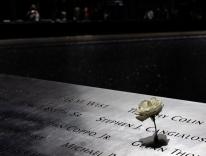
Across the East River, in Lower Manhattan, sits the National September 11 Memorial & Museum, perhaps the best-known memorial in the country. It differs from a typical memorial in that it is not only symbolic, though of course it is also that. It is the precise ground where the World Trade Center’s Twin Towers fell, killing 2,753 people in an instant. Less known is that the site still houses the remains of unidentified victims—in a repository managed by the city’s Office of the Chief Medical Examiner—seventy feet below the museum.
You might like: Dominic Preziosi on 9/11's long shadow
As all eyes turn to Lower Manhattan to mark the anniversary of 9/11, many will pass over the nearly two thousand local memorials made from salvaged World Trade Center steel spread out across the United States. Starting in 2009, New York’s Port Authority distributed pieces of steel that had been reserved after the attack for archiving and investigation. (The vast majority of the steel—more than two hundred thousand tons—was recycled as scrap metal in the months after 9/11.) Museums, firehouses, parks, and local councils sent in simple proposals for memorials on their sites and received pieces of the buildings’ steel skeletons that ranged in size from that of a briefcase to a billboard. Their distribution to small towns and suburbs helped connect communities to a tragedy that otherwise felt distant and difficult to fathom.
Over the past eight years, I’ve been working with my brother, the sociologist Max Holleran, to document those unique tributes. Many of the memorials are presented without fanfare, focusing on the ‘relic’ quality of the steel and encouraging passers-by to touch them. The design styles run the full gamut from over-the-top patriotic displays of stars and stripes and soaring eagles to understated forms that resemble Minimalist sculpture.
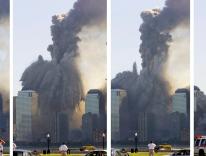
Many of the memorials were made with modest budgets and with the help of craftspeople, some of them creating the memorial as their first public work. The presence of “survivor” steel in memorials also helps shift memory of the attacks away from media images of the towers’ explosion and collapse and toward the physical evidence of their existence. The grassroots relic-making has grown up and flourished alongside Arad’s official memorial in Lower Manhattan.
The memorials also required a staggering amount of local organizing and physical labor. Local groups had to send in proposals to the Port Authority, raise money, then transport the salvaged steel from New York to their respective locations. While interviewing memorial makers we heard stories of small municipalities that found ways for truck drivers who normally move goods for Walmart to take along steel beams. Other groups loaded larger pieces of the WTC’s structure onto the back of flatbed trucks draped in American flags; they were often followed by motorcycle convoys—processions that honored the steel pieces as if they were bodies in a funeral.
Once fashioned and placed in their permanent sites, the memorials often speak subtly and affectingly. One memorial maker, the sculptor Heath Satow, created a pair of polished hands that hold up a WTC beam acquired by the city of Rosemead, near Los Angeles. The hands are formed from 2,977 tiny welded steel birds—one representing each victim from all the 9/11 attacks. The process of welding the work helped connect Satow to the surreal experience of watching the attack on television from across the country.
But he also found the work emotionally grueling. As he welded each bird together he became aware of how many lives were lost. Now among the most-photographed memorials to 9/11 made with steel, very few will recognize the birds’ species. That’s because Satow used the silhouettes of both a hawk and a dove to create the birds—a subtle critique of the headlong rush into the War on Terror. When the sculpture was unveiled in 2011, he kept that to himself, only later revealing the work’s second, cautionary meaning about how violence begets violence.
Memorials like Satow’s point to the need for commemorative sites to be locally managed and to serve local communities, rather than just larger national symbolic purposes. Memorial-making is, above all, a process, and it’s one where small-scale gestures often have the most significance, and the power to keep memory alive.
We welcome your comments about this article. Please send your response to [email protected].