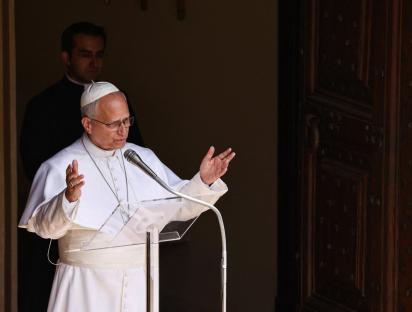
“The Bergoglio Smile” was the headline of Colm Tóibín’s mammoth 2021 London Review of Books investigation into the life of Pope Francis. You can probably picture the smile Tóibín had in mind. It appeared on a cool March night in Rome in 2013, when a small figure clad in modest white robes stepped on the balcony of St. Peter’s. The new bishop of Rome offered his flock a casual buona sera and a quick flash of the ivories, a smile exuding joy with disarming informality. He swept the crowd into a rapture.
For Tóibín, that smile was the pivotal moment in Francis’s biography, completing Bergoglio’s transformation from dour Jesuit disciplinarian to winning Supreme Pontiff. My wife, whose grandmother was born in Buenos Aires a few years before Bergoglio, similarly likes to joke that the smile was a national conversion, the stormy Argentinian giving way to the sunny Italian. But the geniality of Francis’s public performance aroused Tóibín’s suspicion. Did Bergoglio experience a genuine change of heart following his calamitous years as Jesuit provincial during Argentina’s Dirty Wars? Or was this prince of the Church a politician like any other: a man who sought to mean all things to all people, whose smile was a cipher?
Pope-watchers more sympathetic to Francis also got stuck on the smile. Andrew Sullivan—recalling the dictum, often attributed to St. Francis, to “preach the Gospel always; if necessary, with words”—argued that the radicalism of the Francis papacy lay in the demeanor of the man. More than any doctrinal change or institutional reform, it was the way Francis carried himself that made him shocking. Pope Francis, “like Jesus,” Sullivan wrote, “has had such an impact in such a short period of time simply because of the way he seems to be.” The Bergoglio smile was a visual shorthand for the way the pope moved in the world.
One can study the papacy at this surface level without being entirely superficial. The authority of the postmodern papacy, after all, is largely televisual. The pope’s job is, in no small part, to look like a Christian when he appears in public—and by extension, on our screens. A pope teaches through gesture and expression, not just in formal documents. To make sense of Leo’s young papacy, therefore, we must, in addition to the theologians, consult a culture critic or two. New Yorker staff writer Vinson Cunningham, for example, has declared that Leo’s “ongoing performance, though subtle, is one to watch.”
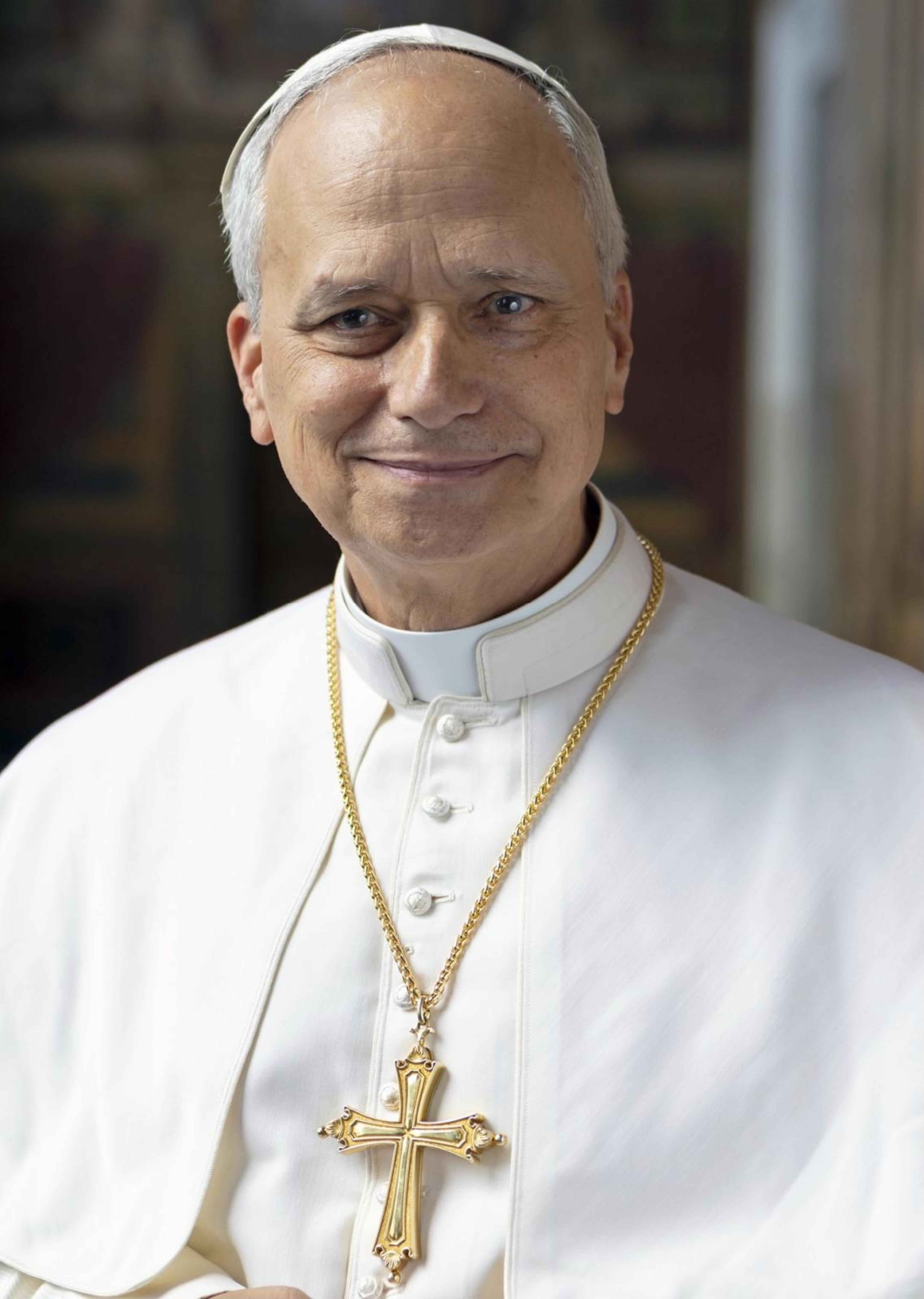
I’ll confess to an unholy thought I had when Leo XIV emerged from St. Peter’s Basilica: that the new pope’s smile was not that great. Maybe I was expecting too much—something that could compare with the luminosity of Francis’s beam. Instead, this relative unknown gave us a wry, lopsided, elusive grin. He kept his teeth to himself, suggesting personal reserve, even shyness. My faith in the Holy Spirit reassured me that Robert Prevost was a man of spiritual depth, but I couldn’t help feeling some nostalgia for his predecessor’s star power.
You might like: E. J. Dionne on Leo and U.S. Catholicism
I was wrong. Pope Leo does seem to possess a strange kind of star power. (He outdrew Bad Bunny in Madrid, for one thing.) Pundits have proposed diverse explanations for a recent surge of interest in Roman Catholicism: a crisis of institutional legitimacy, anomie in the face of the AI threat, a growing conservatism among young men. But as with Francis, it would be a mistake to discount the personal qualities of the man. There is something mysteriously appealing about the way Leo seems to be. His smile—tranquil, sly, at once inviting and eluding interpretation—may hold the key.
To meet Pope Leo is to encounter serenity. On this point nearly everyone seems to agree. In Pope Leo XIV: The Biography, journalist Elise Ann Allen collects first impressions from those who have known the Holy Father. Prelates and Peruvian villagers alike reach consistently for the same handful of adjectives: calm, tranquil, open, peaceful. This appraisal of Leo’s aura bridges ideological divisions in the Church. In First Things, Fr. Raymond de Souza dubs Leo “His Serene Holiness”; in America, Fr. James Martin writes that the pope was “warm, relaxed and serene” in his personal audience. The men who elected Leo pope describe being drawn to Prevost because of something in his demeanor rather than any comprehensive vision for the Church (“What was important was not the substance of what he said, but the manner with which he said it,” Cardinal Robert McElroy recalls).
There’s an aura of calm about the man, no doubt, but careful attention to his bearing reveals a blurrier picture. Leo can also convey deep melancholy, childlike enthusiasm, or frenetic energy, often in close succession. And he is a serious fidgeter. In press conferences, he fusses with the heavy crucifix hanging around his neck, idly rocking from his right foot to his left. When concentrating intensely on what he wants to say, he blinks in an edgy, syncopated pattern, as though gnats are swarming his eyes. Such tics are sometimes read as an absence of confidence, but Leo is not cowardly (one data point: as a young priest in Peru, he turned down repeated offers of bodyguard protection after receiving death threats from Shining Path guerrillas). The jittery, restless mannerisms seem in Leo’s case to be the physical expression of an overflowing inner energy, a kinetic substrate below the serene surface.
Leo famously loves to drive, and the activity serves dual purposes in his life. On the one hand, as you might expect of a contemplative pope, driving for Prevost is meditative. But the Holy Father also has a need for speed. César Piscoya, Prevost’s pastoral vicar in Chiclayo, tells Allen that the future pope “liked to drive like a madman. He liked to go fast. I was really scared, but when he drove us around, he was very careful.” A thrill-seeking motorist who is at once contemplative and thoroughly cautious on the road—just one of the many paradoxes of Prevost’s personality.
Here’s another: Leo describes himself as having something of a localist’s temperament, putting down lasting roots wherever he has lived. At the same time, he’s permanently drawn to the freedom of the open road. Describing his restlessness as a young man, he explains, “It wasn’t like, ‘I’m going to stay home and just stay here.’ I thought, No, be adventurous and go somewhere.”
And a third paradox: Leo the Church bureaucrat, we have often been told, is patient and careful, with a studious attention to detail, but he characterizes his own decision-making style as nearly maniacal. “Some people would use the word courageous,” he tells Allen, “some people would say nuts, but I’m willing to move forward on things.” Nuts? It’s hard to imagine anyone other than the man himself having the thought. Perhaps he’s letting slip something he knows about himself—that his psyche is more turbulent than first meets the eye.
In public, Leo sometimes appears less serene than solemn. And it’s not just a consequence of newfound papal responsibilities: there’s long been something melancholy about Prevost. “He was somber much of the time,” a friend recalls of Prevost as an undergraduate. “In fact, I think he smiles more now than when he was at Villanova.” In old photos you see the familiar hangdog expression, those permanently misty eyes. Not to say that he’s a mope: his highest-octane laugh generates a brief shudder of delight, akin to that of the Pillsbury Doughboy. Leo is entirely capable of childlike ebullience, even if Prevost did not seem to be a terribly ebullient child. His brother John recalls him spending much of his time solemnly playing priest in his parents’ basement, celebrating Mass with Necco wafers. “He did it all the time…it was not a joke; it was not a game; he was dead serious about it.”
There is, then, much more to Leo’s public presence than contemplative bliss. Spend enough time watching the pope, and you’ll begin to notice a stop-motion quality to his demeanor. His expression breaks sharply from frame to frame—first solemn, then sly, next determined, then diffident. The pope knows this about himself. “My face is very expressive,” Leo reflected on a December flight from Beirut to Rome, “but I’m oftentimes amused by how the journalists interpret my face…. You think you can read my mind or my face. And you’re not always correct.”
Like his predecessor, Leo derives much of his moral authority from the way he seems to be. Yet Francis’s genius as a TV pope lay in never leaving any doubt about what he wished his facial expression to communicate, whether delight, commiseration, or disapproval. Leo, by contrast, often leaves us guessing, but the ambiguity can be just as effective as Francis’s clarity.
Still, amid all these paradoxes and ambiguities lies the constant low-pitched thrum of serenity. Why does this tranquility so consistently mark our experience of Leo’s public ministry? Why does the pope’s calm affect nearly all those who meet him? Where does it come from?
Leo’s smile points us toward a possible answer. Its restraint can make it seem as if he’s just been told a secret, but not a surprising one—its contents seem instead to have put him at ease. He arches his eyebrows invitingly, forming two welcoming peaks, and his gaze reaches out through the camera. Whatever it is he knows, I want to know also.
He did not always smile like this. A photo of Prevost as a young Augustinian novice exudes pure, earnest enthusiasm, tempered only somewhat by a slight sadness in the eyes. It’s the smile of a pious kid with a taste for adventure—he even reveals his teeth. What’s missing from that photo is the elusive mix of irony and serenity that makes the adult Prevost’s smile distinctive. Something changed in him, some riddle was answered.
Whenever Leo is asked about his favorite spiritual texts, he is sure to mention The Practice of the Presence of God, a short collection of the teachings of Br. Lawrence, a Carmelite friar from the seventeenth century. Lawrence’s spirituality is centered on the practice of resignation, the act of turning over—in every single moment, in a million simple ways—one’s own will to the will of God. Leo explains that one who practices this method “simply gives his life to the Lord and allows the Lord to lead.” Even while leading an active life—with more than a billion Catholics in his flock to tend—he tries at all times to be resigned. This deceptively simple insight changed everything for Leo. It’s a spirituality that helped Prevost keep his head in the conclave that elected him pope: “I resigned myself to the fact, when I saw how things were going and I saw that this could be a possibility, I said, ‘Here we go, Lord,’” Leo recalls wryly. “You’re in charge.”
There’s a story in Br. Lawrence’s text that is especially important to Pope Leo. He likes it because it’s funny. A very serious man of only twenty-four years when he entered the monastery, Lawrence had clear expectations of what confinement should entail: he thought—he hoped—that it would be agonizing, a time to receive the divine punishment he surely deserved.
In a short introduction to the text, released last December, Leo highlights the comedy in what happened next:
Like many mystics, Brother Lawrence speaks…with humor, because he knows well that every earthly thing, even the most grand—and even dramatic—is a very small thing before the infinite love of the Lord. Thus, he can say ironically that God “deceived” him, because he, having entered the monastery perhaps a little presumptuously in order to sacrifice himself and harshly expiate the sins of his youth, found there instead a life full of joy.
Lawrence jokes that the shocking happiness he found was a disappointment to his melancholy younger self. It is with a similar tone of ironic surprise that Leo describes his own personal happiness. In an interview for the biography, Allen asks Leo, “Who is Robert Prevost?” He briefly struggles to answer, dissembling about theology, before getting to the point: “I think there is a big part of me that just somehow enjoys living.”
In that somehow, I think you hear someone taken aback by the love of God—at first shocked, and then calmly resigned. Try to imagine how Br. Lawrence, a French monk in the time of the Thirty Years’ War, might look after discovering that satisfaction, not divine punishment, was to be his lot in life. I picture him wearing something like the Prevost smile.
Leo’s happiness is meaningful, especially in the face of the overwhelming responsibilities he carries and the profound suffering he confronts. When he travels the world, he regularly appears beside men and women with tremendous power who nonetheless reek of misery (our Catholic vice president among them). In his homilies, his encyclical, and countless interviews, this pope has already said many beautifully appealing things. But above all, I think, he draws our attention because in him we glimpse a satisfaction that is not of this world.
We welcome your comments about this article. Please send your response to [email protected].