The name of the story will be Time,
But you must not pronounce its name.
—Robert Penn Warren, “Tell Me a Story”
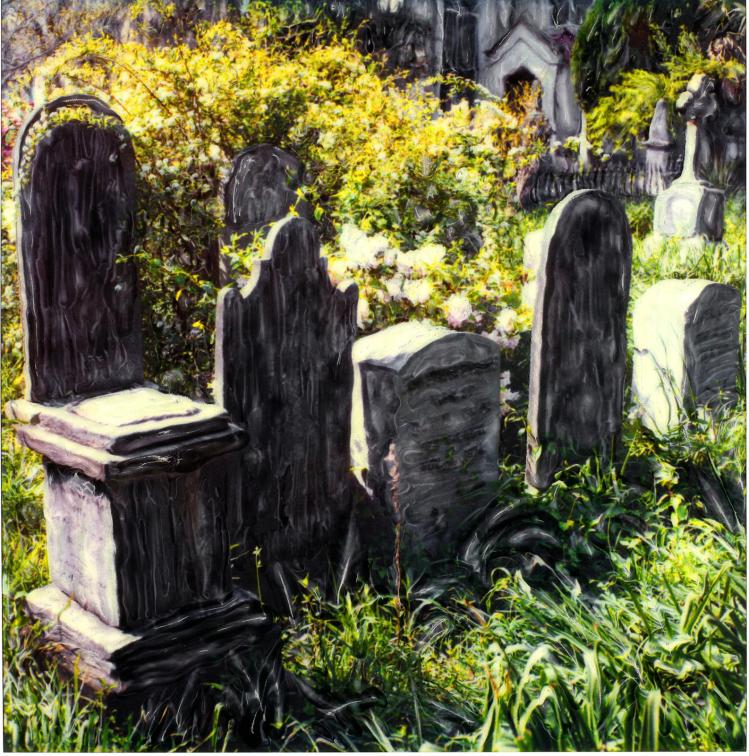
A father, coughing and pale from his days interred in the Iowa coal mines, drinks himself half to death over a stillborn baby. The father collects the little body in a spare blanket, soiled with blood and afterbirth, and carries it through town on a muggy August night. Or maybe it’s a crisp one in November. It doesn’t matter. He’s alone, the child tucked under one arm. With his free hand, he drags a shovel. He finds an out-of-the-way corner of the town graveyard and he sets to digging, interrupted only by swigs from the bottle in his pocket. When the hole seems deep enough, he places the stiffening bundle at its bottom. He does his best to hide any sign of a burial.
He comes to sometime later, still outside. When he returns home, his wife wants to know where her baby is buried, where she can find her passenger of all those months. But he doesn’t know—his memory is diluted by the drink and the dark. She leaves him standing there and stalks the rows of the graveyard herself, but every overturned stone or patch of grass looks the same.
I know this story because I stood, fourteen years old, amid the summer green of an Iowa cemetery, listening to my grandmother report the family lore: a stillborn sibling, a father at the bottom of a bottle, a lost grave. My eyes wandered to the line where graveyard lawn and wild thicket abutted. Even if we could have divined the spot and placed a marker, there would have been no name to put on it. The truth is that all babies die. What matters, of course, is when. It is, as we say, a matter of time. No small part of parenthood, consequently, consists in a long night’s watch against the fear of loss. Hands are compelled to reach into the crib, feeling for the rise and fall of breath. Every child inspires hope for time not promised. Between the present hope and the unpromised future, God has strung the weight of love.
After my son was born, after the feeding and changing and bathing, that weight sometimes pinned my wife and me to the floor. One night, I discovered her crying mutely beside me in our bed. “He’s so little and helpless. I can’t stop thinking he could die.” What could I say? He probably won’t? In the meantime, our boy slept just beyond the foot of our bed, swaddled and breathing in the same whitewashed crib where his mother had been rocked and worried over three decades before.
I’m my parents’ oldest, but not their firstborn. One day Elizabeth stopped moving and my mother knew it, just as she knew that her tiny breathless body still had to be birthed. My mother sometimes mentions how, afterward, my father sat by himself and sobbed. His telling always steered clear of that detail. Not long before they lost Elizabeth, my mom had lost her mother, Betty Jane, not yet sixty. The fear of losing our children trails behind it a fear that they might lose us too soon. But the truth is, it’s always too soon.
My life began in an amniotic grief. I can’t remember a time when I didn’t know Elizabeth’s name. Neither can I remember a time when I didn’t live on ground saturated with sadness. Usually, I’m free to stride above and across it. But if I dig, the sadness always bubbles up into the hollow I’ve made for it. What I appreciate now is that not all of the grief is my own. My dad died a few years ago, and the grief carries over from his time into mine. The time without Elizabeth goes on. It may even be felt by my son and his sisters, if they inherit our persistent sadness and find there some link to their family history. But eventually, even the grief will be lost.
My sister lies awake at night and thinks about dying. I don’t as much anymore. “It just…ends,” she says. I know the rest; she doesn’t have to say. Every joy, every pain, every taste of chocolate, every burning shame, every load of laundry, every moment ends and there are no more moments out ahead. In whatever sense you had them, in death they are taken and you—your very being-yourself—are taken with them.
My sister doesn’t share my religious faith, but we overestimate its consolations anyway. Even stipulating that there is a next life, it won’t be the same as this one. In that final tipping away, we still relinquish our claim on having these moments in this way. Of course, for many believers that is the whole point. “Where sickness, sorrow, pain, and death / are felt and feared no more,” goes the hymn. The passing character of this life is evidence we should not overly cherish it. But we do cherish it. We love it in ourselves and, at our best, we love it in others. Death takes it from us. Worse, death seems to say we never truly had it in the first place.
Death at the end of a long life still mystifies, but when it cuts a life short, sometimes one barely lived at all, it is a shard of inexplicability in our hearts. The person of faith insists that the bleak darkness of such loss is submerged in a deeper but somehow superluminous darkness of divine love. Or, to put it another way, when we wonder why death takes a life too soon, we bring forth a more wondrous puzzle: Why are there lives to be taken at all? The Christian answer to this puzzle is, at one level, merely heuristic: fundamentally, we owe our lives to the wisdom of God—whatever that turns out to be.
This offers no intrinsic consolation, nor is it the bit of wishful thinking the nonbeliever might suspect. While I believe the existence of God is beyond reasonable dispute, the question remains (warranted by the evils of this life, among which stillborn babies must surely be counted) whether God merits our worship or whether God is, to put it bluntly, a real asshole. Could “the Lord gives and the Lord takes away” express simply the arbitrariness of a sadistic cosmic game? The Book of Job hints at the prospect and does not quite bring itself to proffer a clinching refutation. “I’m God and you’re not” was my dad’s distillation.
Still, we might identify a nucleus of Christian faith qua faith in a commitment, a decision that our life has for its source God’s benevolence rather than divine malice. “Before we love this life,” we testify according to our faith, “God loves it and, by loving it, brings it into being from sheer nothingness.”
Beneath the blankets in our Milwaukee bedroom, my wife was consumed again with tearful anxiety over the fragility of our firstborn. A couple of years before, in Boston, a teacher recognized me as the type who “prays with his metaphysics.” So, I began to rehearse to Annie the logical implications of calling God our creator. What God makes, God loves, and what God loves, God knows. Further, God makes, loves, and knows eternally, without beginning or end. This making-loving-knowing does not pass into an infinite past nor emerge into an infinite future. All of God’s making-loving-knowing is a single, perfect, living, and luminous act. Nothing loved or known in and by this act is or can ever be lost.
Our son is loved and known by God. We know that for sure, because he is. Even if he should be lost to us, and even should the grief that is our love’s distension be lost with the passing of time, he will never not be known and loved with the divine loving knowledge that funds and founds our lives. “What’s more,” I whispered to the mother of my son, “the same goes for you and me.” We, too, are made by God, and therefore loved and known by God, and so are forever with our boy (and his sisters and Elizabeth and her parents and that nameless beloved buried somewhere in the Iowa soil) in the swaddling darkness of God’s light. To my surprise, she found this comforting, and eventually, we slept. In part, my surprise owed to the difficulty we have picturing this abstract metaphysical arrangement. Theologians call it “eternal spiritual union with God.” Probably only the mystic has the resources. The rest of us are left to struggle over their poetry.
Christian hope adds the promise of resurrected bodies. We tell each other, with the Nicene Creed, that there will be a new heaven, but also a new earth. The doctrine of the general resurrection returns to our imaginations their familiar frame of time and space. Metaphysics can penetrate deeply, but only narrowly, into the question of human destiny. The promise of resurrection, on the other hand, lets us not merely infer or deduce, but imagine a life that survives death. Still, we should be careful not to conflate the two approaches. Jesus, after all, scolds the Sadducees for treating their fantasies of resurrection like logical premises. We probably need both our metaphysics and our imaginations—even those of us given to praying with the former.
And so, I find myself imagining. I let myself imagine that Iowa cemetery, now in some time beyond time. Freeze after freeze has rendered the verdant bordering thicket a crosshatch of bare branches. A fresh carpet of snow has swept over the dormant lawn and left only the taller headstones jutting through. The sky is grey with the velveteen luster of a January morning. From an out-of-the-way corner of the graveyard, an infant’s bawl interrupts the windless quiet. Ruddy with the rage of life, the newborn boy lies face up in the snow, steam rising around him like breath. Hands—a working man’s callused hands—lift and loosely swaddle him in a blanket. This time the blanket is clean. This time the hands are deft. This time the child is wriggling. The father’s eyes find his son’s, then his wife’s. The bundle passes between them. Mother and child take to nursing, leaving father to take in the scene.
He finds himself surprised that he’s willing to look at this place. Used to be he wasn’t. And in looking—I imagine—he sees at his feet a marker, unweathered, fresh-hewn. It bears a name: David. He never had much schooling, but, somehow, he knows it means “beloved.”
We welcome your comments about this article. Please send your response to [email protected].