Interested in discussing this article in your classroom, parish, reading group, or Commonweal Local Community? Click here for a free discussion guide.
In his justly celebrated “Letter from Birmingham Jail,” Martin Luther King Jr. cites St. Augustine’s lapidary declaration: “An unjust law is no law at all.” Faced with laws or court rulings that undermine human dignity and equality, we are not merely permitted to disobey; we are obligated to do so. In Radical Universalism, the Israeli-American philosopher Omri Boehm wants to establish that this is true, and also to understand why it is true.
Boehm dismisses the idea that human dignity could be grounded in God with a mere wave of the hand. “From the perspective of contemporary political theory,” he writes, “grounding universalism in God is obviously futile”; indeed, the idea that human beings are endowed with rights by God is, he tells us, simply “empty.” One wishes Boehm had slowed down to explain. Is the problem here that in our modern, pluralistic times, many people are—and will presumably remain—secular, and thus largely impervious to religious ideas? Or does Boehm himself see such ideas as somehow dated and even unserious? Given how quickly he moves past them, one strongly suspects the latter, but he never quite says so.
Boehm’s philosophical project is the pursuit of a post-theological ground for human dignity. He is refreshingly honest about how elusive such a ground seems to be: “If universalist humanism has authority, why? What grounds the truths asserted in the Declaration’s legendary second sentence, let alone their self-evidence?… It is not easy to provide these questions with a straight answer. Arguably, they have never received one that is completely satisfactory.” All of this presents a crisis and a challenge. At least in theory, modernity prides itself on a robust commitment to human dignity. But according to Boehm, the very notion of human dignity “resists translation from metaphysical and religious forms of thought.”
Appeals to consensus will not do since, after all, what people accept they can also eventually repudiate. As Boehm writes, “If the principle of human dignity is grounded in the decision of a people to accept it, then that’s actually the very explanation why that principle is not inviolable or inalienable…. Whatever depends on the will of anyone…is violable.” All of this means that what Boehm seeks—and what he thinks a commitment to uncompromising universalism must seek—is a robustly metaphysical conception of human dignity. (For Boehm, religion may be dead, but metaphysics is alive and well.)
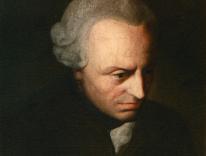
Boehm’s hero is Immanuel Kant. As Boehm understands him, Kant argues that what constitutes our humanity is not anything natural about us, but rather the fact of our duty to moral laws. In other words, what distinguishes human beings from other species is that “who they are cannot be reduced to what they are”; who we are is inextricably bound up with the call of the ought. On Boehm’s reading of Kant, “It is because human beings are open to the question of what they ought to do that they themselves are subjects of absolute dignity.” This is a metaphysical fact about us, prior to any political arrangement in which we may find ourselves. No tyrant—and for that matter, no democratic polity—can take away from us what they did not confer in the first place: our inviolable dignity as moral agents.
There is a potentially momentous argument being made here, but it is made somewhat briskly. “Humans are free to set moral ends,” Boehm writes, and “therefore, they themselves ought to be categorically treated as ends, never as mere means.” One wishes Boehm had paused here to consider some urgent questions. First: What does Kant think are the foundations of human dignity? Is dignity rooted in some feature of the human being, and if so, precisely which one? Or, alternatively, is dignity something that the moral law demands we attribute to people? Or is there some “reciprocal relationship between the dignity of the moral law and the dignity intrinsic to humanity,” as the philosopher Apaar Kumar maintains? The meaning and basis (or bases) of human dignity in Kant have been the subject of enormous controversy among his interpreters. The reader is never informed of this debate, let alone guided through it. So we do not know where Boehm situates himself within that dispute. And second: If one imagines that the capacity for moral reasoning is the basis of human dignity, what happens to those who are so disabled that they are incapable of such reasoning? The pursuit of a dignity-bestowing characteristic always has a potential underside: those who lack that characteristic can be classified as somehow less than human. Surely a philosopher whose (noble, crucial) project is to defend an uncompromising universalism should at least stop to acknowledge this potential problem.
But Boehm is not content to have Kant on his side. Somewhat surprisingly for an avowedly secular thinker—but perhaps less so for a secular Israeli thinker—he wants biblical precedent for his insistence that no one, not even God, is exempt from obeying the universal moral law. So Boehm turns to Abraham, the man who taught the world that “justice transcends any authority,” even God.
As one would expect, Boehm celebrates Abraham’s remonstrating with God over the fate of Sodom and Gomorrah. Appalled at God’s plan to obliterate these two bastions of corruption, Abraham appeals to God’s justice: “Far it be from You to do such a thing, to bring death upon the innocent as well as the guilty, so that innocent and guilty fare alike. Far be it from You! Shall not the judge of the earth deal justly?” (Genesis 18:25). Abraham’s willingness to hold God to an external standard of justice is, for Boehm, the mark of his true greatness. As Boehm sees it, Abraham understood—as Moses did not—that “since justice is universal, it stands not just above the earthly authority of kings, as familiar from other prophets, but also above the authority of the one true deity.” This, according to Boehm, is “monotheism’s chief intellectual achievement.”
But as Boehm well knows, many readers of Genesis will immediately object: Yes, Abraham argued with God in defense of Sodom, but he also readily obeyed God’s command to sacrifice his beloved son upon an altar (Genesis 22). How can a man willing to take a knife to his own child’s throat be valorized for his willingness “to contradict God’s authority on the basis of universal justice”? The rebellious Abraham of Genesis 18 cannot magically erase the docile Abraham of Genesis 22!
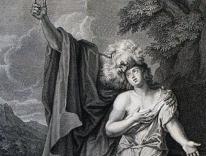
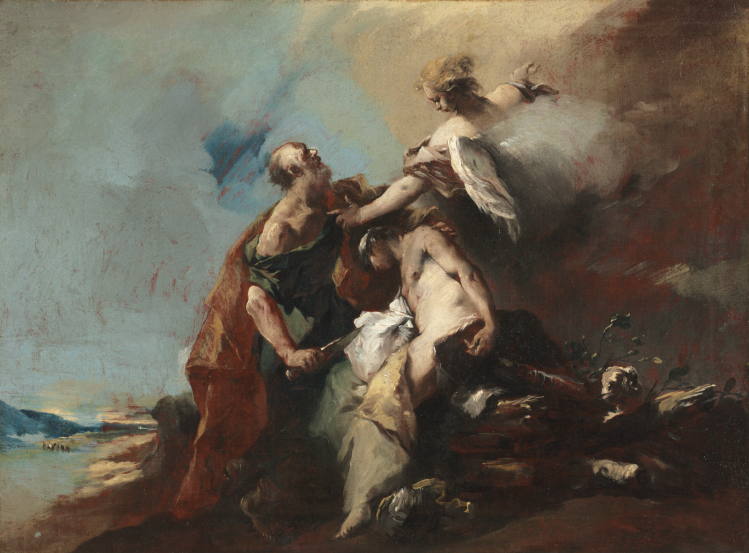
Boehm’s response is nothing if not audacious: he denies that the received text of Genesis 22 is original. Instead of taking the familiar text at face value, he says, we need to understand what Boehm insists is “the original story of the Binding of Isaac.” The text as we have it reports that, just as Abraham was about to slay his son, an “angel of the Lord” appeared to him and ordered him to desist, explaining “now I know that you fear God, since you have not withheld your son, your favored son, from Me.” Abraham then lifts his eyes and sees a ram, which he offers up as a sacrifice in place of his son. Engaging in some creative source criticism, Boehm insists that the angelic intervention is a later interpolation. The original story, he claims, has Abraham make the switch of his own accord: whereas God commands him to sacrifice Isaac, Abraham chooses to offer up a ram instead. For Boehm, the damaging implications of the interpolation are monumental (and tragic): “It takes a story that culminates in Abraham’s ethical disobedience as the symbol of faith and makes it into one that celebrates obedience.” Abraham the rebel has been thoroughly recast, and thus domesticated.
There turns out to be no contradiction between the two Abrahams. The first Abraham audaciously steps forward and argues with God to save Sodom; the second Abraham, as reimagined by Boehm, flouts the divine command to sacrifice Isaac, choosing to act in a way that conforms to the moral law rather than permitting God to override it. Abraham thus remains consistent throughout: a moral hero who obeys his “absolute duty” to justice in any and every circumstance.
Now, in Boehm’s defense, it is worth noting that the text of Genesis 22 is quite puzzling at points. In most of the story, the divine name used is “Elohim”—source critics thus tend to attribute the story to E, or the Elohistic source—but the verses about the angel refer to God as “YHWH” (most often rendered in English as “The Lord”). So Boehm is within his rights to wonder whether there might be multiple voices at work in the version of Genesis 22 most of us are familiar with. Yet it’s also worth observing that most scholars who have attempted a source-critical reconstruction of the chapter have reached a conclusion antithetical to Boehm’s: in the original story, Abraham did in fact sacrifice his son, but a later interpolation softened the horror by having the angel intervene in the nick of time to prevent the slaying.
I am not interested in litigating the scholarly debate here, but when philosophers place so much weight on purely speculative reconstructions of biblical texts, they walk extremely treacherous ground. The only Abraham Boehm can accept, let alone valorize, is an Abraham who is, to some extent at least, one of his own (re-)construction. To push the point further, even if Boehm was right—and it should be said forthrightly that we have no sure way of knowing—the question is what status a reconstructed text such as his might have, and what weight it might carry. The text that has mattered for Jews and for Christians, and indeed for Western civilization, is the one we all know, in which Abraham is ready to do just as God commanded. Boehm’s version is provocative, but it is not Scripture, and it will not matter to most readers of the text. So one wonders whom Boehm aims to convince with his source-critical inversion of the received text.
Boehm’s approach suffers, in my view, from another problem. Like so many contemporary interpreters, he reads the Binding of Isaac in the shadow of Søren Kierkegaard, who famously argued that Abraham’s actions should be understood as a “teleological suspension of the ethical.” As Kierkegaard tells the story in Fear and Trembling, Abraham is a “knight of faith” who sets aside his very real moral obligations to his son in order to obey the divine command.
Kierkegaard’s reading is very powerful—if also immensely disturbing—and it has exerted a great deal of influence upon modern interpretations of Genesis 22, Jewish ones included. But where the plain sense of the text is concerned, Kierkegaard’s interpretation is unconvincing. As the biblical scholar (and rabbi) Robert Gordis argues, Kierkegaard’s reading of Genesis 22 is an “anachronistic…distortion of Biblical faith.” Child sacrifice was a common practice in the ancient world; Gordis suggests that it was “an all-but-universal practice in ancient Semitic religion and beyond.” “To be sure,” Gordis observes, in the biblical world “offering up one’s child was an infinitely more painful gift than sacrificing the first-born of one’s cattle or the tithing of one’s crops. Yet it took place time and time again.” In biblical times, in other words, child sacrifice was often seen as different in degree but not necessarily in kind from other forms of sacrifice. To put it simply, although the Bible does prohibit child sacrifice, it does not consider it inherently immoral. Accordingly, Abraham does not protest God’s command to sacrifice his son because…he does not regard it as immoral. The divine command is no doubt enormously difficult for him, but he does not perceive it as a moral violation—as he does God’s plans to annihilate Sodom and Gomorrah. So, understandably, he protests in one case but not in the other.
In seeking to center Genesis 18 and to neutralize Genesis 22, Boehm could thus have availed himself of a very different strategy. He could have noted that, from the Bible’s own perspective, Genesis 18 explicitly deals with the question of divine justice, whereas Genesis 22 does not. Abraham could have remained exactly what Boehm wants him to be: a man who speaks up in the face of (what he regards as) injustice, even when the (potential) perpetrator is God.
There is admittedly something quite disturbing about the interpretive path I am proposing. On the one hand, as I’ve suggested, we get a smoother, more consistent picture of Abraham, willing to speak up when he perceives a moral violation, no matter who the guilty party is. Yet on the other hand, this type of interpretation forces us to confront the vast gap between our own moral intuitions and the Bible’s. How can the text many of us hold sacred, the text we interpret and experience as divine revelation, treat the horror of child sacrifice as anything other than immoral?
I understand, then, why believers may feel queasy about taking this approach, but I find Boehm’s reluctance more surprising. Why should a secular thinker find a gap between the biblical text and his own moral world surprising, let alone jarring?
More fundamentally, why, beyond (or before) Kant, does Boehm also need Abraham? Why not Homer or the Bhagavad Gita? Perhaps I am asking too much from a short book, but I would have liked to hear Boehm reflect on what he is doing here, and why. Perhaps, as a Jew and an Israeli, the Bible matters to him in a way that other texts and traditions do not. But that, in turn, raises another important question Boehm could perhaps consider in a future work: Precisely what role can particular traditions—and, more generally, the author’s own cultural context—play in the worldview of a committed “radical universalist”?
To read all the contributions to the symposium, click here.
We welcome your comments about this article. Please send your response to [email protected].