St. John’s University faculty are currently embroiled in a bruising labor battle with university leaders. The administration fired the opening salvo on the afternoon of February 19, when it informed its faculty, in the midst of contract negotiations, that it would be unilaterally derecognizing their two unions: the local chapter of the American Association of University Professors and an independent, standalone Faculty Association. The announcement has triggered one of the most tumultuous episodes in the history of the 155-year-old Vincentian institution.
The decision to derecognize came as a rupture, not just to the ongoing, monthslong contract fight, but to the institution’s relationship with its faculty overall. For more than five decades, St. John’s University had recognized its faculty’s right to organize and collectively bargain. But since its previous contract expired on June 30, 2025, the faculty have worked in accordance with terms outlined by the university’s faculty handbook, which serves as a paltry substitute for a collectively bargained union contract. The handbook may be changed by the university at will, and it offers faculty little recourse to challenge administrative decisions.
One precipitating incident came in October, when the two faculty unions filed an official complaint with New York’s Public Employment Relations Board (PERB). They argued that the university had actively withheld information relating to the calculation of members’ health-insurance premiums. According to union members, this complaint represented the culmination of numerous appeals for transparency from the university that had been flatly rejected.
The university’s official response denied the union’s accusations and then went a step further. St. John’s contended that the PERB had no jurisdiction over its faculty, citing an exemption on First Amendment grounds as a Catholic university. It is the latest in a recent spate of Catholic universities that have used a 2020 National Labor Review Board (NLRB) decision to seek exemptions from federal and state labor oversight on religious grounds. In December, Christopher Denny, a theology professor and president of the St. John’s Faculty Association, explained the situation to the National Catholic Reporter in stark terms: “Rather than dealing with the particular financial and contractual issues at play, they’re just sort of going for the jugular.”
By the new year, the St. John’s administration had all but ceased engaging with union representatives. February’s announcement concretized what, in the interceding months, had come to seem inevitable. Before the end of the month, the dispute had elicited more than a dozen press hits and earned the condemnations of numerous New York politicians, including House representatives Grace Meng and Gregory Meeks, Brooklyn Borough President Antonio Reynoso, and New York City’s Public Advocate Jumaane Williams.
In April, the unions filed another suit with New York’s PERB, alleging that the university’s abrupt derecognition constituted illegal labor practice. The university responded by filing a federal injunction with the Eastern District of New York, formally making the legal case that they should be exempt from PERB oversight. An overwhelmingly conservative federal judiciary may very well be receptive.
As the administration pursues its legal fight, it’s unclear whether it’s taken stock of the collateral damage the conflict is inflicting on the St. John’s community. A recent controversy over immigration enforcement already suggested the administration’s ignorance—or apathy—to the social, cultural, and political climate on campus. Last May, the university announced a training program in partnership with U.S. Customs and Border Patrol (CBP), prompting a swift and intense backlash from the campus community, which boasts a diverse student body, with many students coming from first- or second-generation immigrant families. Observers were bewildered at how the partnership—launched, in the words of the administration’s announcement, to “[equip] the next generation of homeland security professionals with the essentials needed to succeed”—could possibly comport with the university’s stated commitment to social justice, especially during a time when ICE terror filled national headlines. Nine months later, amid widespread campaigning against the partnership by student and faculty organizers, the university backed out of the agreement.
In the wake of the administration’s anti-union actions, morale has plummeted among faculty members, many of whom fear their jobs could be axed under dubious pretenses. “The university is blatantly violating New York state labor law to bust a faculty union that they have successfully negotiated with since 1970. It’s incredibly disappointing from an institution that supposedly values the rights of the worker,” says Dohra Ahmad, a St. John’s English professor. Relations between the provost’s office and faculty—even department chairs—have grown icy, with little communication from administrators on future planning. For students, the ongoing labor dispute has been “very unsettling, disorienting, confusing, and disheartening,” according to Ahmad, especially for those students who “had understood St. John’s as a university that cared about social justice and marginalized communities, which is how it had marketed itself for decades.”
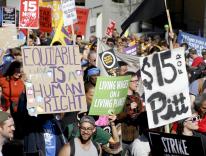
Students have been constant fixtures at union protests and are overwhelmingly supportive of their professors’ efforts. “If they’re not allowing professors to bargain and improve their work conditions, the quality of instruction will decline,” reads an op-ed penned in The Torch, the university’s student newspaper. “And if they’re willing to worsen the quality of instruction, why would they care about improving academic facilities or programs as a whole?” One recent St. John’s graduate told me that the dispute has “created unnecessary uncertainty and tension on campus.” St. John’s students, the alum continued, “deserve an environment where their professors feel respected, supported, and secure, because when educators are treated with dignity, the entire university community benefits.”
Like many universities, St. John’s is facing legitimate concerns about its future solvency. Enrollments across the country are down, while costs are up and federal support is diminished. But rather than transparently negotiating a path forward, St. John’s administrators have opted to cut the faculty out of governance entirely, reducing the university’s hundreds of instructors to mere liabilities and assets on a balance sheet. By consolidating control, they aspire to act more nimbly and decisively. The university’s ongoing restructuring has already seen the termination of dozens of university staff and announced cuts to academic programs.
By freezing out the faculty, they’re leaving a wealth of knowledge and experience on the table. “Abstract business principles aren’t practical if they have no real connection to what works and what doesn’t in an educational community,” says Mary Townsend, a philosophy professor at St. John’s. “My faculty colleagues at SJU have this practical wisdom, but we’re not being consulted about what the practical goals of our community ought to be.”
Instead of partnering with faculty, the university has opted to consult EAB, an education-services firm that specializes in cost-cutting reforms (EAB is owned by two private-equity firms). EAB’s specific remit is unclear at this point, but it appears to be dispensing advice to the university on how it might consolidate departments, lay off staff and faculty, and most importantly, spin communications. One internal document for EAB clients, for instance, instructs administrators to “frame reorganization as an opportunity to reevaluate how the institution should be organized to be sustainable with a smaller number of positions.”
In 1949, a group of primarily Catholic gravediggers went on strike while employed by the Archdiocese of New York. Cardinal Francis Spellman, the Archbishop of New York and most powerful midcentury American Catholic prelate, took it as an affront to his personal authority. He broke the strike with young seminarians from the nearby St. Joseph’s Seminary. The strikers appealed to Dorothy Day, who, by that time, was well-known as the founder of the Catholic Worker movement.
Day’s relationship with Spellman was complicated. They seemed to respect one another, but the “American Pope,” as Spellman would come to be known, had difficulty managing the “troublemaking” anarchist Day, especially given her revered status among scores of American Catholics. Day, according to Garry Wills, “handled Cardinal Spellman so well, he didn’t know what to do with her.”
In a letter dated March 4, 1949, Day pleaded with Spellman to meet with the strikers and hear them on their own terms. “It is not just the issue of wages and hours as I can see from the conversation which our workers have had with the men,” she wrote to him. “It is a question of their dignity as men, their dignity as workers, and the right to have a union of their own, and a right to talk over their grievances.”
For Day, moral and legal rights to organize are an extension of the innate human dignity imbued into every person. She was drawing on the rich tradition of Catholic social teaching (CST), which, since Pope Leo XIII’s 1891 encyclical Rerum novarum, had affirmed the relationship between dignity and workers’ ability to organize. In the years following Day’s intercession, that connection has only grown more pronounced. In 1986, the United States Conference of Catholic Bishops issued a pastoral letter, “Economic Justice for All,” that explicitly states that workers must retain the right to collectively bargain for fair wages and just working conditions.
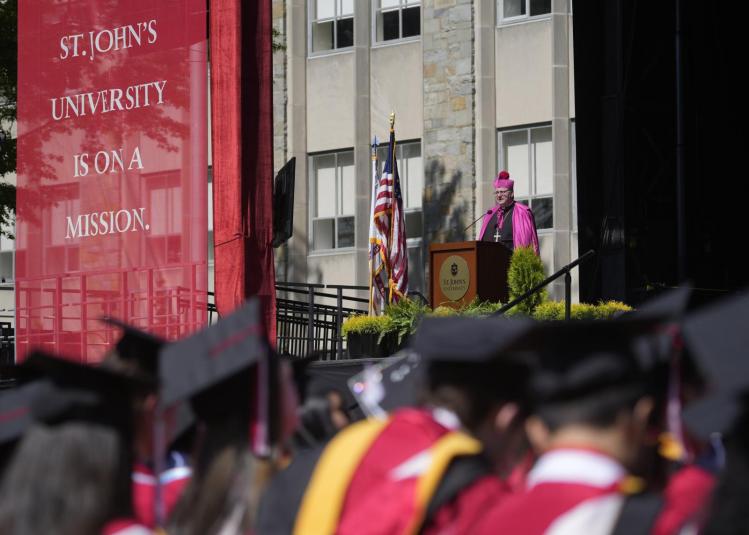
Of course, this context hasn’t been lost on the St. John’s faculty. “When the U.S. bishops said that denying the right to organize is an attack on human dignity itself, it’s because fundamentally, such a denial marks a denial of human agency and participation,” says Christopher Vogt, a professor of theology and religious studies at St. John’s. To many faculty members, the university’s cynical invocations of its “Catholic identity” and “mission” to justify its union-busting drive have been particularly repugnant. The initial February message announcing derecognition closed with a brief statement that reads, “It has become clear that the university does not have the flexibility required to fulfill its Catholic-centered mission while its core academic decisions are entangled in a collective bargaining relationship.” That message even included a nominal nod to CST’s affirmation of collective-bargaining rights: “First and foremost, we believe in the right to organize and the right of free association.” A curious—almost comically tone-deaf—assertion to make while actively repudiating those rights.
Vogt tells me that those in the St. John’s community “most invested in the mission of the university are taking this the hardest—they’re well-versed in the tradition of Catholic social teaching, and they know this doesn’t add up.” It’s shocking to see an ostensibly mission-driven university act in such clear contravention of its principles. The present leadership of St. John’s seems to have unilaterally dispelled those traditions and swapped concern for human dignity with market-driven solutions. The dispute has mobilized unprecedented numbers of faculty: over the last five-and-a-half months, the unions’ membership has reached an all-time high. Faculty members stand ready to continue the fight on both the grassroots level and in state and federal courtrooms, where the legal battle will trudge along.
At some point, though, the legal fight could expand, with stakes far beyond St. John’s. If appeals force the case up the rungs of the federal judiciary toward an activist Supreme Court, it may become a promising test case for right-wing forces looking to further constrict workers’ rights. A protracted legal fight might seem inadvisable for a university ostensibly panicked about its financial future, but St. John’s administrators will find no shortage of deep-pocketed patrons. It would hardly be the first time corporate interests used religious institutions as vehicles to try to break worker power.
We welcome your comments about this article. Please send your response to [email protected].