Editor’s note: The Senate primary was called for Abdul El-Sayed on August 5.
Infighting in the Democratic Party has spiked to levels not seen since Bernie Sanders’s 2016 insurgent presidential campaign. A series of uncomfortable revelations culminating in an accusation of sexual assault forced Graham Platner to end his populist, antiwar Senate campaign in Maine, mere weeks after trouncing Gov. Janet Mills, the establishment favorite, in the June Democratic primary. Stunned supporters and left-wing organizers from afar had barely come to terms with his unraveling before prominent centrist voices, paid influencers, and cable-news pundits shifted their focus to Abdul El-Sayed, the outspoken progressive candidate in Michigan’s Democratic Senate primary, and his kindred brand of antiestablishment politics.
The race in Michigan has swiftly replaced Maine’s as the central battleground in the war over the Democratic Party’s direction. A prominent advocate of Medicare for All, former public-health official, and staunch critic of Israel, El-Sayed is vying with four-term congresswoman Haley Stevens in the August 4 primary to replace retiring Democratic senator Gary Peters. Unsurprisingly, the party’s factional feuds have reached a fever pitch online, a dynamic that can obscure the idiosyncrasies of regional electorates. Still, the national significance of this primary cannot be overstated.
Both candidates think their pitches to working-class Michiganders make them more electable in this key swing state, but that is where the similarities between them end. Apart from her emphatic support of Israel, Stevens is an unremarkable liberal promising a vague “can do” ethic. In recent weeks she’s adopted a wildly parodic blue-collar affectation in an awkward bid to seem more relatable. El-Sayed, meanwhile, built momentum by blending the pointed rhetoric of Sanders and Platner with the humor and affability of viral podcasters, in the process helping to push state senator Mallory McMorrow out of the race in early July. El-Sayed appeared to take the lead following McMorrow’s exit, but despite his outreach to her supporters, the race remains a dead heat (though some late-breaking polling has El-Sayed up significantly).
Many observers believe the tight race has more to do with the avalanche of outside spending on Stevens’s behalf than her talent as a candidate. After left-wing upsets in Colorado and New York earlier this summer, there is a feeling among progressives that a phalanx of “pro-corporate” and pro-Israel interests are trying to foil El-Sayed and other competitive Democratic insurgents. For progressives, the Stevens campaign is sobering testimony to the peace the Democratic elite have made with Citizens United, the 2010 Supreme Court ruling that effectively opened the floodgates to unrestricted dark money in politics. The pick of the Democratic Senatorial Campaign Committee (DSCC) and centrist group Third Way, Stevens has been buoyed by the American Israel Public Affairs Committee (AIPAC), which has spent approximately $30 million to improve her chances (combined with support from dark money groups, the amount rises to a staggering $50 million).
Stevens and her surrogates have argued that she is more likely than El-Sayed to retain Peters’s seat in a general election contest against former representative Mike Rogers, a run-of-the-mill conservative who recast himself as a MAGA voice during the Biden era. They maintain El-Sayed is simply too “radical” for Michigan, and that regular voters prefer a “workhorse” who tends to local “kitchen-table” concerns. The unsubtle message is that Stevens is the safe choice—indeed, the only real choice if Democratic voters wish to “stand up” to Trump.
El-Sayed’s supporters counter that the unprecedented flood of lobbyist money has far more to do with stopping El-Sayed himself than keeping Michigan’s Senate delegation blue. The fear-mongering contradicts the premise that Stevens is a dedicated “fighter.” It is also baldly tone-deaf: in a state where Arab- and Muslim-Americans comprise some four percent of the population, it seems presumptuous to construe El-Sayed as riskier for Democrats than denying the salience of Israel’s record. Nevertheless, it’s not clear whether enough Democrats will concur with El-Sayed that “every single dollar [spent] in this race” by Stevens’s allies is a “down payment” on a Senate seat that will “[do] their bidding.”
The primary offers a vivid contrast of two different theories of the Democratic base. Stevens’s campaign represents an older theory of turnout predicated on coalition management. She and her backers assert El-Sayed is overly reliant on white leftists, pointing to reports that suggest Black voters prefer her. She has also successfully courted several local labor unions. Although El-Sayed has secured the endorsement of influential unions such as the United Auto Workers and National Nurses United, Stevens still enjoys solid ratings from organized labor and key advocacy groups. Her “Hope Agenda” is of a piece with the pragmatic populism espoused by Democratic contenders in other tough races. Part of her bet is that anti-Trump female moderates in Michigan’s smaller cities and suburbs will be persuaded that her chances are better that El-Sayed’s against Rogers. By sticking to a more restrained script about “affordability,” she is likely also angling for “soft” Trump voters, who may find her more palatable than El-Sayed and his relentless critique of American foreign policy and ICE.
But Stevens may be misreading the mood of rank-and-file Democrats and Michigan voters horrified over Israel’s war in Gaza. Disgust with the Biden administration’s response to the unfolding genocide very likely depressed Democratic turnout among Michigan’s sizable Arab and Muslim communities, and even allowed Donald Trump to flip the normally Democratic, immigrant-heavy city of Dearborn.
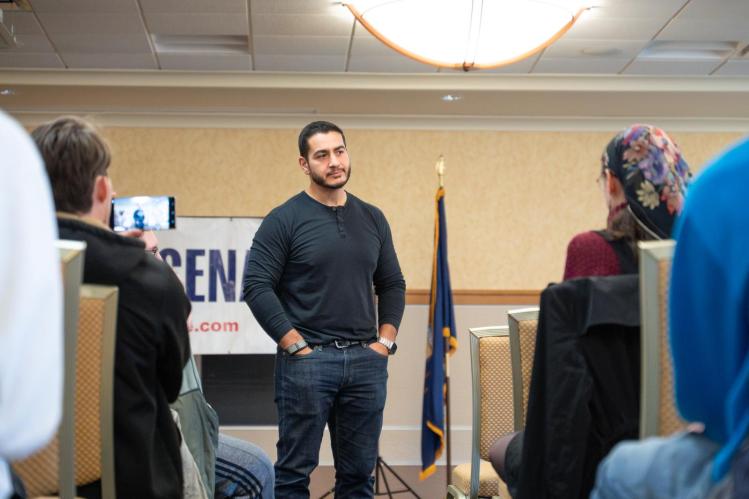
Meanwhile, El-Sayed has modeled his confident and charismatic campaign style on that of New York City mayor Zohran Mamdani. While he does not identify as a democratic socialist, El-Sayed enjoys the enthusiastic support of left-wing populists such as Sen. Bernie Sanders, Rep. Alexandra Ocasio-Cortez, Rep. Ro Khanna, and Sen. Elizabeth Warren, as well as stalwart liberals such as Senators Tina Smith of Minnesota and Chris Van Hollen of Maryland. El-Sayed’s forceful antiwar stance distinguishes him from some other insurgents who have similarly yoked affordability to broadsides against tech oligarchs and government corruption. With Platner out of the spotlight, that has commanded the attention of grassroots activists and small donors eager to overturn the status quo. Their hope is that his conviction, juxtaposed with Stevens’s obsequious tribute videos to AIPAC, sparks a sea change in Michigan’s politics.
The challenge for El-Sayed is to overcome doubts about his odds among Democratic voters caught between disappointment with their leadership and the perennial fear that impassioned progressives are underdogs in today’s Rust Belt. He has tried to assuage them by arguing he would actually perform better with Trump-leaning independents in November. But to beat Stevens and be a viable contender against Rogers, he must indeed broaden his coalition beyond Millennial, college-educated progressives and mobilize disaffected younger people of color, older liberals who flocked to last year’s “No Kings” protests, and voters fed up with both parties.
Michigan’s swing electorate is diverse, spanning from the well-documented white “Obama-Trump” voter to hard-pressed minorities weary of Democratic inaction. Moreover, as a battered manufacturing hub, Michigan is not a state in which foreign policy is a distant, secondary concern of working-class voters. Its connections to domestic economic conditions are especially clear and pronounced. Trump’s misguided tariffs, his spiteful rejection of green industrial policy, and the inflationary U.S.-Israel war in Iran have throttled the tenuous recovery of recent years.
Accordingly, El-Sayed’s campaign has made a point of highlighting the effects of the lobbyist capture of foreign policy on ordinary people. Struggling voters, he emphasizes, are fed up with their tax dollars “being spent to drop bombs on other people’s children [when they] should have been used to provide healthcare, or education, or functional infrastructure for our own.” He is connecting the growing dissent over the United States’ unconditional support of Israel to a kind of progressive variant of the “America first” mantra.
Like Platner before his downfall, El-Sayed invokes the arguments of generations of past antiwar Democrats. A significant strain of Democrats has always emphasized that expansionism and bloody foreign entanglements, beyond betraying America’s ideals, hurting its stature, and costing lives, invariably serve monopolists while robbing ordinary Americans of public investment and shared prosperity. This message of paring back military commitments and rebuilding at home while still extending a hand to the global poor was perfected by Barack Obama in 2008. Trickle-down economics and forever wars came to be seen as two sides of the same coin. Democratic candidates’ positions on the invasion of Iraq became symbolic of their willingness to stand up to foreign-policy elites and the military-industrial complex. Although it’s sometimes forgotten, the revived peace movement was a crucial factor in Obama’s success. El-Sayed has forcefully reclaimed that anti-interventionist heritage.
A key difference is that Democrats in the Obama era were much less agitated over the “special relationship” with Israel. The U.S.-Israel alliance, though certainly criticized, was a relatively peripheral issue in progressive politics. Pro-labor Democrats such as Sherrod Brown and Tammy Baldwin did not question it, and it was not a central issue of the Occupy Wall Street demonstrators who later rallied to Bernie Sanders’s 2016 campaign. Only since Israel’s response to the Hamas attacks of October 7 has the issue acquired the weight to make or break candidates and decide pivotal elections.
The money machine behind Stevens is determined to undo that development—or at least convince enough Democratic primary voters to shrug at the great moral failure of our age. Stevens is gamely doing her part to transport Democrats back to less challenging times. She touts her role as chief of staff for the Obama administration’s 2009 auto bailout task force and endorsements from the Congressional Black Caucus and Michigan governor Gretchen Whitmer as proof she is a practical, seasoned legislator focused more on local needs than the cause du jour of the “radical campus left” El-Sayed supposedly embodies. Stevens’s surrogates, meanwhile, have claimed she has suffered sexist attacks from El-Sayed supporters, reprising a familiar complaint first lobbed at “Bernie Bros” in 2016. (Recently, surrogates accused El-Sayed of using “violent” rhetoric when it was leaked that he described defeating defendants of the status quo as putting an “ogre on a pike.”) Perhaps most worrisome for El-Sayed is that Stevens appears to have bolstered her edge with Black voters through deceptive ads that imply Obama backs her (the former president has not made an endorsement in the race).
The intent of those tactics is to convince unsure primary voters that El-Sayed is, like Platner, not “vetted” and “not really a Democrat” and thus untrustworthy. They are part of a larger strategy to hinder the left’s momentum and limit its upsets to a few ultraprogressive districts “unrepresentative” of the broader Democratic coalition and the voters the party needs to convert.
Following the 2024 election, there was a protracted debate over whether the Democratic Party had deferred too much to the left’s “cultural radicalism.” Purity tests on key cultural questions no doubt hurt Democratic fortunes in more conservative districts. But the bigger issue driving defections has long been the party’s hypocrisy—on getting money out of politics, taming corporations, and actually standing up for human rights abroad. Loyal Democratic voters, as well as many of those who have deserted the party, loathe the current “Democratic brand” not because of identity politics or purity tests, but because they view the party leadership as too compromised and too timid. The party’s central problem isn’t “wokeness,” but rather its inability to tackle political corruption.
Stevens’s biggest liability is her willful indifference to the chief lesson of the Trump era—namely, that antiestablishment authenticity is the most powerful currency in contemporary politics. While the establishment will take immense comfort in a Stevens victory over El-Sayed, her theory of politics is unlikely to be validated in the long term. On top of extractive health-care costs, a new generation of voters is grappling with a host of novel problems in the form of data centers, AI’s impact on the job market, surveillance pricing, and other monopolistic practices. Setting aside the matter of how easily Stevens has been bought by AIPAC—and what it says about how other lobbies might sway her vote in the Senate—there is little indication she is prepared to address these challenges.
A sane political party determined to rehabilitate its relationship with working people ought to be embarrassed by that deficit. But the depressing possibility is that, for many party elites, this race is mostly about control: over what it means to be a Democrat and which popular reforms are to be deemed out of bounds. On August 4, we will find out if the rest of the party is prepared to fight for something more.
We welcome your comments about this article. Please send your response to [email protected].