I met up with Martin Scorsese on June 12, in his office. He was deep in his work—he is always deep in his work—but we sat down together, unhurried, to talk. We spoke about the screenplay for his possible new film on Jesus, and we came back around to The Last Temptation of Christ. “It took such a beating, back then,” he told me, with that mixture of astonishment and sorrow that settles over him whenever he speaks of it. And then he told me about Paul Alfonso Soto, a student of Mary Karr, a writer friend of his: “He’s just won a major prize—a poet, thirty years old, a hard life, but he came out of it on his own. He has a real spiritual life now. And she told me that the thing that changed his mind, that brought him to Jesus, was The Last Temptation, exactly that.” We had spoken about the film in our book Dialoghi sulla fede (published in English as Conversations on Faith).
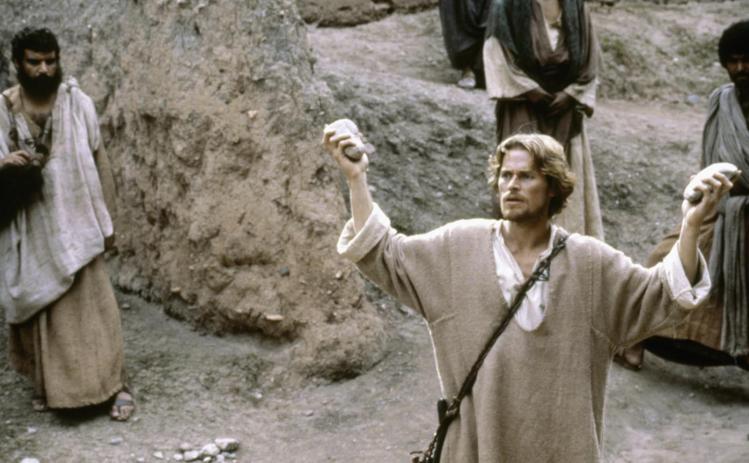
“So much criticism, back then,” Martin told me. The film, released in 1988, was adapted from Nikos Kazantzakis’s 1955 novel of the same name—a work that had already known a vexed history with religious institutions. The Cretan writer had been opposed by the Greek Orthodox Church, and his novel was eyed with suspicion in the Catholic world as well. Scorsese’s film inherited that old controversy and amplified it until it became one of the most emblematic cases in the latter half of the twentieth century of the clash between the artistic freedom and institutional religion. Pierluigi Di Pasquale examines the film’s story with care in his book L’ingiusto processo al Gesù di Scorsese (“The Unjust Trial of Scorsese’s Jesus”), published in Italy by La Nave di Teseo.
The scandal arose not from any single episode in the film but from the very architecture of the story: a Jesus shot through with doubt, fear, and temptation, all the way to the famous sequence: the “temptation,” envisioned by Christ on the Cross, of a married life with Mary Magdalene—a temptation to which he does not yield. For its detractors, this was an impious falsification of Christ, presenting him as a figure riddled with doubts. There were protests even before the film opened. Boycott campaigns were organized in the United States. When the film premiered at the forty-fifth Venice Film Festival in September 1988, Franco Zeffirelli withdrew his own Young Toscanini from the program. In several countries, there were demonstrations and even episodes of violence against the theaters showing the film, including an arson attack on the Saint-Michel cinema in Paris.
In Italy, the most categorical statement came from the presidency of the Italian bishops’ conference, which declared that the film was “unacceptable and morally offensive” and “does not deserve to be seen”; in fact, it “deserves only the silence reserved for mediocrity and shame.” It was “a commercial operation that humiliates those who carried it out.” Its fundamental flaw was a radical falsification of the figure of Jesus. The Catholic press was urged to refrain from reviewing the film. La Rivista del Cinematografo, a Catholic journal that specialized in film criticism, chose to run no review. The official strategy, then, was a combination of condemnation and critical silence.
The affair had a judicial coda as well. In Italy, complaints were filed for contempt of religion, along with petitions to have the film impounded. Yet as early as 1988 the Court of Venice found no grounds for an offense, observing that the depiction of a Christ who is fully man—and therefore capable of normal human feeling—did not constitute a crime. A quarter-century later, the Court of Cassation definitively upheld the acquittal, reaffirming the legitimacy of free expression even when it diverges from religious morality.
In my own article “From the ‘Temptation’ of Christ to Moral Ambiguity in the Cinema of Martin Scorsese,” which appeared in the May 2026 edition of La Civiltà Cattolica, I set out to read the film as the key to the director’s entire body of work. Christ’s inner struggle in The Last Temptation struck me as profoundly bound up with the ethical ambiguity of the protagonists in Taxi Driver, Silence, Killers of the Flower Moon, Raging Bull, The Irishman, Goodfellas, and Cape Fear. Together, these films offer an “implicit cinematic theology” that addresses sin, redemption, and grace, with no easy resolutions. In my article, I claim that The Last Temptation of Christ is a “Christologically correct” film. This is no small detail; it contradicts what the Italian bishops said when the film was first released. The galleys of La Civiltà Cattolica are approved by the Secretariat of State of the Holy See before publication. The fact my claim was allowed to go to press marks a reversal on the part of the Church—from the “silence reserved for shame” to an acknowledgment of the film’s Christological correctness.
In a reflection that Scorsese recorded for an event I helped organize at the Milanesiana, he uses the word “attempt” to describe what he was doing in that film (see video). It is exactly the right word. Before Jesus, one possesses nothing and concludes nothing: one attempts; one reaches toward. And in that reaching—as anyone who prays, paints, writes a line of verse, or composes a shot knows—there is already all the love we are capable of and all our trembling. This is the condition of the artist who draws near to the sacred: not to arrive, but to attempt. And film, perhaps more than any other art, knows this uncertain step, because, like faith itself, it is made of light and of time.
For Scorsese, The Last Temptation of Christ stands apart. Not because it doesn’t fit his other work but because it is the secret heart of all his work: the point at which his entire filmography—with its themes of guilt and grace, violence and tenderness—finds its expressive core. Scorsese has always filmed the sacred by way of the streets. His characters are damned and saved in the same bloody alleyways. Grace, when it comes, always comes through a wound. In The Last Temptation of Christ, he took on directly what shows through only faintly in his other films, and he came up against what he calls “mystery territory,” a region destined to remain forever uncharted.
That mystery is expressed in an ancient theological formula: fully human and fully divine. This is the formula of Chalcedon, but Scorsese does not recite it as a dogma to be guarded; he inhabits it as a question to be lived. What is the life of Jesus? What does it really mean to say he was human? The greatness of the film lies precisely here, in having taken the humanity of Christ seriously all the way down: down to the fear, down to the exhaustion, down to the temptation. Because a God who had not truly known our flesh would not have saved us. Reading the Kazantzakis novel, the temptation that struck the young Scorsese like lightning was not a life of vice or sin; it was the normal life: to come down from the Cross; to have a home, a wife, children; to grow old in peace. “A normal life,” he says, “in most cases, is very, very blessed.” And it is true. The whole vertigo of the film lies in the refusal of that legitimate blessing in the name of a greater calling: the total gift of self. Only a Jesus genuinely tempted by ordinary happiness can choose the Cross as freedom rather than as fate.
This is why the controversy over the film has always bothered me. A work born—as Scorsese confesses, in words that move me—of “a really deep love” and “a sense of awe” that has been with him since his earliest youth was received as an outrage. But the real outrage would have been to settle for the Jesus he himself describes: “The image of a picture of Jesus on the wall, something we have no connection with.” A devout image but also a dead one, revered and forgotten in the same gesture. Scorsese wanted to take that picture down from the wall and return the figure of Christ to the present, to our hearts. He wanted a Christ one could speak with. And that is exactly what faith asks for: not an icon to be venerated from a distance but a face to be met.
I know that Scorsese’s camera is a form of wrestling—Jacob’s wrestling with the angel, who will not let him go until he gives his blessing, and who comes away wounded and limping. Every one of his films carries this wound. In Silence, years later, he would take up related questions: not the temptation of the ordinary but the silence of God, and the faith that stays hidden in the heart even when the lips seem to deny. Scorsese has never stopped circling the face of Christ, the way one circles a beloved whose features one is never done discovering. And each time he does it with the same honesty, without feigning certainty he doesn’t possess, without settling for cheap consolations. His is a believing that passes through doubt, not one that skirts it.
In his recorded video message, Scorsese speaks about having been welcomed by Pope Francis and received at the Vatican. I remember those encounters as moments of disarming grace: a director and a pope who recognized each other as two men in search of the same face. Over the ten years since then, in my friendship with Scorsese I have learned that faith and art are not two languages to be translated one into the other but two modes of the same desire—the desire for the face of God that will not let itself be possessed, and that, for precisely this reason, never stops drawing us toward it.
We welcome your comments about this article. Please send your response to [email protected].