It’s not every day you hear a couple of sheep discussing the nature of God. But that’s one of the funniest scenes in the family-friendly flick The Sheep Detectives, in which a flock of talking sheep try to solve the murder of their loving shepherd. In the scene, three sheep are headed into town in the hunt for clues when they pass the local church. Lily, the smartest one and lead detective, asks, “What’s that?”
“This is the church where someone named ‘God’ lives,” answers Sebastian, a literal and figurative black sheep for the sin of being born off-season in winter. Something of a know-it-all, he goes on to explain that God is a shepherd, but also a lamb, who is made of bread, and damns things. “Like a beaver?” asks Lily, mistaking the homophone. “Yes,” says Sebastian. “So God is a big, invisible lamb-beaver made of bread?” she clarifies, to which Sebastian replies: “Yes, and they eat him on Sundays.”
The hilarious misinterpretation is just one of many things the misfit sheep get wrong about humans, and among several funny Easter eggs thrown to the adult viewers of a PG-rated movie aimed primarily at kids. (The chicken crossing the road is another.) But you’d be wrong if you assume that the writers are taking potshots at religion. The Sheep Detectives is an entertaining whodunit, but it also touches on some of life’s bigger questions, and its answers aren’t wholly incompatible with our faith’s complexity. Based on the 2005 novel Three Bags Full by German author Leonie Swann, the hybrid live-action and animation film is directed by Kyle Balda (Minions and Despicable Me 3) and written by Craig Mazin (Chernobyl and The Last of Us). Released in May, it is now available on Amazon Prime Video.
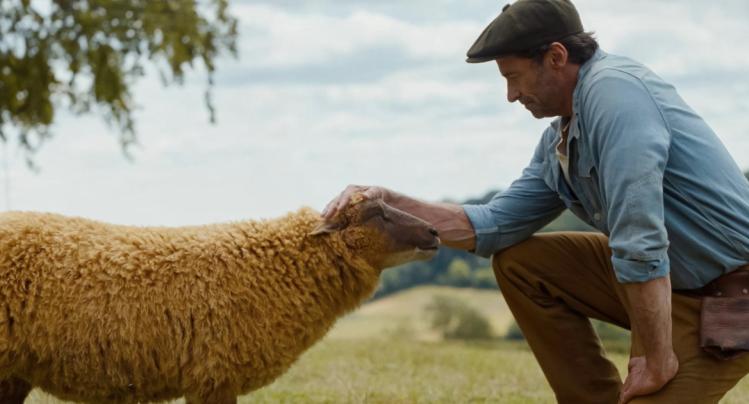
The obvious Christian parallels in the movie involve the biblical sheep-and-shepherd imagery. George Hardy (Hugh Jackman) is a recluse living in the English countryside, where he knows each of his sheep by name and reads them murder mysteries before bed. Quietly heroic, he cares for all his sheep, even the most vulnerable. In a flashback scene of George rescuing Sebastian, who has been abused at a carnival, there is an obvious Jesus-as-Good-Shepherd image of him carrying Sebastian on his shoulders. George also cares for the outcast “winter lambs,” modeling a lesson the prejudiced sheep themselves need to learn.
George’s own children had been placed for adoption after his wife died in childbirth, and when he is found poisoned in the meadow, we learn that there is a giant inheritance at stake—George had invented a treatment for a disease that affects sheep. Suffice it to say that the adoption tropes are tired, problematic, and especially egregious since Jackman is himself an adoptive parent. They also include something of a cheap shot at the Catholic Church for not always being open and fair in its facilitation of adoptions. But the movie is full of murder-mystery stereotypes, from the bumbling police officer and money-grubbing businessman to the city-slicker lawyer and the unethical priest. Everyone in town is a suspect, and the sheep use what they’ve learned listening to the novels George read to them to try to solve this real-life mystery.
The movie is at its best when it uses the wooly characters to illuminate the human condition. In addition to Lily (Julia Louis-Dreyfus) and Sebastian (Bryan Cranston), the flock includes constantly fighting ram brothers Reggie and Ronnie (Brett Goldstein), inquisitive lamb Zora (Bella Ramsey), the diva Cloud (Regina Hall), wise Sir Ritchfield (Patrick Stewart), accident-prone Wool-Eyes (Rhys Darby), and Mopple (Chris O’Dowd), who never forgets anything. Memory is a recurring theme. In the movie sheep have a magical protection against trauma: the ability to erase painful memories by closing their eyes and counting to three. With the loss of their beloved shepherd, they are tempted to use the trick to overcome their grief. But blocking those memories would also destroy their ability to bring his killer to justice and find healing for themselves.
The murder also forces the sheep to reexamine their belief about death: that sheep never die but instead painlessly transform into fleecy clouds in the sky. Mopple, who alone knows the truth, helps the rest of the flock realize that, although it is painful, there is meaning and even beauty in remembering and grieving a loved one. “Do you know what humans call stupid people who can’t think for themselves?” Sebastian asks, chastising the flock for their fears. (“Ducks!” guesses a clueless sheep.) It turns out that in reality sheep are actually surprisingly smart. And by the end of the movie, the already anthropomorphic sheep detectives have become even more “human” in their understanding of life, death, and love—and they solve the murder.
Some days I’d like to close my eyes and count to three to make all the pain in the world disappear, at least from my consciousness. In fact, I was hoping for an evening of escapism when I asked my husband and two teenagers to take me to The Sheep Detectives for my birthday. We did leave the theater laughing, admitting that none of us had correctly guessed the murderer. But the film also had me contemplating why pie-in-the-sky answers to grief and loss are ultimately unsatisfying, and why remembering, even when painful, is what humans—and maybe even sheep—must do.
We welcome your comments about this article. Please send your response to [email protected].