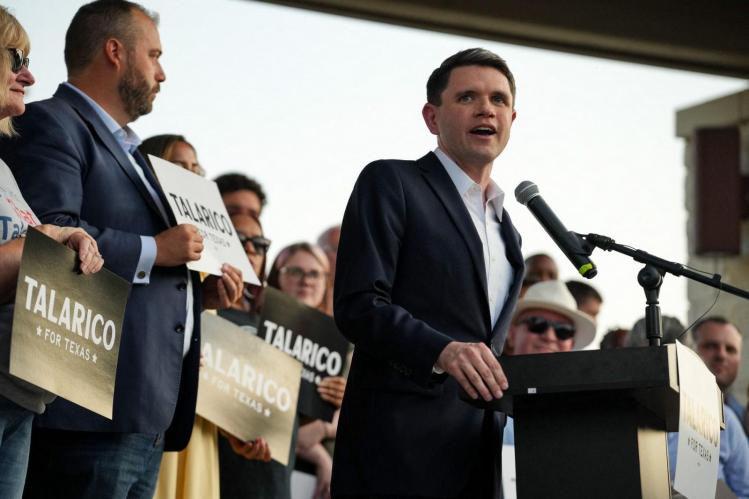
Of all the upsets Democrats may score in the November midterms, none would do more to transform the national political landscape than a victory in Texas. State representative James Talarico has a genuine chance of becoming the first Democrat elected to the Senate in the Lone Star State since 1988. In just a few months, the boyish, faith-driven candidate has seized the limelight, becoming one the party’s most talked about left populists, along with New York City mayor Zohran Mamdani and Maine Senate candidate Graham Platner. But in contrast to them, Talarico, a Presbyterian seminarian, has partly premised his campaign on a conciliatory message of Christian empathy and a desire to overcome the sordid dysfunction of the Trump era. It is a bet that even right-leaning Texans—caricatured as insatiable consumers of “red meat” bravado—have tired of the enmity that pervades our politics.
Talarico’s theory of change has found a fitting test in his recently nominated opponent, Texas attorney general Ken Paxton. Many observers believe his path to victory has become easier since the scandal-tarred Paxton, even more hardline and Trumpian than Governor Greg Abbott, defeated incumbent Republican senator John Cornyn in the May 26 run-off. Seeking his fifth Senate term, Cornyn was hardly a moderate—his voting record was consistent with the rise of a Southernized and small-government-obsessed GOP. But to the modern Republican base, Cornyn had become part of an “old guard” insufficiently committed to Donald Trump and the MAGA movement.
That has presumably created an opening for Talarico among middle-class suburbanites rattled by Trump’s second term—the same kind of “Romney Republicans” Joe Biden peeled off in key states in 2020 (Biden also narrowed Trump’s margin of victory in Texas that year). Those voters were also crucial to the election of Senators Jon Ossoff and Raphael Warnock in Georgia, currently the most purple Southern state.
Nevertheless, to match those white-knuckled feats and turn Texas into an actual battleground, Talarico will have to win over working-class voters ailing in Trump’s economy. His ground game in the Democratic primary this past winter and increasingly populist oratory suggest he understands as much. While his media-savvy primary opponent, Rep. Jasmine Crockett, used name recognition and near-monolithic support from Texas’s ample Black communities to propel her campaign, Talarico crisscrossed the state in search of disaffected independents, low-propensity voters, and nominal Democrats. He particularly needed voters from blue-collar Latino enclaves, who backed Trump in 2024 but have come to regret their choice. Combined with Talarico’s base in Austin and an advantage among culturally liberal, college-educated whites, Talarico’s outreach paid-off, yielding a six-point margin over Crockett on March 3 in a contest that surpassed Republican turnout by nearly 150,000 votes.
The challenge before Talarico is to rapidly build on that foundation by cementing the trust and enthusiasm of Black Texans while developing a message that resonates with swing voters who may have switched from Biden to Trump in 2024. Exactly how much ground Talarico needs to make up in the Black community remains a matter of speculation. After her loss, Crockett signaled that she would help unite Texas Democrats behind Talarico, but the pair found themselves again on opposite sides in the race for a House seat between Julie Johnson and Colin Allred. Talarico, meanwhile, has been courting Black community leaders in an effort to dispel the mistrust social-media influencers sowed earlier this year over his alleged denigration of Allred’s unsuccessful 2024 campaign to unseat Sen. Ted Cruz. Elected Democrats maintain that the base knows that the stakes in the race against Paxton are too great to let past clashes depress turnout. And the traditional centers of Black political leadership—the church and a deeply rooted entrepreneurial class—are likely to look favorably on Talarico’s unabashed religiosity. But given the primary brouhaha and the defection of a significant share of young Black men to Trump’s side in 2024, Talarico can be expected to devote many of his summer campaign stops to consolidating Black support.
Connecting with moderate independents and disaffected Republicans presents an entirely different set of challenges. Boosted by viral social-media clips that capture his neighborly demeanor, Talarico comes across as a determined idealist, eager to restore integrity to public office and surmount toxic partisanship. This strategy seems tailored to attract past Cornyn supporters and undercut the GOP’s efforts to frame Talarico as unmanly and insufferably “woke.” A recent Paxton-aligned PAC ad uses an AI-generated image of Talarico in a dress singing pro-transgender lyrics, and Paxton has referred to him as “Talafreako”—an epithet Talarico’s team playfully adopted for new campaign merchandise. In what still promises to be an extremely close election, Talarico’s frequent use of post-partisan rhetoric could move the needle with suburbanites more disturbed by Paxton’s record and sleazy personal history—he was charged with fraud and accused of adultery—than Talarico’s past statements like “God is nonbinary.”
But Talarico has also taken steps to show he is running on more than the abstract ideals that tend to woo beltway pundits more than economically insecure voters. Perhaps more than any other up-and-coming Democrat from below Mason-Dixon line, he has positioned himself as a champion of regular people and a foe of government corruption. Like Sen. Ossoff with his recent broadsides against the “Epstein class,” Talarico has found a convincing register for attacking a decadent oligarchy and its brazen assault on the last pillars of corporate oversight and the federal safety net. Like other Democratic challengers in red territory, Talarico tends not to associate this rhetoric with a doctrinaire leftism but to instead insist that the true battle in American politics is not “left versus right” but “the top versus the bottom.”
This populist, big-tent message is both modulated and reinforced by Talarico’s Christian faith. Instead of the gruff cadence of Platner or the combative style of Abdul El-Sayed, the left-wing insurgent vying for Senate in Michigan, Talarico invokes scripture to bolster his call for a “politics of love.” This is a far cry from the “dirtbag leftism” often bemoaned by centrist Democrats. His cheerful resolve also defies the normal temperature of Texas politics. This comportment has no doubt driven much of the fawning media coverage, though it has also sparked concern that Talarico might not withstand the Republican attack machine.
Because of his style, the national media pegged Talarico as the moderate vis-à-vis Crockett. But his message should not be mistaken for the promise of some shallow truce between America’s political tribes that is stripped of prospects for serious reform. Just as he maintains that his faith compels him to extend his hand to Trump supporters, Talarico casts his opposition to plutocratic rule as fundamentally rooted in the Gospel. He communicates a righteous, Sanders-style demand for accountable government in a manner designed to transcend bitter ideological divisions and persuade voters who normally reject progressives.
Of course, Talarico also doesn’t shy away from tactical maneuvers and ambiguities that might boost his momentum heading into the general election. As with many of the most viable Democratic female contenders running on “affordability” this year, Talarico can be categorized as a pragmatic populist who is careful not to alienate potential converts and donors (Talarico’s extraordinary haul of more than $40 million in campaign funds is thus far the largest this cycle of any non-incumbent Democrat). Indeed, Talarico has not yet identified himself with any distinct policy agenda of the left, though he recently pledged a “comprehensive” anticorruption bill if elected.
Despite his impressive rise, some Democrats worry Talarico’s chief liability is that he is too representative of Austin’s own “Brahmin left”—that his cultural views will ultimately hinder any earnest outreach to blue-collar Texans. Apparently aware of that concern, Talarico has joined other rising Democrats like Sen. Ruben Gallego in staking out one or two “heterodox” positions that symbolically break with the policy demands of influential advocacy groups. In an interview with The Bulwark after his primary victory, Talarico pointedly said of the Biden administration’s border policy that “chaos is not compassionate.” While his remarks fell short of Clintonian triangulation, they did show that Talarico thinks he must assuage voters who are open to his message and dislike Paxton but look askance at progressive activists.
Can this blend of Christian uplift and progressive populism really strike a chord among the Texans who have eluded Democrats this century? The answer has nationwide implications. From the Midwestern Farm Belt to the Deep South, Democrats have a long way to go before they start flipping rural counties. Some of that is due to the residual impact of trade shocks, the lack of economic opportunity outside large cities, and the mistrust of liberal promises that spread in the aftermath of the Great Recession. Other factors include hostility toward Democrats’ embrace of cultural progressivism and, in some cases, plain bigotry. Whatever the exact combination, Democrats, even those sympathetic to the struggles of rural and working-class whites, have been largely ineffective in their sporadic efforts to reengage former supporters inundated with right-wing propaganda. These obstacles are especially stark in Texas, where Talarico must slash Paxton’s lead in some forbidding deep-red districts in order to win.
That said, there is a Texan populist tradition—albeit a largely forgotten one—that Talarico might be able to reawaken. Nearly 150 years ago, the Farmers Alliance, which originated in Texas, set the stage for the revival of the antimonopoly movement and the Populists, who ultimately allied with the Democratic Party in the 1896 presidential election. With varying degrees of success, they established a reform faction within the party’s otherwise conservative Southern wing. During the original Progressive Era, those grassroots organizers agitated for railroad regulation and other antitrust measures, farmers’ cooperatives, expansionary monetary policies and lower interest rates, and greater public investment. Although its objectives shifted over time, this movement against concentrated wealth and ownership did as much to shape New Deal and Great Society liberalism as the labor and urban reform movements of the industrial North.
Is it possible that in the present era, one similarly punctuated by obscene levels of inequality and government capture, ordinary Texans could rediscover this legacy? Beneath healthy GDP and low unemployment numbers, economic conditions have become increasingly precarious. Texas’s prosperity is inordinately dependent on low corporate taxes, low-wage immigrant labor, and transplants from other states. And of late, the state’s one-party rule and the GOP’s militant fidelity to “free-market” governance seem ill-suited for a host of problems. Texas has become a testing ground for driverless trucks, which could threaten blue-collar employment in that critical industry; the AI data-center surge may drastically aggravate local water shortages (an issue which could turn right-leaning suburbanites into a swing bloc); screwworm has reappeared and will afflict ranchers and exacerbate the already-elevated cost of beef; housing construction has slowed down thanks to Trump’s aggressive deportation policies; Trump’s war in Iran has worsened rising inflation; and the continuing impact of his tariffs has darkened the outlook for agricultural exporters and manufacturers.
Together, those issues could create opportunities for Talarico, but it is here that the limits of his current strategy become evident. His biggest strengths lie not in policy, but personality and biography. In addition to his faith, he cites his modest and precarious early childhood (his birth father was abusive toward his mother) and experience as a public-school teacher as key moments that shaped his identity and passion for public service. In an election that presents a clear contrast in character, those traits can’t be discounted. But there is a difference between the soundbite jabs against elites that are au courant among urban Millennial Democrats, Talarico included, and the distinctly agrarian radicalism that historically shaped Texas and other states in which Democrats hope to regain a foothold.
That in a nutshell captures the dilemma facing Democrats who want to harness populist anger in places hostile to the national party. Despite his spirited outreach, Talarico may struggle to escape the “nationalization” of politics and get his message out about the local policy concerns that could decide the election in his favor. That said, the tenor of Talarico’s campaign and others shows that red-state Democrats no longer assume a business- and tech-friendly pitch is the best way to rebuild their coalition. He has sounded the alarm about the economic forces distorting American democracy far more than Beto O’Rourke did in his close loss to Ted Cruz in 2018. We will soon find out whether enough Texans are listening.
We welcome your comments about this article. Please send your response to [email protected].