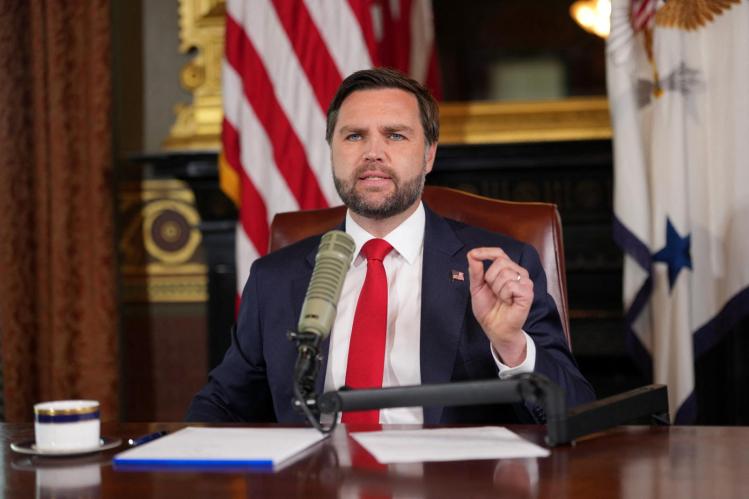
The reviews of Vice President J. D. Vance’s new book Communion are starting to roll in, and the consensus is that this sequel to his bestselling Hillbilly Elegy is as much a political accounting as it is a spiritual memoir. Still, the subtitle—“Finding My Way Back to Faith”—promises that the book will discuss Vance’s conversion story to Catholicism, so it’s not surprising that much of the chatter on the book-tour circuit has focused on questions of religion and morality. But even on those topics, Vance comes off more as a politician running for president than a spiritual seeker seeking redemption.
Of course, interviewers have asked Vance a fair number of political questions, especially since Trump put the vice president in charge of negotiating the peace deal with Iran, unhelpfully timed to overlap with his book launch. New York Times columnist Ross Douthat spent nearly half of his hourlong Q&A with Vance pumping him for details about the fragile ceasefire and peace-deal framework, and then had to make an awkward segue to the topic of the book: “You know who only makes good deals? Jesus.”
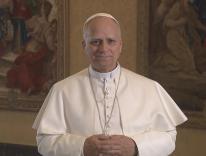
When Douthat asks him the inevitable question about why, as a Catholic, he’s part of an administration that seems to be waging war against the first U.S.-born pope, Vance blames the media for taking things “out of context,” apologizes for his own “boneheaded” comments, and insists that he and the pope have different roles. Pope Leo XIV has to preach the Gospel, Vance says, but politicians must apply those principles amid competing interests—an explanation that could have come straight from the mouth of a pro-choice Catholic politician.
“What I said about the pope is, I actually like that he offers his opinions,” Vance told Douthat. “I actually like that he’s speaking about the issues of the day and that he’s an advocate for peace. But that doesn’t mean that on provincial questions of how to balance these competing principles, you’re always going to have an elected administration that is going to agree.” What Vance didn’t mention is that he also disagrees with the Church on even basic theological principles, notably receiving a slap on the wrist from Pope Francis in February 2025 for his misrepresentation of the ordo amoris, or order of love, as an excuse to ignore the common good. Not content to insult just one pope, Vance later said Leo should “be careful when he talks about matters of theology.”
The vice president was again on the political defensive during a ratings-busting appearance on the daytime talk show The View, where the panel of six women cohosts came out swinging with questions—and follow-up corrections and clarifications—about the Trump administration’s policies on a range of topics including immigration, Black history, and the Epstein files. Though many of the questions were specifically phrased to connect to Christian faith and values, Vance avoided religious language until the end—he mentioned his need for grace as a “bad Catholic,” referencing the apology he makes in the book for his “childless cat ladies” comment about the Democrats. Host Sara Haines tried to press on why he went from warning fellow Christians about Trump as “America’s Hitler” to becoming his vice president, but Vance’s only explanation was to describe the “humility” in discovering he was wrong about wage growth during Trump’s first term. The entire interview had the ring of a presidential-campaign stump speech.
Perhaps Vance knows his audience, since his visit to Fox News featured more religious language and multiple mentions of Jesus, especially in response to softball questions like, “Do you find yourself, as vice president, communicating with the Lord?” from The Five cohost Jesse Watters. “All the time, man,” responded Vance, “especially in the most stressful and tense moments, because you need to be centered and have your eyes on the right thing. Sometimes I just talk to God and say, ‘God, give me wisdom and courage because I need both right now.’”
In that and other interviews, Vance tells a somewhat compelling story of being lured back to faith by Christians who seemed to be happier, better people who had life “figured out”—namely, tech billionaire Peter Thiel, who inspired Vance’s conversion. Vance had grown up in an Evangelical “institutionally unrooted” church in Ohio’s Rust Belt, but fell into individualistic atheism as a young adult after the death of the grandmother who had raised him. Vance admits that for a while he cared only about the “social competition” of striving to get into the best school, make the most money, and become one of the “elites” he now disparages, before getting back on the path to faith. Meeting his wife, Usha, who is not Christian, prompted him to realize “there is something sacramental about love” and change his mind about religion, he says.
All this talk about Vance’s faith resurfaced a news story from April about the baptism of the Vances’ six-year-old child at Easter, delayed both so that the child could remember it, the vice president said, and as a compromise to his wife. This prompted a social-media debate about the importance of infant baptism in Catholicism, with more than a few conservative Catholic commentators bending over backwards not to criticize the vice president, whose views seemed more in line with his Baptist background.
When Vance is discussing his faith journey, he also is careful not to offend any constituencies he may need in a presidential run. With Douthat, he praised Catholics but also the Black church, poor Appalachian Pentecostals, and MAGA Christians, whom he insists really care more for the poor than they do about culture-war issues. He does have some critique for the “business side” of the Republican Party that ignores the Christianity’s social tradition, especially on economics. But it would be easier to believe his concern for the working class is genuine if the Trump administration’s policies weren’t so diametrically opposed to feeding the hungry, welcoming the stranger, and caring for the least of our brothers and sisters.
I have not read the book, but some who have noted that it borrows from and expands upon the 2020 essay Vance wrote about his conversion for the Catholic publication The Lamp, titled “How I Joined the Resistance.” Yet the book features a photo of a very Protestant-looking church on the cover. Maybe it’s a signal that Vance wants to keep his Evangelical sensibilities but add the beauty, history, and other perks of Catholicism. He certainly wouldn’t be the first convert to want to do so. Or maybe he’s just an opportunistic politician—one reviewer says Vance’s “true religion” is careerism—and Evangelicals and Catholics are just two demographics he needs to win the presidency.
We welcome your comments about this article. Please send your response to [email protected].