“We have third-degree burns on our souls.”
This is how Rachel Goldberg-Polin, whose only son Hersh was abducted by Hamas terrorists on October 7, 2023, describes her pain in her memoir, When We See You Again.
Hersh, an American-Israeli, had been attending the Nova music festival when terrorists broke across the barricades separating southern Israel from the Gaza Strip. The attackers killed and injured thousands of people, raped and sexually assaulted others, and ultimately took 251 individuals, including children, as hostages back to Gaza. Hersh Goldberg-Polin, then age twenty-three, was one of the kidnapped. After 328 days in captivity mostly in Gazan tunnels, Hersh was finally executed at close range. His body was found with traces of gunpowder in his hair.
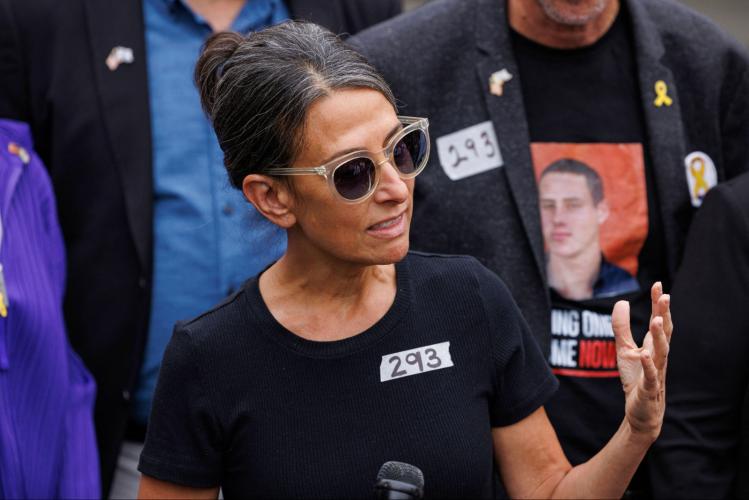
During his almost yearlong disappearance, his mother became a ubiquitous figure onscreen and on speaking stages as she and her husband Jon advocated around the clock for Hersh’s release. Almost always, she appeared with a signature look: gray-black hair swept up in a clip behind her head; simple, loose shirts and pants on her petite frame; and no real adornment other than a small piece of masking tape that marked how many days Hersh had been in captivity. The cover of When We See You Again features the title written on a piece of masking tape.
Goldberg-Polin never planned on becoming a public figure. At the start of her book, she refers to her life preceding Hersh’s abduction—“The Before”—as “a regular and beige life…. It was a warm beige. We felt, and were, blessed and lucky. Normal.” Goldberg-Polin’s version of “normal” is a not-so-out-of-the-ordinary journey of an observant Jew who moved her growing family to Israel in the early 2000s, when Hersh was six years old.
Having grown up in a secular Jewish family, Goldberg-Polin was introduced to Modern Orthodoxy in her early teens and fell in love with observant Jewish life. Her interest eventually took her to Israel for several long trips, including a five-year stint of serious Jewish learning. It’s clear that Goldberg-Polin is highly literate in Jewish texts. The book weaves in thoughtful discussions of the Torah, the Talmud, and Jewish rituals and prayer. It’s also clear that she is an educator; Goldberg-Polin writes (and speaks in interviews) in a way that makes this high level of Jewish learning available to the less initiated, both within and outside the Jewish community. Regular people can see themselves in her. In a recent 60 Minutes interview, she commented that, with the name Rachel Goldberg, she is the Jane Doe of the Jewish world. It’s a funny line, even though, as she recounts in her book, she feels that in this new era of her life—“The After”—she has lost her sense of humor.
Goldberg-Polin categorizes “The After” as the period of Hersh’s abduction, the eventual return of his body to her family, his burial and shiva, and the new, daily nightmare of having buried her only son. The period of Hersh’s abduction included her global travels with Jon, speaking at rallies and meeting with every politician they could to save Hersh and the other hostages. Her journeys took her to Davos, the United Nations, and Washington D.C., as well as a country she doesn’t name but suggests she and her husband never should have visited. Sometimes she cryptically describes other parties as “people not like us.” It’s unclear what she means—presumably a lack of shared values or ethical principles. Some might read her phrasing as a tribalist way of indicating Muslims or non-Jews, but that doesn’t seem to fit Goldberg-Polin, clearly both an observant Jew and a humanist.
Goldberg-Polin’s vagueness is part of her choice to leave politics out of her account, and she specifies almost no politicians by name in her recollections. She mentions Israel’s current president Isaac Herzog, who attended the widely streamed funeral for Hersh. (The presidency of Israel is not considered a fundamentally political role.) And she recounts a video call President Biden held with the families of hostages during which one parent found out that both her daughters had been found dead. As Goldberg-Polin recounts it, Biden sobbed at the news.
Also absent is a discussion of Israel’s war in Gaza, which Israel declared right after the October 7 attacks and which has left an estimated seventy thousand Gazans and 1,200 Israelis dead. Prime Minister Benjamin Netanyahu, who has been accused of ignoring warnings of an attack prior to October 7 and who has overseen the expansion of the conflict in Gaza into a three-front war, is entirely missing from this book. Facing prosecution on corruption charges, Netanyahu was already a highly divisive figure in Israel before the war. Notably, he refused to meet with hostages’ families when the war was in its early stages in Gaza.
The political divisions over the Israel-Gaza war created echo chambers on all sides of the conflict. Part of what made Goldberg-Polin so popular as a voice for hostages was not just that she is a very skilled speaker—and, it turns out, writer—but also that she veered away from broader commentary about the Arab-Israeli conflict. In the book, she remembers taking heat from a journalist who disapproved of Goldberg-Polin’s statement that innocent victims were being killed on both sides of the war. Her message was simply that she wanted all the hostages returned from Gaza—now. At Davos and elsewhere, politicians are not given names or identifying details; they are not her focus. What Goldberg-Polin remembers clearly, however, are the people who helped and the people who did not.
Goldberg-Polin tells us about the many friends, family members, and synagogue members who came to her family’s aid in the wake of Hersh’s abduction and death. For the most part, she uses their first names without giving much background information. (She refers to her therapist as “the Smart Man.”) Those editorial choices send a message: we are regular people living heretofore ordinary lives; here is a glimpse of the people in our lives; and beyond that allowance, other curtains to our private and normal world will remain closed. She establishes an intimacy with the reader while also giving it parameters.
In memoirs, writers often strive for a balance between vulnerability and excessive exposure. Goldberg-Polin describes in painful, vivid detail the ever-fluctuating daily experience of being a bereaved parent. Grief has physically changed her. She says that likely due to the trauma, she has shrunk in size to the point where her doctor noticed. Her hair has grayed, and her teeth have shifted and made speech slightly challenging. She struggles with eating because Hersh was starved in Gaza’s tunnels.
We hear about her grief in heartrending detail. We hear little, however, about how Hersh’s abduction and death have impacted her relationships with her husband and her two daughters. It would be worthwhile to hear more about Goldberg-Polin’s identity shift in these roles in her future work, but perhaps this is another curtain she wishes to draw.
People often say the wrong thing or release emotions inappropriately to those who are grieving. Goldberg-Polin is made to tolerate all sorts of awkward or even insulting reactions, as very few people really know what to say to her. Strangers constantly approach her and touch her. At Hersh’s shiva, one couple tells Rachel’s daughters that their parents are now in their graves psychologically, too. Goldberg-Polin hears laughter coming from her kitchen while preparations are underway for the shiva. She calls the sound “sadistic and unconscionable. Unforgivable…. The cruelest, most offensive and repulsive noise I had ever heard in my life until then, and it remains so.”
Yet Goldberg-Polin also names the inherent awkwardness of her situation and the unpredictability of her reactions. She finds herself curious and moved when another person sends her a letter comparing Hersh’s death and Abraham’s sacrifice of Isaac, a story that continues to confound and unsettle Biblical readers. The letter seems wildly offensive, but that particular reaction touches her.
Since all the events surrounding Hersh have unfolded, Goldberg-Polin says that she finds herself drawn to the Biblical forefather Jacob. She’s not sure why. It is true that many people see Jacob as a “trickster”—he stole his brother’s birthright, he ran away from home due to this familial dispute, and he engaged in (and was victimized by) trickery during his relationship with his cheating father-in-law Laban.
Yet I found myself thinking about the Kabbalistic version of Jacob: the human embodiment of Tiferet, an integrated truth that balances divine compassion with its opposite, divine judgment. Tiferet can be seen as the truth-beyond-truth. That is to say, it’s God’s truth, which supersedes human understanding or our limited notions of justice. Jacob acted in duplicitous ways and was deprived of truth in order to one day embody a larger, God-sanctioned truth. Tiferet can also be understood as an expression of God’s specific love for the Jewish people.
Throughout her story, Goldberg-Polin makes clear that her experience of bereavement has in no way compromised her religious faith. When she gets the news that Hersh has been taken, she writes, “I remember thinking, I will never see him again. I remember thinking, very clearly, God is here. God is here.” Goldberg-Polin also frequently says that she is certain she is meant to carry on living, but that she hasn’t yet figured out her “why.” Clearly a believer in a world to come, Goldberg-Polin seems confident that her next meeting with her son—when they will see him again—will occur after she dies. In the meantime, she constantly looks for signs of his spiritual or energetic presence and frequently speaks to him in his physical absence.
While in the tunnels, Goldberg-Polin notes with great pride, Hersh was beloved by the other hostages. An encouraging presence despite having lost his hand and part of his arm in the initial attack, Hersh reminded his fellow captives to remember their “why” in order to survive. He even managed to procure a book from his Hamas captors. That book, Shadow and Bone by Jewish author Leigh Bardugo, is a fantasy story about surviving physical darkness.
As Goldberg-Polin carries on—as she finds her own “why” in the darkness—her book stands as an account of the truth-beyond-truth, and a fiercely moving tribute to her beloved son.
When We See You Again
Rachel Goldberg-Polin
Random House
$30 | 288 pp.
Correction: The video call with families of hostages was held by President Biden, not President Trump.
We welcome your comments about this article. Please send your response to [email protected].