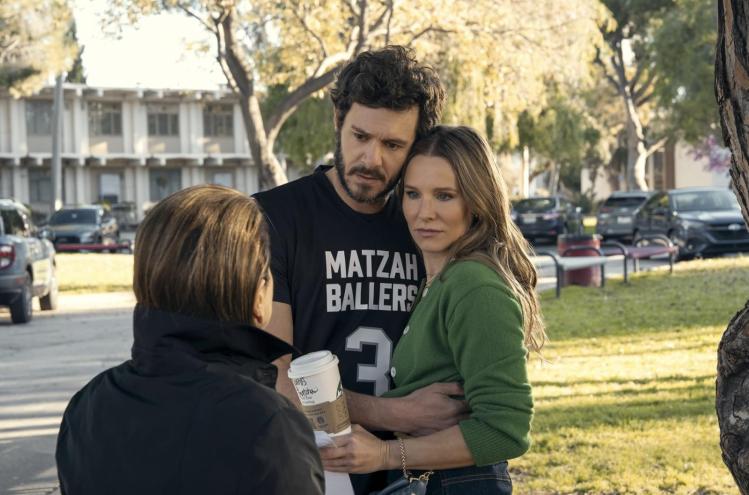
“You’d be a pretty good get for us.”
In the second season finale of the hit Netflix series Nobody Wants This, this encouragement is offered by a Jewish woman named Esther to protagonist Joanne, who has been wrestling with the decision to convert to Judaism. It’s a remarkable turnaround from the previously frosty dynamic between Joanne (Kristen Bell), and Esther (Jackie Tohn). Joanne is learning a key aspect of the lived Jewish experience: the choices that would normally feel solely hers have an impact on other people in the Jewish community.
Joanne finds herself at this crossroads because of her romantic relationship with a charismatic Reform Jewish rabbi named Noah (Adam Brody). Despite their different backgrounds—Noah is a professional shepherd to the Jewish people while Joanne hosts a podcast about sex and relationships with her scene-stealing sister, played by Justine Lupe—Joanne and Noah click profoundly. From a secular perspective, they share a seemingly ideal relationship. It’s not without its bumps, but their fluent communication and mutual ability to see the best in one another safely steer their relationship through all sorts of obstacles. To borrow language from Pirkei Avot, Joanne and Noah are able to look at one another with a favorable eye.
It’s hard to judge where Joanne and Noah are in life developmentally. They are mature adults who have clearly been to therapy, yet with their single lifestyles and youthful styling it’s not clear how old they are intended to be. The show hints at elder-cohort Millennials. Both Bell and Brody were adolescent stars in the early-2000s hit teen drama series Veronica Mars and The O.C., respectively, and the script is filled with nuggets of hard-earned talk-therapy relationship wisdom à la Esther Perel. (At one point in Season 2, Joanne, who is eager to get married, asks in frustration how old a hesitant Noah thinks she is. Viewers are wondering about the answer to that question as well.)
Despite confusion about their ages, they clearly have the maturity to make their relationship blossom. They encourage one another to grow. Joanne helps Noah express his suppressed emotions about the frustrations of his job in healthy ways, while Noah notices small things that Joanne needs—such as a nightstand—and provides them for her, to her delight. In the words of Joanne’s sister, who observes their romance, “You’re in a psychotically annoying relationship.”
Yet time and again, Judaism appears to be the one problem they cannot solve. As a Jew in the public eye, Noah cannot marry a non-Jew; Joanne needs to convert if their relationship is going to survive much longer. It’s a lot of pressure for Joanne, who shows an early interest in and eventual love for Judaism, but who wants to convert for herself and not simply to marry Noah. Matters are made worse by Noah’s disapproving family, consisting of his well-off but traumatized Soviet Jewish immigrant parents and their older son, a goofball whose shrill wife, the aforementioned Esther, makes Joanne’s life miserable early on. The show’s creator Erin Foster, herself a convert to Judaism, has faced criticism for her portrayal of some Jewish women on the show.
A word on those criticisms: Foster has the right to tell her story the way she wants, and in real life, she and her sister are highly public activists against antisemitism. The controversy over some of the characters’ portrayal speaks mostly, I think, to the uneasy tension between the outsized success and status of American Jews in public life and the real, rising threat of antisemitism. The acceptance and celebration of American Jews has meant that joining the Jewish people isn’t out of the ordinary. Erin Foster is in the company of Hollywood stars Elizabeth Taylor and Marilyn Monroe, who also converted to Judaism. Yet the persistence and recent increase of antisemitism in America—Jews are the most targeted religious minority in the U.S. for hate crimes—means that there is an ongoing sensitivity within and outside the Jewish community regarding depictions of Jews onscreen. Stereotypes about shrill or controlling Jewish women can trigger that sensitivity. That said, Season 3 would perhaps benefit from female Jewish characters who don’t require so much time to thaw emotionally or who don’t use the word “whore.”
Joanne is an ever-supportive partner to Noah, but her uncertainty about committing permanently to a Jewish life is the show’s ongoing point of tension. Being Jewish, as she is learning, is not something she can compartmentalize or separate from the rest of her life. At one point, she realizes suddenly that she’ll have to say goodbye to Christmas if she proceeds with becoming Jewish.
As the season continues, Joanne attends Jewish baby-naming ceremonies, celebrates Purim, and attends Friday-night Shabbat dinners with Noah’s family, who grudgingly realize that she is good for Noah and begin to include her. Much like a ger toshav in the Torah, Joanne is a resident alien of sorts; she is living among the Jewish community without formally staking her claim to it yet. To viewers, it appears that on some deep level Joanne has already made her decision to convert, and so at times her overthinking shifts from conscientious to overwrought, even exasperating.
Joanne also occasionally crosses the line into cluelessness. She speaks about Noah’s bedtime habits on her podcast, to the point where employees at Noah’s synagogue compliment him on his bedroom aesthetic. As any pulpit rabbi knows, optics matter, and the publicizing of his romantic relationship outside marriage with a non-Jew isn’t ultimately doing his career any favors. Joanne seems surprised when Noah complains to her about these disclosures from her podcast. At the same time, of course, Noah is as responsible as Joanne for staying in such a risky relationship. He appears helpless as he tries to balance patience with the real-life considerations of a future family and career.
Amid the plot twists and tensions of Joanne’s journey, Nobody Wants This makes a keen contribution to the public perception of converts and Jewish identity. Conversion with an initial motivation “for marriage”—at times looked upon doubtfully or suspiciously—often produces very committed Jews who form their own deeply meaningful relationships with Judaism apart from their partners. Joanne realizes over the course of Season 2 that she loves Judaism and feels Jewish—with or without Noah.
A point that Nobody Wants This makes is that converts who arrive at Judaism through their romantic partners also want to lead their own individual Jewish journeys. Ivanka Trump, one of the world’s most visible Jews, came to Modern Orthodox Judaism through her husband Jared Kushner but speaks frequently of her personal relationship with Judaism and with Israel. Writer and television producer Taffy Brodesser-Akner’s husband converted to Judaism after meeting her and is now the more religious partner in their marriage. Like Joanne, Nobody Wants This creator Erin Foster married a Jewish man who encouraged her to convert, but the experience led to an ardent sense of personal Jewish identity in Foster. She has consistently spoken out passionately both about her Judaism and in support of Israel, especially after the October 7 Hamas-led terrorist attacks in Israel. Suspicious minds about “converts for marriage” often seem to forget that the archetypal Jewish convert Ruth—a celebrated figure in Judaism—joined the Jewish people initially out of love for her mother-in-law.
Throughout Season 2, Joanne seems to be waiting for an epiphany—a lightning-bolt moment—to show her that she should convert. But of all people, dating-podcaster Joanne should know that often a slow, stable burn leads to a sustainable long-term flame. She doesn’t need a passionate love-at-first-sight experience to make a lifetime commitment. Noah’s formerly ice-cold sister-in-law Esther helps her unlock that insight by the season’s finale.
While Nobody Wants This could have been seen as a risky bet for Netflix due to its focus on religion, its success indicates that many people still find spirituality and community appealing. Since the October 7 attacks, rabbis are reporting increases in conversions to Judaism. People with personal connections to Judaism are realizing that labels matter. Unlike Joanne, these individuals feel a sense of urgency to commit to Judaism. More people are literally taking the plunge (conversion requires ritual immersion in a mikveh, or pool of water). Amid a global spike in antisemitism, people with a previous desire to convert are now finding the motivation to formally stand with the Jewish people despite the dangers of doing so.
Nobody Wants This has been a breakout success, and it has been renewed for a third season. It offers a feel-good storyline and a compelling romantic relationship that is fluent in Millennial therapy-speak but “sin-adjacent” enough to prevent the show’s spiritual themes from feeling cloying or corny. Yet what Nobody Wants This does most artfully is tell the story of a “convert for marriage” from the convert’s perspective. It’s the story of a person trying to choose Judaism for what she believes are the “right” reasons: her own.