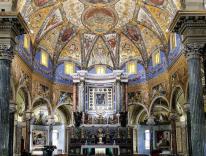
An architect’s vision for a church is magnificent in scope. They must design a massive structure that is both beautiful and sacred. They have to coordinate the work of hundreds of nameless builders and craftspeople. They also have to reckon with the idea that the work is unlikely to be completed in their own lifetimes. The great cathedrals of the Middle Ages and Renaissance—Chartres, Notre Dame, St. Peter’s Basilica—often took centuries to complete, from the time that the cornerstone was laid to the church’s consecration. When I teach my students about the process of building medieval cathedrals, I show them how incremental progress stretched out over many years: moments of great innovation, or wartime years when progress was stalled or thwarted. I ask them to imagine what it would be like to know your work will outlive you.
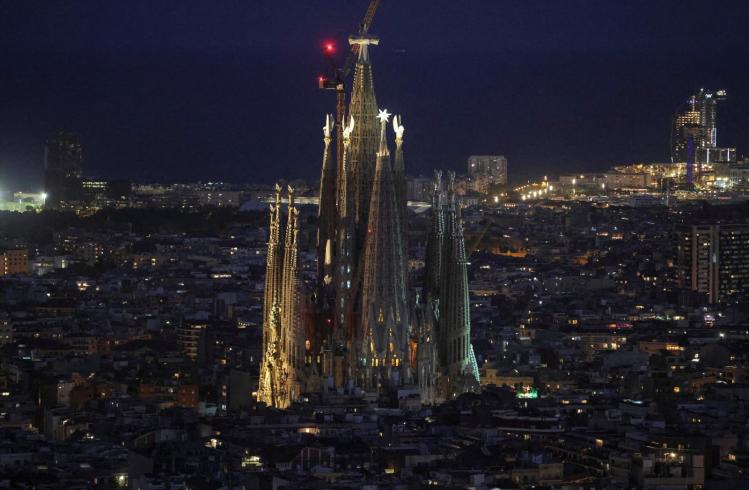
In our own lifetime, we are bearing witness to a major milestone in Catholic architecture: the addition in February of a twenty-four-foot cross to Barcelona’s Sagrada Família (“Holy Family”). With this installation, the 556-foot basilica is now the tallest church in the world. The designation comes on the centenary of the death of Antoni Gaudí, the visionary architect most known for his contributions to Sagrada Família. Gaudí’s creative vision was magnificent, but his philosophical approach to his work is worth attention too—especially at a time when Pope Leo XIV is extolling the virtues of human creative excellence.
Known as “God’s architect” for his numerous religious projects throughout Barcelona, Gaudí was one of the great contributors to the Catalan Modernisme movement. He took over as the master architect of Sagrada Família in 1883, one year after its construction began. Gaudí’s plan was ambitious: eighteen spires representing the twelve Apostles, the four Evangelists, the Virgin Mary, and Jesus. As of May, fourteen of those have been completed. Sagrada Família is often referred to as “the Bible in stone,” as the different towers, carvings, stained glass windows and other decorative features work in harmony to tell biblical stories to the millions of visitors who travel to the unfinished basilica each year.
The basilica was only a quarter complete when Gaudi died in 1926, and he knew that it would be incumbent on his successors to carry on his vision. He famously noted, “There is no reason to regret that I cannot finish the church. I will grow old but others will come after me.” In this, Gaudí took an approach similar to the medieval builders who came before him. According to twelfth-century author John of Salisbury, it was Bernard of Clairvaux who coined the phrase “standing on the shoulders of giants.” “We see more and farther than our predecessors,” he wrote, “not because we have keener vision or greater height, but because we are lifted up and borne aloft on their gigantic stature.” The idea that the accomplishments and discoveries of the past make possible our creativity today animated the thinkers of the medieval era. Peter Parler, the fourteenth-century German-Bohemian architect who helped craft St. Vitus Cathedral in Prague, learned the craft of masonry from his father. Passed down from generation to generation, masons like the Parler family worked in community to create some of the most famous medieval structures in Central Europe and Northern Italy.
Those cathedrals were primarily built in the Gothic style, which emerged first in France and then spread throughout Europe by the mid-thirteenth century. Innovations such as flying buttresses and ribbed vaults allowed the builders to ascend to greater heights, drawing worshipers’ eyes toward God in the heavens. Simultaneously, stained-glass windows helped congregants to maintain focus on the altar. It is evident in Gaudí’s work how much the Gothic style influenced his designs so many centuries later.
As of 2026, Sagrada Família has been under construction for 144 years. Its current architect is Jordi Faulí, the ninth master architect of the basilica. Though he continues to support Gaudí’s vision, Faulí is a decisively twenty-first century architect: he uses 3D software to design the towers’ mosaic tiles. Because many of Gaudí’s designs were lost during the Spanish Civil War (1936–9), Faulí has used extant models, drawings, and photographs as well as Gaudí’s letters to interpret the original plan for the basilica. Like Gaudí, Faulí recognizes that there isn’t a direct continuation of thought between him and his predecessors. “We’re not his disciples, because that’s not possible. But we are his successors, without doubt. Most of all, we’re his collaborators.” When asked if he would live to see the completion of the basilica, Faulí replied, “Whatever God wishes.”
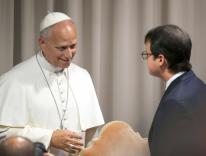
As part of his apostolic journey to Spain and the Canary Islands in June, Pope Leo XIV will visit the basilica on June 10 (the hundredth anniversary of Gaudí’s passing) to inaugurate the newly completed Tower of Jesus Christ. This trip comes on the heels of his first papal encyclical, Magnifica humanitas (“Magnificent Humanity”), which largely focuses on preserving human dignity in the wake of the AI revolution. The 42,000-word encyclical is also an affirmation of beauty and human creation: “Humanity—in all its grandeur and woundedness—must never be replaced or surpassed.” Gaudí’s vision is a prime example of the human creativity that Pope Leo XIV praises in Magnifica humanitas.
There’s been a recent surge among innovators of various kinds to embrace the idea of imagining and planning how your work will continue past your own lifetime. Some have taken to calling this “cathedral thinking.” Environmental activist Greta Thunberg used the term in a memorable speech to MPs at the Houses of Parliament in April 2019, arguing that for a goal as large as saving the planet, “we must lay the foundation while we may not know exactly how to build the ceiling.” Business strategist Luis Vives writes in Forbes, “The companies being built by today’s cathedral-thinking executives will similarly stand as monuments to the power of long-term vision, patient capital, and generational stewardship.” But in their use of the term, business and tech bros miss something about what it means to build an actual cathedral (or, in the case of Sagrada Família, a basilica): a vision motivated not by profit or prestige but by working for God’s glory and creating something that will serve God’s people for future generations. As Gaudí put it, “What must always be conserved is the spirit of the work, but its life has to depend on the generations it is handed down to and with whom it lives and is incarnated.”
We welcome your comments about this article. Please send your response to [email protected].