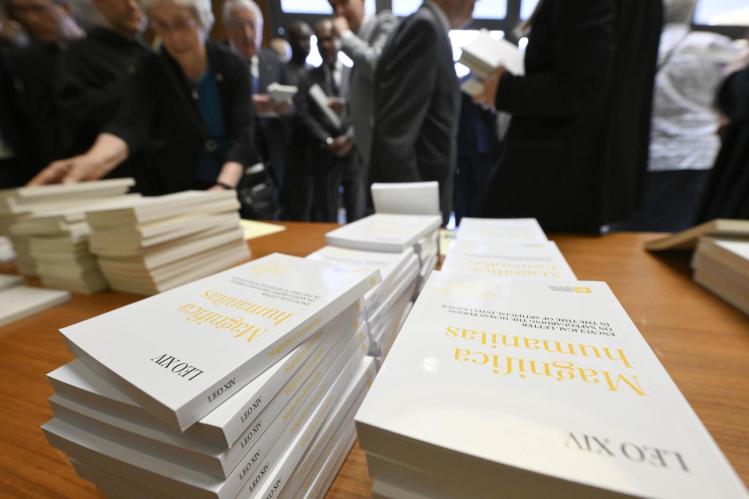
Pope Leo XIV mentioned artificial intelligence on the first day of his papacy a little more than a year ago, making the publication of a technology-focused encyclical all but inevitable. Magnifica humanitas, published on May 25, is an impressive feat, addressing a society-changing technology as it takes hold instead of decades after it has already transformed the world.
Leo, who chose his name as a signal that he would emphasize Catholic social teaching in the vein of Pope Leo XIII, grounds his work in the tradition of the famous 1891 encyclical Rerum novarum. “While many of the historical conditions described by Leo XIII have changed,” Leo XIV writes, “at least two insights remain highly relevant today: the primacy of human labor over any mindset focused solely on finance or productivity…and the inseparable link between proclaiming the Gospel and pursuing a more just social order.” He notes that Rerum novarum reminds us “that there is no authentic evangelization that does not also affect the structures of human society” (30).
One of the most important contributions of Magnifica humanitas is Leo’s expansion of Pope Francis’s idea of the “technocratic paradigm,” language first used by his predecessor in Laudato si’. The original framing of the technocratic paradigm often proved too broad and indistinct to wield properly, especially in the public square. Leo’s use of this framework is tailored, specific, and constructive: he names the overarching danger, but then spends many paragraphs specifying how and where such dangers can be located and challenged in culture. “Every technical tool embodies choices and priorities through what it measures, ignores and optimizes, and how it classifies people and situations,” he writes. Our conversations about technology cannot be limited to “using a system for good or bad purposes.” We must “examine how that system is designed and what vision of the human person and society is embedded in the data and models that guide it” (104). In this, Leo aligns himself with the overwhelming consensus among scholars of science and technology. Technology, whether a bomb or a washing machine, is not neutral. All technology serves individual or social goals, and must be analyzed with those goals in mind as well as the effects they have on society as a whole.
What are these effects? AI has not redistributed wealth; it has consolidated it: “AI tends to amplify the power of those who already possess economic resources, expertise and access to data” (108). AI has not allowed us to become better humans; it has “regarded the human person as an object to be manipulated or a resource to be optimized, removing all safeguards against the unchecked pursuit of profit” (172). AI has not given us a post-work society; it rests “on the silent work of millions of people engaged in essential yet largely unseen activities, such as data labeling, model training and content moderation, often involving disturbing material” (173).
Leo elaborates on the ways AI exploits people, in visceral detail:
In many cases, these workers are young people, predominantly women, working under demanding conditions for minimal wages. Added to this invisible labor is the even harsher work of extracting the resources required for the production of the devices and microprocessors on which AI depends. In some regions of the world, children and adolescents work in dangerous conditions, crushing the materials from which rare earth elements are extracted. The bodies of these people are scarred, injured and worn down so that computational flow may continue uninterruptedly. Furthermore, criminal networks use online platforms, messaging systems, anonymous payment methods and profiling techniques in order to recruit, control and transport victims of trafficking—very often minors—reducing men and women to “data” to be tracked and “packages” to be moved around within the same digital circuits that support much of the global economy (173).
Given these dangers and abuses, Leo reaches an unavoidable conclusion, one he emphasized in his presentation about the encyclical on the morning of its release: we must disarm AI.
The military metaphor is not accidental. Much of the final chapter of the encyclical focuses on war, peace, and justice. Leo emphasizes the importance of peace in dialogue (182), the need to move on from antiquated “just war” language (192), and the symbiotic relationship of peace and justice (215). He calls for us to return to nuclear and non-nuclear disarmament, and to end seemingly endless technological wars that cause mass migrations and impoverish millions. We must physically disarm our militaries, we must verbally disarm our voices and documents, and we must disarm AI.
To disarm AI is to free it from alignment with power and wealth and instead use it to serve the needs of communities and protect our shared home. Disarming AI “means discrediting the assumption that technical power automatically confers the right to govern” and “freeing technology from monopolistic control and opening it to discussion and debate, therefore making it human-friendly and restoring it to the plurality of human cultures and ways of life” (110).
The call to disarm AI is simultaneously ethical, theological, technological, and, referencing Laudato si’, ecological. “It is ecological in the deepest sense, for it concerns a new dimension of our common home. AI is already an environment in which we are immersed, as well as a force with which we must engage. For this reason, merely regulating it is insufficient; it must be disarmed, welcoming and accessible” (110).
This lengthy encyclical contains multitudes and yet does not contain enough. Leo makes no distinction between generative and nongenerative AI systems. An AI system made to play chess does not carry the same ethical weight as Gemini’s new video-creation AI, which carries different weight than Palantir’s Project Maven. There is, more importantly, no mention of the way that generative AI preys on humanity’s vast troves of art and literature to fuel its newest models without paying or crediting artists. Leo does mention specific art and artists—Gandalf even gets a line (213)—but the threats to art and creativity that have dominated so much of our conversation about AI are never addressed. Would it have been so difficult to include a paragraph or two about the magnificence of human art in a time of the enshittification and nonstop AI slop?
Nevertheless, the call to disarm AI is powerful. It invokes decades of language of resistance to power and destruction. It conjures images of dialogue and encounter and points to visions of a well-cultivated earth, whose flora and fauna (including humans) depend upon the responsible use of technology to steward a future of health and prosperity for all people. In this effort, “no one is without responsibility” (212).
Disarmament, crucially, is not a rejection of AI wholesale. It is a resistance to dehumanization and a refusal to capitulate to inevitability. Disarmament leaves room for the possibility that AI can have good uses, but those uses can only be discovered by those who work for flourishing communities—not by those motivated by profit margins and exploitation.
Until then, the central message of Magnifica humanitas is clear: AI is armed and dangerous, and the act of defusing it will take work from us all.
We welcome your comments about this article. Please send your response to [email protected].