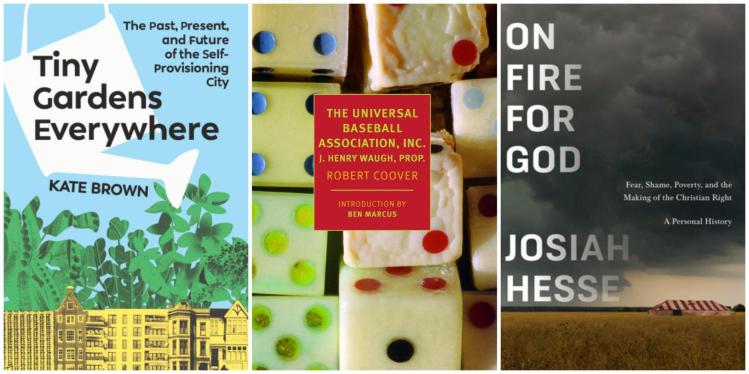
As the Industrial Revolution pushed them off the commons and into cities, peasants lost the little independence they had. To reclaim it, they built gardens. In Tiny Gardens Everywhere, environmental historian Kate Brown documents an alternative history of urbanization in North America and Europe: one in which working-class people grew food in the nooks and crannies of cities to feed their communities and make themselves less dependent on wage labor. From England to Washington D.C. and Estonia to Ohio, small gardeners sustained each other amid famine and war, racial terror and disinvestment. In the meantime, they created “the most fertile agriculture in recorded human history.”
Tiny Gardens Everywhere
The Past, Present, and Future of the Self-Provisioning City
Kate Brown
W. W. Norton & Company
$31.99 | 336 pp.
*
Reissued by New York Review Books, postmodernist Robert Coover’s 1968 novel, The Universal Baseball Association, Inc., J. Henry Waugh, Prop., plays pepper with the national pastime and puts the American mythos into a pickle. To Henry, the league’s eponymous founder, the dice- and scorecard-determined outcomes of his imaginary league best the on-the-field exploits of flesh-and-blood ballplayers. When chance strikes down Henry’s freshly conjured phenom, the association starts to crumble and its creator soon cracks up. A metafiction, a parable, and a portent, Coover’s Summa Baseballica (as Wilfred Sheed described the novel upon publication) is a confounding classic of the genre.
The Universal Baseball Association, Inc.
J. Henry Waugh, Prop.
Robert Coover
NYRB Classics
$18.95 | 264 pp.
*
From a young age, Josiah Hesse was speaking in tongues, dreaming of demons, and living in constant fear of the rapture. In his new memoir, On Fire for God, Hesse unpacks the history of the right-wing Evangelicalism that shaped his childhood and condemns the impact that relentless anxiety about a religious apocalypse has on a child. Framed as a rebuttal to Hillbilly Elegy, Hesse’s book seems written for white liberals eager for another peek inside the lives of rural American Evangelicals, this time with an anti-GOP slant. By including personal anecdotes and interviewing family members back in Mason City, Iowa, Hesse tries to articulate a narrative of healing from religious and childhood trauma—but by the end of the book, it seems that process has only just begun.
On Fire for God
Fear, Shame, Poverty, and the Making of the Christian Right – a Personal History
Josiah Hesse
Pantheon
$32 | 368 pp.