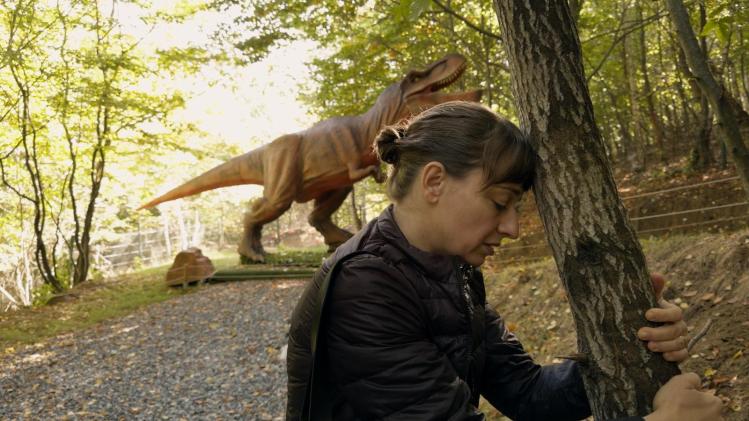
A woman crouches in a park and recites the Lord’s Prayer through tears. Her hands are wrapped around a thin tree, her forehead rests against it. All the makings of a moving scene, except that behind her a life-sized plastic dinosaur is going through its own animatronic convulsions.
This is the Romanian filmmaker Radu Jude’s world—and, quite possibly, our own. Things are dire, but it’s often difficult to take them seriously: the background ephemera of our lives—social media, advertising, plastic crap, spam, slop, the president of the United States—are increasingly uncanny and absurd. Our sarcasm and cynicism—understandable, even inevitable—offer us a thin layer of protection, but they also allow things to keep getting worse. Are we disaffected because things are so bad or have they gotten bad because we’re so disaffected?
The scene is from Jude’s latest film, the ruminative but trenchant Kontinental ’25, and the weeping woman is Orsolya, a court officer in the Transylvanian city of Cluj, who is pulled out of her disaffection by guilt. A down-and-out former athlete named Ion kills himself after she and a team of gendarmes, kitted out like ICE agents, arrive to evict him from a boiler room the building’s previous owner let him squat in. The new owner is an Austrian real-estate firm called Europa that is converting the building into a boutique hotel, The Kontinental, and they’ve obtained—possibly through a bribe—a court order to have him removed. Orsolya had managed to secure a weeklong extension for Ion, but now his time is up. Rather than accept her help finding a place in an overcrowded shelter, he ties wire around his neck and somehow manages to hang himself from a radiator. The gendarmes are reluctant to touch him; Orsolya’s comically inept attempt at CPR does no good.
Orsolya, her colleagues, and the police make it clear again and again that she’s not criminally liable. Her legal innocence is reiterated so often that it almost becomes a kind of incantation to ward off the possibility of any other kind of culpability or complicity. But for reasons she can’t understand, Orsolya remains consumed by guilt and plagued by images of Ion’s death. Instead of going on a planned vacation with her husband and kids to Greece, she stays behind to “clear [her] mind” and “make some decisions.” “I’ll be better when you come back,” she tells her husband.
Kontinental ’25 is inspired in part by Roberto Rossellini’s 1952 film Europa ’51. (Jude wryly turns the continent of its title into a private enterprise, whose bidding Orsolya, ostensibly a public servant, is forced to carry out.) In Rossellini’s reflection on a sick society trying to rebuild itself after World War II, Irene (Ingrid Bergman), the frivolous wife of an American industrialist based in Rome, is guilt-ridden after her neglected and sensitive son throws himself down the stairs and later dies of an undiagnosed blood clot. Initially unable to get out of bed, Irene is revived by her husband’s cousin André, a Marxist who takes her to the newly built but already dilapidated tenements on the outskirts of the city. She finds meaning and purpose helping the marginalized—a sick boy whose family can’t afford medical care, a single mother and her impoverished but cheerful brood, a lost young man who turns to crime, a prostitute on her deathbed.
Rossellini called Irene “a spiritual sister to Simone Weil.” Like Weil, she works for a time in a factory (although her single day of hard labor pales in comparison to Weil’s year) and turns herself into a paragon of self-sacrifice. Also like Weil—and like Rossellini himself—she resists attaching herself to any orthodoxy, rejecting both André’s militant Marxism and the priggish moralism of a priest who tries to talk her into more conventional limits to the love that has brought her out of her luxury apartment and into the streets. As Martin Scorsese put it in a recent interview with Commonweal, in Europa ’51 Rossellini asks what sainthood would look like in the modern world. The answer? Irene so confounds the powers that be that they end up institutionalizing her.
Jude frames his movie as “a caricature of sorts of Rossellini’s.” The suggestion seems to be that, if sainthood was difficult to understand in Rossellini’s time, it’s all but impossible today. And indeed, Orsolya is no Weil. Instead of channelling her guilt outward toward the poor and upward toward God as Irene does, she searches—in a series of one-on-one conversations that Jude shoots in characteristic long takes—for ways to buy it off, move past it, cover it up (she even has a prop moved to block her view of the radiator in her office). Her guilt and conscience drive her ever further inward: she is looking for psychological fortification, not social redemption.
One encounter is with her friend Dorina, who tells of her own guilt after she called the police on a homeless man who was living (and defecating) on her block. She “felt better” after she started supporting an NGO that helps Roma families living in a landfill on the outskirts of the city. In a near exact quotation of Europa ’51, Dorina invites Orsolya to visit a boy in need of expensive medication. Where André’s invitation to Irene arose from his ideology, Dorina’s is solely in the service of therapy. Orsolya decides to go, only to immediately think better of it. She’s worried about being criticized on social media for taking a “poverty safari” (as an ethnic Hungarian she’s already been harassed by Romanian nationalists over Ion’s death), and about her own fragile state of mind. “I can’t see that boy, I just can’t.” Instead, she sends Dorina 500 euros to help the family. She prefers to do her charity at a convenient distance.
Later, Orsolya seeks distraction in a former legal student of hers whom she runs into by chance when he’s delivering food on his bike. A creature of the internet, he watches war porn, quotes rapper Ice-T and absurdist Zen koans, and wears a light-up sign on his backpack saying “I am Romanian” to avoid the harassment that Bangladeshi and Sri Lankan deliverymen are subject to. Initially annoyed by his antics, Orsolya ends up using him to relive her drunken student years and relieve her torment.
Her hangover drives Orsolya to an Orthodox priest, who is more interested in condemning atheists and excoriating Ion for suicide than in helping Orsolya deal with her anguish. He has nothing to say about the corrupt system in which Orsolya finds herself entangled, though he does recognize something performative in Orsolya’s guilt, even as he waves away the suffering of innocents in Gaza, Ukraine, and Yemen as an opportunity for the “works of God” to be “made manifest.” Still, his authority gives Orsolya the permission she needs to move on. Where Irene’s sainthood was illegible amid the great ideological conflict of early Cold War Europe, Orsolya’s guilt can be nothing more than a temporary posture amid all the other distracting options for self-curation in a post-ideological age. Maybe she can go on her vacation after all.
Not far below the surface of Orsolya’s self-involved quest for absolution lingers Europe’s project of collective redemption after the horrors of both fascism and communism. One night, Orsolya falls asleep with a translated copy of Tony Judt’s 2005 book Postwar: A History of Europe Since 1945 on her lap. Judt’s book traced Europe’s economic, political, and moral reconstruction—the attempt to come to terms with the horror and destruction of World War II—and ended on a sanguine note about the continent’s social-democratic model: “The 21st century might yet belong to Europe.” Louis Menand, in turn, ended his prescient review of the work in The New Yorker by writing that the coming years—and the expansion of the European Union, in particular—would be a “test of Judt’s hope that the ashes of the old Europe are truly cold.”
Jude’s films suggest they are not. I Do Not Care If We Go Down in History as Barbarians (2018) confronted the ongoing denial of Romania’s participation in the Holocaust under fascist prime minister Ion Antonescu. Still-simmering ethnic hatreds—the mistreatment of the Roma especially (his historical 2015 film Aferim! is about the enslavement of the Roma, another taboo subject in Romania)—are never far from his characters’ minds, nor are the specters of twentieth-century fascism and its present-day offspring. Orsolya gets into a screaming match with her mother over the Orbán regime.
Romania’s place near the bottom of the European hierarchy—it was not admitted to the EU until 2007—is also a recurrent theme. The heroine of Jude’s excellent Do Not Expect Too Much From the End of the World (2023) is also, like Orsolya, forced into morally compromising positions by an Austrian multinational. Angela, a production assistant for a ragtag film production company, spends fifteen-hour days crisscrossing traffic-snarled Bucharest to interview exploited workers injured on the job for safety videos intended to whitewash the corporation’s responsibility.
If the expansion of the EU was supposed to be a victory lap for the triumphal technocratic liberalism of the nineties and aughts, the reality has proved more complicated, especially as the benefits of market-friendly reforms go to those already on top. Cluj is a case in point. A tech boom, aided by EU membership, brought economic growth to Romania’s second biggest city but also—as in the Bay Area and Seattle before it—raised prices, drove out the working poor, and set off a housing crisis. Meanwhile, tech workers didn’t even have to pay income tax until recently.
Orsolya herself lives in an anodyne, mass-produced house in Florești, a suburb where, she says, they’re building “like mad, China-style, all squeezed together.” Jude’s camera lingers over apartment buildings—new luxury condos, old Communist-era blocks, slapdash and likely illegal new construction. “Real-estate developers rule Romania,” Orsolya complains. The one constant in these documentary-like sequences (the whole film was shot on an iPhone) is the few people one sees outside. The architectural anomie is the natural accompaniment to the travails of the film’s alienated heroine, who is more likely to interact with uncanny automata—a battery-operated toy on the fritz, animatronic dinosaurs, a remote-controlled car whose controller we never see, an exercise-promoting bus stop that offers a free ride if you let it surveil you doing squats—than human strangers.
Jude filmed Kontinental ’25 at the same time (and with much of the same cast and crew) as a very different feature: a version of Dracula consisting of AI slop based on the Transylvanian myth made by a filmmaker within the film who’s desperate to hit on something cheap and commercially viable. The unsubtle satire suggests that AI is sucking the lifeblood out of our culture. Viewed together with Kontinental ’25, it also suggests something slightly subtler: that our tech-stricken culture cannot sustain us morally or politically. Or as the German-Jewish philosopher Theodor Adorno put it after fleeing Europe during the war, “Wrong life cannot be lived rightly.”
We welcome your comments about this article. Please send your response to [email protected].