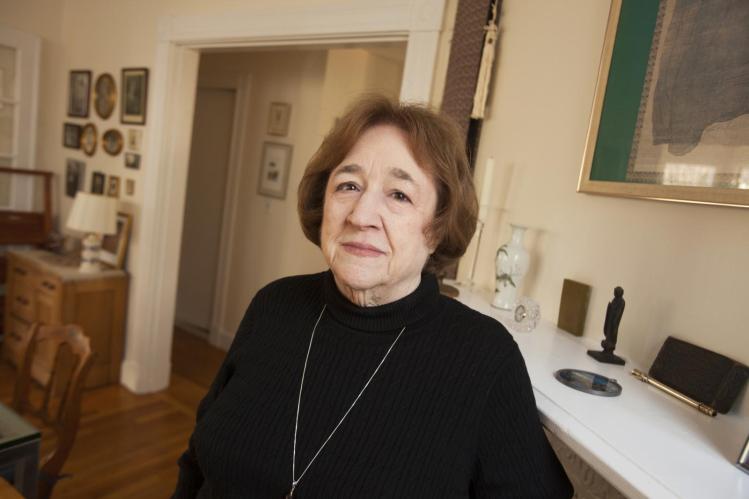
The subtitle of this book—Last Essays—reminds us that its author, Helen Vendler, died in April 2024, leaving behind twenty volumes of enlivening criticism of poets and poetry. The book’s title, Inhabit the Poem, I take to be a directive to readers, and the thirteen substantial essays collected in it are exemplary illustrations of what exactly it means to inhabit a poem—the activity that Vendler practiced so notably throughout her career, in the classroom and on the page. She spent all her critical energies on poetry rather than on other modes of literature. “I was not a novel reader,” she admitted early in her career and, with the exception of a single review (of a novel by Mary McCarthy), she wholly abstained from any writing not directly focused on poets and poetry. She labeled her way of dealing with poems “aesthetic criticism,” and engagingly characterized her book reviewing as a “self-seminar in the new.”
The essays in Inhabit the Poem are divided between poets old and new, or newish: from John Donne and William Blake to twentieth-century poets such as W. B. Yeats and Sylvia Plath. Apart from Ocean Vuong, no living poets were included. Each poet is represented by a single poem, followed by an essay about it; each essay originally appeared in the journal Liberties, edited by Leon Wieseltier. That they now appear together under the Library of America imprint suggests the esteem Vendler’s name brings with it and the conviction that, even as the reading and teaching of poetry grows more marginal to academia and culture at large, her contribution to that activity deserves to be memorialized. She never behaved as if getting a poem “right” were less than supremely important—no easy task even for serious readers. She once wrote of the “scientific” aspect of her discipline, defining it, rather formidably, as the effort to engage with “the logic of sequential and evidential exposition” to be discovered in good poems. Education in reading and criticizing poetry was above all else “training in subtlety of response,” a training that was arduous as well as more than occasionally rewarding. Those familiar with the critic I. A. Richards will recognize Vendler’s debt to him, one she gratefully acknowledges.
To inhabit the poem often means to move from a sense of its oddity and strangeness into a more humanly welcoming feeling. Wallace Stevens’s “The Bird with Coppery, Keen Claws” offers a sparse portrait of a “parakeet of parakeets,” unmoving in his curious activity—“He munches a dry shell while he exerts, / His will, yet never ceases, perfect cock, / To flare, in the sun-pallor of his rock.” The portrait is unwelcoming, even trivial, but it can be inhabited by a reader able to describe the poem’s off-putting landscape and—since this is a reader (Vendler) who seems to have inhabited all of Stevens’s poems—able to achieve a satisfying “evidential exposition.” Donne’s much admired Holy Sonnet, “Batter my heart, three-person’d God,” is not the “prayer” expected from a devout clergyman but, in Vendler’s words, “an electric sequence of tumultuous moods” ending in a plea for chastity, not through a divine suppression of appetite but through something very different: “For I / Except you enthrall me, never shall be free, / Nor ever chaste, except you ravish me.” Vendler’s chapter on Donne’s sonnet is titled “How to Talk to God,” and she uses a Yeats poem, “The Moods,” to assist the explication. Thus we are instructed in how one poem talks to another rather than bullied into being told what Donne’s sonnet “really means.” Subtlety of response is one possible outcome of such a conversation and comparison between poems.
Vendler’s reasonable judgment is that Yeats was the greatest poet of the last century, and she alludes to an early poem of his that declares the poet’s task is “to articulate sweet sounds together,” a recognition of the ear’s centrality in the poet’s art. But Yeats knows that those “sweet sounds” need to be articulated in order to attain a persuasive structure. Vendler undertakes such critical articulation with relentless inventiveness and takes the risk of overwhelming us with it, sometime resulting in our inability (or at least mine) to follow or assent to all her moves. This happens with Gerard Manley Hopkins’s “On the Portrait of Two Beautiful Young People,” where Vendler tracks “the rapid—the instantaneous fluctuations of response that the poem will mirror.” The fluctuations were, I am sorry to report, too rapid for me, who failed to meet the challenge of Hopkins’s dazzling virtuosity. Vendler herself confesses to finding the poem’s second stanza “almost unintelligible” but does not shy away from it, charting its “rapid” movements as best she can. She gives her twenty-four-page essay on Hopkins the provocative title “The Selfless Self of Self.”
I found myself looking for moments when Vendler concedes that a writer chosen for such close inspection may not be quite up to her prevailing standard. Adrienne Rich, whose work Vendler admires more than I do, was celebrated for revolting against “the coercive customs of her own society.” But Vendler admits that Rich is occasionally led into “coarseness of expression,” while her catalogues “of suffering, poverty and needless death in this country and abroad…are in theory unending and like Whitman’s they can sometimes go on too long.” It is good to be reminded that, even with a poet fine enough to earn a chapter in Vendler’s book, distinctions between fine and not so fine still need to be made. Inhabiting the poem should not be a matter of merely adding another plaudit to already famous names like Blake, Marianne Moore, and Plath. Slightly less famous ones such as Robert Hayden will be new to some readers; we look to Vendler’s essays for evidence that they have a place beside Hopkins and Whitman.
Inevitably, one is tempted to pick out a favorite poet and poem from those that interested Vendler enough to earn a place in this volume. For me it was, unexpectedly, William Cowper, now seldom read except by a few specialists in eighteenth-century English poetry. The poem Vendler chooses to discuss is equally surprising: “Epitaph on a Hare”—not “The Poplar Field” or “The Castaway,” which are better known. What distinguishes “Epitaph on a Hare” from those other poems is the central presence of humor. Here are two of the eleven quatrains about the hare:
On twigs of hawthorne he regaled,
On pippins’ russet peel,
And when his juicy sallads fail’ld,
Sliced carrots pleased him well.
A Turkey carpet was his lawn
Whereon he loved to bound,
To frisk and gambol like a fawn,
And swing his rump around.
This is “Old Tiney, surliest of his kind,” a “wild jack hare,” but domesticated and affording William Cowper—an English clergyman who suffered from suicidal depression—supreme pleasure. Vendler sees the central component of the epitaph as “utterly dependent on charm,” a quality for which poems are not usually praised. She notes that charm requires a constant management of tone that cannot be “single-mindedly earnest or sorrowful.” In one of her best formulations, she lays out what charm in a lyric consists of: “It is a social utterance. It needs a stylized attitude of wistfulness and irony, a blending of the impersonal with the personal, of the independent mind with the troubled heart, and above all it requires an evident awareness of itself and its listeners.” Vendler’s essays contain moments where her own voice rises in intensity, where words on the page are brought satisfyingly to fuller life, where the critic was herself moved. Combining wistfulness and irony, as Cowper does so artfully in his “Epitaph on a Hare,” results not only in charm but in humor. Over the course of its eleven stanzas, this poem is unconventional, wayward, and playful—three words Vendler uses to sum up the epitaph’s nature. She titles the essay “Forced to a Smile,” referring to one of the poem’s lines. The smile is all the better for its not coming too quickly or easily.
Thinking about this book after reading its thirteen essays more than once, I was moved to consider what its ideal reader might look like. Or rather, to wonder whether someone who wished to become more confident as a reader of poems might be helped by any or all of these essays. Two books that were once helpful to me in that way were The Fields of Light, written by my teacher of seventy years ago, Reuben Brower, and Hugh Kenner’s The Art of Poetry, a later discovery. I read and reread their commentaries on poems familiar and unfamiliar. Both books were of invaluable use to me as a reader and teacher of poetry. Inhabit the Poem is not such a book: its demands are heavy and only an experienced reader, familiar with countless poems, is likely to meet them. Most of these essays address readers who are already confident in their ability to follow extended treatments of difficult poems. Vendler’s engagement with poetry always has such readers in mind, and she has no use for jargon or the latest critical fad in literary studies.
The concluding chapter is titled with a question: “Can Poetry Be Abstract?” It begins with some pages on Emily Brontë’s “No Coward Soul Is Mine,” a poem that eludes fixed religious categories because of its “abstract” nature. But Brontë is soon joined by Emily Dickinson as a later poet who also made a poem abstract by “stripping the Christian God of all supernatural credibility.” We go on to encounter an ever-widening group of poets complicating the original question: Coleridge, Keats’s “Ode to Psyche,” Hardy’s “The Darkling Thrush,” T. S. Eliot’s “Journey of the Magi,” and, completing the chapter and the book, John Ashbery’s “Three Poems.” The reader is likely to take in only a portion of this chapter’s complex argument. There is nothing for it but to reread the poems and Vendler’s commentary on them in search of a fuller grasp. Inhabiting the poem is a lifetime enterprise that Helen Vendler performed so brilliantly throughout her remarkable career, as this last collection reminds us.
Inhabit the Poem
Last Essays
Helen Vendler
Library of America
$17.50 | 279 pp.
We welcome your comments about this article. Please send your response to [email protected].