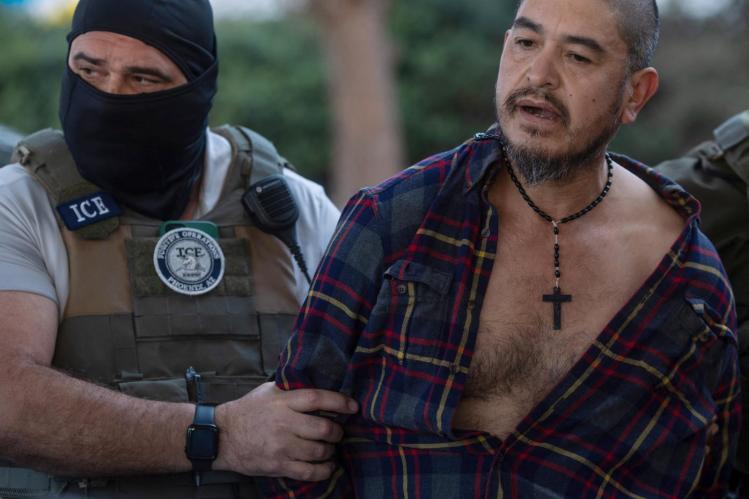
When we ask for Mary to guide us, we should be prepared. The journey might be inconvenient, rainy, freezing cold, dangerous. Sometimes Mary brings us to the foot of the cross, sometimes to the gates of ICE detention.
I pray the rosary at my parish on Tuesday mornings with a remarkable group of women. We convened fifteen years ago—young, weary, overworked moms, desperate for community and support. Most of us thought the rosary was for old ladies. Now, I’m pretty sure we are the old ladies, and together we’ve developed both profound friendship and deep devotion to Mary.
Over these many years of praying the rosary, I have also been working with detained immigrants and asylum seekers. I helped to establish El Refugio, a ministry of hospitality and visitation in Lumpkin, Georgia, down the road from one of the largest immigration-detention centers in the United States. El Refugio accompanies immigrants, asylum seekers, and their families though the crises of detention and deportation. Such work can be—both literally and metaphorically—a desert journey.
As we near the end of the Lenten season, I find myself desperately longing to move past the Sorrowful Mysteries. My heart sinks each time we return to the agony in the garden and witness again the scourging and the crowning with thorns. I’m weary of calling to mind my own profound weakness, then asking Mary for the fruits of these mysteries: patience, perseverance, and—the real kicker—moral courage.
One morning in October, I arrived at my parish rosary meeting in a state of despair. Masked federal immigration agents were sweeping through U.S. communities with head-spinning scope and speed—detaining people on the street, charging into homes without judicial warrants, and lobbing tear gas into crowds. I longed that morning for the Luminous, Glorious, maybe even Joyful mysteries. Instead, we prayed the Sorrowful, and when the fruit of moral courage came up, I silently pleaded with Mary: What in the world should, or even could, a handful of faithful people do in such a time as this? The answer came to me, clear as a spring of water: pray the Rosary at the gates of ICE.
I had done this before, fifteen years ago, at the Broadview ICE Processing Facility in Chicago. I was there to work on a documentary project called The Sisters Sent a Message, about the extraordinary witness of two Sisters of Mercy, Pat Murphy and JoAnn Persch. In the world of immigration advocacy, the sisters are bona fide rock stars. They managed to accomplish things that the rest of us could barely imagine. As Sr. JoAnn told me when I interviewed them for the documentary, they were “just two nuns. Two bold women who will say what it takes to get our point across.” When words didn’t quite do the trick, they weren’t afraid to badger politicians or lie down in the road to block deportation buses. These two faithful women were soft-spoken, gentle, diminutive, but also powerful, courageous, audacious.
They visited with detainees, set up a court watch and visitation program, provided housing to people released from detention, and assisted asylum seekers and their families settling in the Chicago area. For almost two decades, they also joined friends and volunteers for weekly Friday-morning prayer vigils at the Broadview ICE Processing Center. Royal Berg, the Chicago immigration attorney who started this Broadview Rosary in December 2006, described the sisters’ motivation to begin participating in January 2007: “Instead of cursing the darkness,” the sisters asked, “what can we do to light a candle?”
Almost nineteen years later, driving home from my parish rosary group, I recalled his words. I called a dear friend from the rosary group to ask about praying together outside the Atlanta ICE building, then a couple of folks from church. I reached out to another courageous nun I know, Sr. Mary. They were all in.
The night before our first gathering, I barely slept. By this time, Operation Midway Blitz was well underway in Chicago. The Friday morning Broadview Rosary had been expelled to an area several blocks away, behind concrete barriers and blockades. Clergy, nuns, and lay leaders had endured tear gas and pepper balls. Attempting to enter the facility and offer communion to those being held at Broadview, priests were turned away, and Catholic groups filed lawsuits to regain access. I wondered: Did we adequately consider the risks?
Both weary and wary, I arrived at the Atlanta ICE field office on the first Friday of Advent, with my adult daughter and a friend. We set a small table under a tree, facing the entrance to the office, an imposing edifice surrounded by spiky black fencing. We placed an image of the Virgin of Guadalupe on our table, passed out rosary beads and prayer guides, and began.
Eight of us gathered on that brutally cold first morning. We huddled in hats and scarves and puffy coats. I recalled Sisters Pat and JoAnn telling me that the first time they prayed at Broadview, the temperature was twenty below zero. In Atlanta, it was thirty above, so I forced myself to remove my gloves and feel the beads, solid between my fingertips. When our prayers ended, we gazed at the American flag flapping in the bitter wind, at the dark mirrored windows, and we wondered if anyone in there saw us, if our presence mattered at all.
We returned each Friday, ardently believing that Mary hears our prayers and that she intercedes on our behalf. We asked for God’s protection over those standing in line for ICE check-ins and court hearings. We asked for God’s mercy on our nation, which has strayed so far from God’s great commandment to love our neighbors.
By the time this Lent came around, ICE and the Border Patrol had moved on from Chicago to Minneapolis. Operation Metro Surge had flooded that city with more than two thousand immigration agents, resulting in nearly four thousand arrests and the unbearably tragic deaths of Renee Good and Alex Pretti. By then, every one of us understood the risks.
Nevertheless, in Atlanta, our group continues to expand, and I marvel at each person’s gentle courage. When we arrive before dawn, people awaiting ICE check-in appointments have already begun to form a line along the fence. We greet them warmly and tell them why we’re there. Sometimes, those in line join us in prayer, and a few accept a rosary as a sign of our solidarity. Many ignore us, and some turn away. It’s difficult to trust.
One Friday after praying, a friend and I waited with a man from Venezuela. We sat together in the warmth of my car, listening to his story as he watched anxiously for his wife to come out. She did, praise God. We hugged, then went our separate ways. Another morning, an unhoused person joined us, and a young woman in our group patiently stood shoulder-to-shoulder with him, teaching him how to pray the rosary. When we finished, our new friend enthusiastically embraced each one of us. I was reminded that Sisters Pat and JoAnn often described their work as a “ministry of hugs.”
A few weeks ago, one of the women in our group felt unwell. As we neared the end of our rosary, she slumped against a tree, her legs extended into the street. A few of us stood in front of her to protect her from oncoming cars. When we finished our prayers, a vehicle pulled up, emblazoned with the Department of Homeland Security’s Federal Protective Service logo. An agent stepped out of the vehicle, with POLICE HOMELAND SECURITY in bold letters across his uniform. None of us knew what to expect as he knelt beside her.
He asked if she needed medical attention, then gently helped her stand and escorted her to Sr. Mary’s car. Watching from a short distance, a friend said, “I guess his kindness is a reminder. We’re tempted to call them enemies, but we have to see God in every person.” I recalled what Sr. JoAnn told me about their prayers at Broadview: “Even though it breaks my heart every Friday, we can’t lose our hope that at some point this is going to change.”
Sometimes I want to know: Whose idea was it, anyway, to only pray the Sorrowful Mysteries during Lent? Lent is waiting in joyful hope for the Resurrection! It’s bold assurance that when the stone is rolled away, the tomb will be empty. The risen Christ lives! Yes, and also: Lent is walking alongside the suffering Christ and refusing to turn away. It’s putting one foot in front of the other on a long journey through the desert. It’s standing vigil at the foot of the cross.
What sustains us on this Lenten journey? How do we persevere, and why?
Fifteen years ago, sitting together in their living room, I posed a similar question to Sisters Pat and JoAnn. Sr. Pat replied in her soft, firm voice, “You cannot not do it. You cannot not do it…. We are one body, and we are one family, and we draw on [the] strength of each other. The more human we become, the more God-like, I do believe, that we become.”
Sr. Pat died in July, at the age of ninety-six. Sr. JoAnn died in November, at ninety-one, shortly before we first gathered in Atlanta at the gates of ICE. Both prayed the Broadview Rosary until their final days—two gentle women whose moral courage and bold witness inspire us to stay present and persevere.
We welcome your comments about this article. Please send your response to [email protected].