The Sunday after Renée Good was killed in Minnesota, I was in Chicago, visiting a friend. We sat around her kitchen table and spoke aloud about the horrors unfolding across the nation, confessing our fears and anxieties as two young Latina women. For decades now, we have watched the language of “U.S. citizen” become entangled with arguments about who is entitled to the legal protection of basic human rights. Good’s death (and later Alex Pretti’s) laid bare the truth behind the talk of immigration: it was never really about citizenship. It was about power, control over bodies, and state-sanctioned violence. That same night, over Chicago deep-dish pizza, she and her husband asked me to be the godmother of their child.
As I flew back to Mexico City to continue my year-long research stay, I found myself reflecting on the paradox of different senses of belonging and of community invoked by citizenship and baptism. I am a dual citizen and sought out Mexican citizenship as a teenager, to have legal recognition of my bilingual, bicultural, and binational reality. I was born a U.S. citizen on U.S. soil and to a U.S. American mother. I was baptized a few months after my birth in Chihuahua, Mexico. Born a citizen in one country, I was reborn into the waters of new life in another. All this swirled in my mind as I thought about what it meant that I had just said “yes” to being the godparent of a child who will be born a U.S. citizen and become a baptized Catholic in this political moment. In a country where Christian language has been used to sanctify great horrors and draw stark borders between countries and people, what does it mean to welcome a new Christian into our community?
Today’s gospel draws a parallel between the baptism of Jesus and the event of the Transfiguration, when Jesus is revealed in glory before his disciples. Verse 5 reads: “From the cloud came a voice that said, ‘This is my beloved Son, with whom I am well pleased; listen to him.’” This line echoes an earlier line in Matthew’s gospel, except here “listen to him” is added. Both the baptism and the Transfiguration mark moments of affirmation and commissioning in Jesus’s earthly ministry.
The witness of St. Óscar Romero feels particularly resonant today. For some time now, I have found myself returning to his work, searching for some semblance of hope amid our national turmoil. Romero released three of his four pastoral letters on the Feast of the Transfiguration, celebrated on August 6 as the patronal feast day of El Salvador. His theology of the Transfiguration clearly connected the suffering history of El Salvador and what Ignacio Ellacuría called the “great history of God.” Romero insisted that the history of nations is not peripheral to salvation history, and that the coming of the kingdom of God is entrusted to the cooperation of every Christian disciple, regardless of national citizenship.
As theologian Margaret Pfeil has noted, Romero’s theology of transfiguration was a call for every baptized member of the Salvadoran Church to heed the summons to conversion rooted in their own baptism. Romero reminded the faithful in his second pastoral letter, “All of us who have been baptized form the church, and the church makes Christ present in the history of our country.” In his final homily the day before he was murdered, Romero spoke directly to the soldiers who were killing their fellow citizens: “Brothers, you come from our own people…. In the name of God, in the name of this suffering people whose cries rise to heaven more loudly each day, I implore you, I beg you, I order you in the name of God: stop the repression.”
Romero was clear that the call to conversion in our baptism is a call to make present the Body of Christ in our national reality. Pfeil correctly notes that the Church as the Body of Christ is not a promise that the story of history ends with the passion and death on Calvary, but that history culminates in the promise of the Resurrection. Lent is therefore the discipline of trusting the promise that God’s mercy will be given to us and that the promises of the Resurrection will be fulfilled (Psalm 33). Lent is an act of great hope that God truly is the God of life, despite all the death that surrounds us.
It is telling that on Easter Sunday, we will be called to renew our baptismal vows. We will promise to renounce sin, profess our faith, and walk as children of God. But this renewal cannot be mere repetition; it must call us to a discernment. Our “yes” cannot be abstract. It must be a “yes” to the difficult, communal work of asking where and how God is calling us to make that Body visible now, in our neighborhoods, our politics, and our national life.
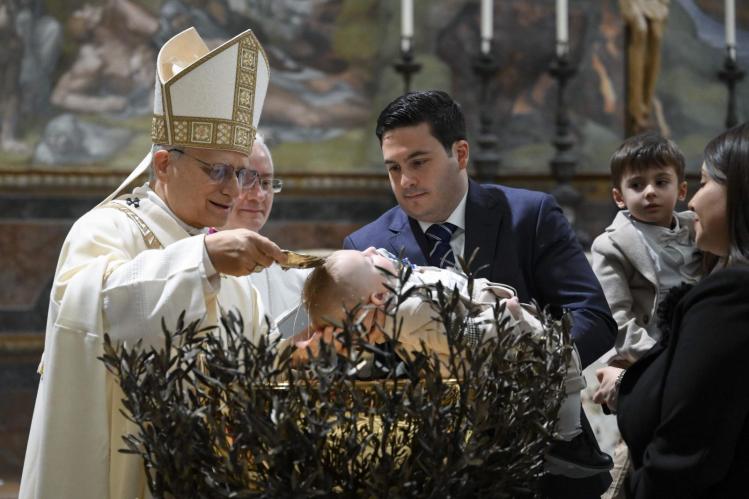
As I prepare to stand beside the baptismal font as a godparent, I know my “yes” is a concrete promise to help my friends form a child who will hold both a passport and a baptismal candle, who will belong to a nation and to the Church. To accompany him in his faith is to teach him to listen to the voice that names him beloved, and to the Christ who calls us to love without borders. My prayer this Lent is for the courage, wisdom, and communal discernment to answer that call and live out fully the command, “listen to him.”