Two weeks ago, on the fourth Sunday of Lent, I found myself in a classroom in St. Patrick’s Cathedral in El Paso. It felt like an impromptu church: mismatched chairs, the sharp aroma of stale coffee, and a group of people gathered to share food and stories. That morning, we ate Whataburger burritos and listened as a bishop, migrants, nuns and even a former immigration agent offered an unvarnished account of our nation’s moral crisis.
The group was small, but global: a Guatemalan father and his teenage son, a Brazilian mother cradling an infant, a woman who had fled corrupt agents in Ciudad Juárez. On a projected screen, others joined via Zoom from New England and South America. All had spent time inside the expanding U.S. detention network. The gathering was the result of an act of pastoral solidarity: Bishop Mark Seitz of El Paso had invited those who had been detained and deported to speak and be heard.
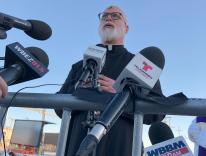
Seitz opened by apologizing for the United States’ mass deportation campaign, saying it did not reflect the nation he knew. He said he was there to listen—not to judge, but to learn from the victims and survivors of a brutal, dehumanizing system.
You might like: St. Óscar Romero on the political dimension of Christian love
One by one, the victims and survivors spoke. On the screen, a middle-aged man in New England recounted months of isolation inside Camp East Montana, the sprawling immigrant detention center on Fort Bliss, headquartered in El Paso. He spoke of the grinding monotony of confinement, days that blurred together, and the strange grace that accompanied his unexpected release: the reunion with his wife, the tears, the rediscovery of home and family after an ordeal that had nearly extinguished both. The emotion in his voice was matched by his wife’s, who described him as the family’s center and spiritual leader.
Others were less fortunate. Video calls included people who had been deported back to countries they’d fled. Their voices resounded with pain, trauma, and bewilderment, but also with stubborn dignity. One young woman in her twenties described the fifteen months of detention that followed her voluntary surrender to authorities. Officers refused her repeated pleas for medical help—they dismissed her illness as fraudulent—until she finally collapsed. She had a blood clot that required emergency surgery. Now back in South America, she spoke through tears of the urgency to reclaim her story—to say that what happened to her was real and that naming it mattered.
Sitting in the classroom with his son, the Guatemalan father offered a testimony focused on resilience and family. He’d arrived in El Paso with legal papers, but soon found himself detained, stripped of his documents, and left alone in front of a church on a rural Texas road. It was, he said, like being summarily returned to the start in the board game Monopoly, only without money or a job. Despite his weariness, he found consolation in his reunion with his son.
Following the opening of Camp East Montana last summer, Bishop Seitz began ministering to detainees at the prison, visiting them and celebrating Mass. There, a fragile parish formed, and the classroom became an extension of it. Belonging, participating, sharing—that, and not detention, was what mattered. Many of those present in the room and on the screen had celebrated the Eucharist with Bishop Seitz during their detention at Camp East Montana.
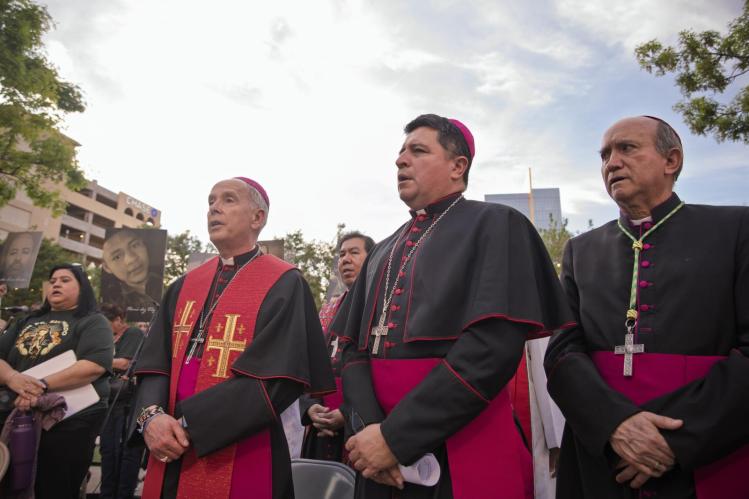
After breakfast, we processed into the Cathedral for Mass. Following Communion, Seitz signed a pastoral letter condemning the current campaign of mass deportations. He spoke plainly about the neighbors snatched outside courtrooms; workers taken from construction sites; young women languishing in private detention, their mental health eroded by isolation. He also noted the growing number of deaths at Camp East Montana. He declared that conscience, not mere compliance, must guide those who enforce unjust policies. Seitz’s words reminded me of St. Óscar Romero’s prophetic challenge, spoken during his final Sunday Mass, to the military, police, and government agents in El Salvador:
Brothers, you come from our own people. You are killing your own brother peasants…. No soldier is obliged to obey an order contrary to the law of God. No one has to obey an immoral law. The Church, the defender of the rights of God, of the law of God, of human dignity, of the person, cannot remain silent before such an abomination.
When Bishop Seitz finished, most of the assembled church stood and applauded. I noticed that a retired ICE agent seated near the front did not clap. He was crying. He said he identified as a witness of conscience, recognizing in the bishop’s words a truth he could no longer ignore.
Contained in that man’s tearful silence was a deeper affirmation: faith can awaken conscience across political divides, demanding repentance and repair. Becoming a faith community, Bishop Seitz suggested, means allowing the faces of the displaced to enter our liturgies, our Lent, and our civic imagination. It requires us to refuse silence in the face of suffering and to insist that mercy be not merely private piety but public practice.
We welcome your comments about this article. Please send your response to [email protected].