I have sat tearfully through the final credits of many films in the comforting dark of The Neon—Dayton’s arthouse cinema. But never before have I openly wept with everyone else in the theater. Others who have seen The Testament of Ann Lee report the same experience.
A biopic of Mother Ann Lee, the leader of the “United Society of Believers in Christ’s Second Appearing,” commonly known as the “Shakers,” is an unlikely project. The film’s writers have spoken about the difficulty of crafting an elevator pitch for a musical based on songs and dialogue from the writings of an eighteenth-century religious sect. The Shakers strived for millenarian perfection: creating a celibate, pacifist, socialist community that practiced gender and racial equality. Today they are remembered for graceful furniture design, “naïve” celibacy, and a dubious legend about Ann’s invention of the circular saw. Aaron Copeland and Martha Graham played the Shaker hymn “Simple Gifts” as a motif of American innocence in Appalachian Spring. The Shakers’ theologically rich images, such as Hannah Cohoon’s Tree of Life, adorn scarves in the kind of catalogues sent to public-radio subscribers.
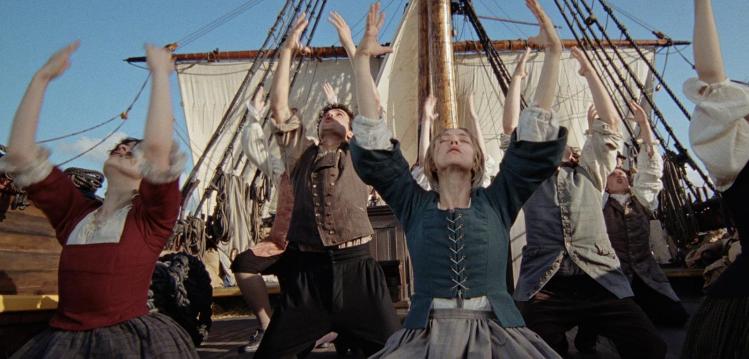
The Testament of Ann Lee opens in far less domesticated territory: dancing figures emerge from the mist, their movements inscrutable and discomfiting, their breathing rhythmic and sharp. It is not clear where the scene is going. The film’s director, Mona Fastvold, describes the choice to make Testament a musical (although she isn’t sure it qualifies as one) as an attempt to honor the Shakers’ form of life. Daniel Blumberg’s soundtrack and Celia Rowlson-Hall’s choreography are as central to the film as its plot or dialogue. The musical form lends a liturgical frame to a biopic that might otherwise collapse into voyeuristic sensationalism. Early Shaker worship is portrayed as a disorienting blend of Georgian propriety and religious frenzy: the characters pray and confess sin with breaths and moans that verge on the orgasmic. Their individual movements and vocalizations coalesce into and emerge from communal rhythms.
The pre-released songs from the film’s soundtrack are tellingly safe. “Hunger and thirst” reworks a Shaker hymn in the mode of contemporary praise-and-worship music. “Woman clothed by the sun” sounds like Christian alt-folk. Both are beautiful and compelling, but conventional. The rest of the soundtrack is strange, disturbing, and far more powerful. Blumberg’s setting of “I never did believe” conveys the disorienting power of Shaker worship in a way utterly unlike contemporary praise music. The scene takes place in a British manor, where members of the Wardley Society—the group from whom the Shakers emerged—have gathered. The music begins with eerie string saws, cries, and rhythmic moaning, out of which emerges a quavering Georgian tenor singing “I never did believe / that I ever could be saved / without giving all to God.” Rowlson-Hall’s choreography captures the interplay of freedom and order in this raucous worship in which the “Shaking Quakers” (as they were mockingly called) move in individual ecstasy and flow together into swells, surrounding and lifting up those who cry out the refrain. After three days of this, constables arrive to break up the gathering and drag Ann away. The sequence ends with Ann (played by Amanda Seyfried) bloodied, in prison, singing the final verse: “So I freely give the whole / My body and my soul / To the Lord God, Amen.”
I watched Testament a few days after ICE agents had killed Renée Good and Alex Pretti. That week, Bruce Springsteen released the “Streets of Minneapolis” and Tom Morello performed “Killing in the Name” in Minneapolis, shouting with the crowd “Fuck you, I won’t do what you tell me!” Grief and outrage were in the air. But it was Seyfried’s voice singing the Shaker verse of total commitment that echoed in my head that week, more powerfully illuminating the demands of our dark moment than those protest songs.
Ann’s body—violated and ill, in labor and in ecstasy—is at the center of the film. Her revulsion against “fleshly cohabitation” is portrayed from early childhood. Ann marries Abraham Standerin, a Quaker blacksmith who brings a libertine novel with pornographic woodcuts into their bedroom for use as a marital manual, lauding the book for its “unrelenting attack on the traditional clergy.” There follows a series of four awful conceptions, labors, and infant deaths. If Ann is portrayed as barely consenting to Abraham’s sexual impositions, she is active in motherhood: laboring through exhaustion and hemorrhage, expressing milk in a desperate attempt to nourish an infant too ill to nurse, clinging passionately to her stillborn child. Seyfried (with the aid of a dizzying array of prosthetics) appears naked throughout these excruciating scenes.
Some have criticized this portrayal of overwhelming trauma for reducing Lee’s faith to a compensation for suffering and loss. But something far more interesting is going on here. Blumberg’s setting of the Shaker hymn “Beautiful treasures” combines a nursery tune, which we first hear hummed by Ann’s mother, with what sounds like a horror soundtrack. Love and grief are mixed with tension and dread. Ann’s sexual subordination and heroic yet futile struggle to give life to her dying children are interspersed with scenes of ecstatic freedom and sisterly support as she dances in worship with the Shakers. The bridge of the song—and climax of the sequence—is a grief-stricken wail, not of madness but of Ann in labor. The film is founded on this interplay of motherly love and death, bodily vulnerability and fierce resolve.
Fastvold has said that she does not share Ann Lee’s faith but found herself “moved deeply” by her “implausible” prophecies. Her statement that Ann took “horrible trauma and turned that suffering into compassion, into community, into how she could mother the world” reads, at first glance, like artist-statement speak. But her film—by means of drama, music, and dance—conveys this connection with the utmost seriousness and power. Ann’s cry of labor returns later in the film, this time ecstatic, ferocious, and unbound: opening the sequence “Building and Growing,” where the Shakers dance in the sunlit warmth of a beautiful Shaker barn. Seyfried’s wailing visage in this scene provides the cover image for the soundtrack album.
The connection between natural and spiritual motherhood, between childbirth and spiritual labor, is true to the historical Ann Lee. While it is unclear whether she considered herself to be the second incarnation of Christ, she definitely did consider herself to be “Mother.” If her experience of reproductive loss was behind her condemnation of lustful “natural generation,” it’s also true that she repeatedly used words such as “labor” and “travail” to describe her spiritual struggle and her ministry to “birth” children into “regeneration” in Christ. As her later followers wrote:
Ordained of God…to be the first Mother of all souls in the regeneration, she had, not only to labor and travail for her own redemption, through scenes of tribulation, and to set the example of righteousness, and mark out the line of self-denial and the cross for her followers, but also to see and feel the full depth of man’s loss, and the pain and judgment which every description of lost souls were under. Hence she was destined to pass through inexpressible sufferings for their redemption.
In his history of the Shakers, Edward Deming Andrews argues that the sect’s first converts found in its demanding perfectionism a surprising respite from anxiety about the uncertainty of salvation that roiled the Great Awakening. Mother Ann and the Shakers insisted that we could live sinlessly now. This millenarian perfectionism is manifest in the revered craftmanship that continues to bear witness to the Shakers’ religious vision long after their numbers have declined.
The film telescopes decades of Shaker history into Ann’s lifetime. Filmed on location at Hancock Shaker Village, the sequences of life in the first Shaker settlement at Niskayuna are set amid the glories of the Shakers’ golden age: beautiful architecture, joinery, woven chairs on peg rails, an eight-sided woodstove for the efficient heating of irons in a communal laundry. Ann’s aphorism, “Do all your work as though you had a thousand years to live, and as you would if you knew you must die tomorrow,” is voiced by the narrator. Ann’s reference to a “thousand years” here is theologically precise, meaning not simply a very long time, but the inauguration of the Christian eschaton.
The cultlike order of a community centered on Ann’s charismatic leadership is conveyed in uncomfortably joyous and placid harmonies: “I love mother / I love her way / I love her gospel / precepts to obey.” Floors are swept, wood is planed, food is served, and the children of recently converted families are told they all have only one “Mother,” Ann.
The Shakers’ pacifism was considered seditious during the Revolutionary War; their celibate sexual equality was no less scandalous. They suffered violence for both. The film condenses years of mob violence into one harrowing scene with startlingly paschal resonance. A mob attacks a Shaker meeting seeking Ann, who exhorts her followers to nonviolence as she is dragged out. Her brother William is bound and scourged while Ann is beaten and stripped in a violent gender scrutiny.
The final sequence of the film opens with an unfocused shot of the sky through the leaves of a tree that resolves to Ann sitting in an orchard at the end of her life, muttering in tongues and retelling the Parable of the Sower in terms of apples. The Shakers were guided from England by a vision of a shining tree that they understood to be the church they would plant in America. In Hannah Cohoon’s iconic painting (which the film places on the wall of the meeting house), it became the flaming Tree of Life. Ann sits in the new Eden, the Shaker community a living embodiment of her belief that salvation is possible—here and now.
Ann’s Shaker children enact this in the deeply moving final moments of the film. Singing “Beautiful treasures” again, this time as a joyous funeral song, they lovingly wash Ann’s body and tenderly join and upholster her casket to cradle her in death. Footsteps echo throughout this sequence; they are revealed to be the sound of the Shakers dancing together in the ordered harmony of their later liturgical style.
Ann’s truest testament was the Shaker community’s practice of care across the boundaries of kinship, gender, and race. To appreciate how radical their achievement was—and how much ahead of its time—consider that they accomplished these things under the leadership of an illiterate woman during the very period when the drafter of the Declaration of Independence, a learned product of the Enlightenment, was raping an enslaved teenager.
Seyfried’s powerful performance in Fastvold’s film gives voice to Ann now amid the rise of an exclusionary Christian nationalism, when pious politicians attempt to justify violent deportations with platitudes about the limits of love, while ordinary people risk their lives in the streets to care for those who are not their kin but are nonetheless their neighbors.