By the time you read this, I will have celebrated my sixty-third birthday in the company of my loving wife of nearly thirty-four years as well as my grown daughter and her partner. I am, knock on wood, in relatively good health, and I have gotten to a point in life where I am fully engaged in pursuits I am passionate about: writing, teaching nonfiction writing at the college and graduate levels, and making visual art. I am, in other words, a very lucky man.
But sixty-three is sixty-three. I am excited for what’s ahead, but there is more behind me. I am, of course, fortunate to have made it this far. But to reach a certain age is to become keenly aware of the passage of time, to wonder how much of one’s time remains, and to contemplate the time already spent. Those ideas inform a number of the works in Color and Mystery, my show at New York City’s Blue Mountain Gallery, on view until April 18.
I have sometimes said that as a painter I make a very good writer. This is not to disparage my own abilities as a visual artist (at least not overly so), but to suggest that the themes in my paintings and drawings are as much literary as visual—and what subject is more literary than the passage of time? That said, the inspiration for the works is visual as well. The segmented work of a painter from a different era, the Uruguayan-born Joaquín Torres-García (1874–1949), had a direct influence on several of the twenty-five pieces in my show. The result of all of this together can be seen in a few of the pieces in particular:
Time. As the squares and circles in Torres-García’s signature works usually frame symbols related to the artist’s life, the fifteen colorful segments in Time each contain one image of the same male as he passes from boyhood to old age. Both the first segment and the last are black, suggesting a life as, in Nabokov’s words, “a brief crack of light between two eternities of darkness.”
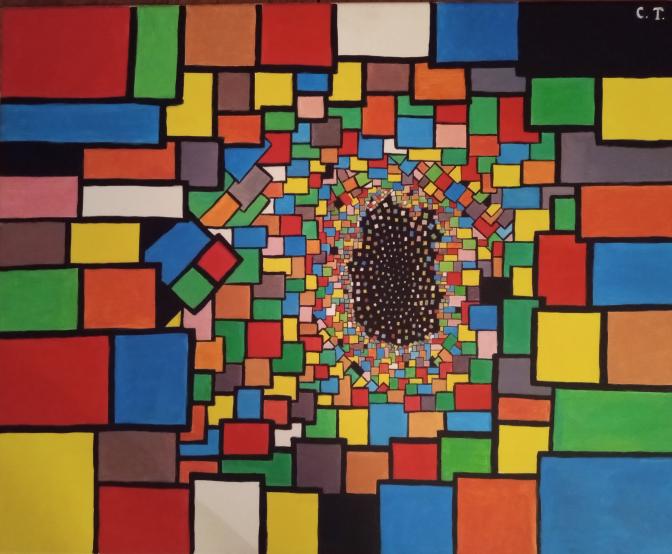
Life. The segments here, containing only color, are arranged with the largest around the periphery of the painting, the others decreasing in size as the eye moves toward the center, where the very smallest segments, separate now, fall into blackness. The painting represents the way I see life: as an experience of great variety and ever-increasing minutiae, progressing toward the heart of its central mystery.
My Body. The segments here each frame a part of a man’s body; the focus on the individual parts suggests the body as an object, one that is part of us and yet separate from us, as indeed it one day will be—hence the entirely white segment on the lower right.
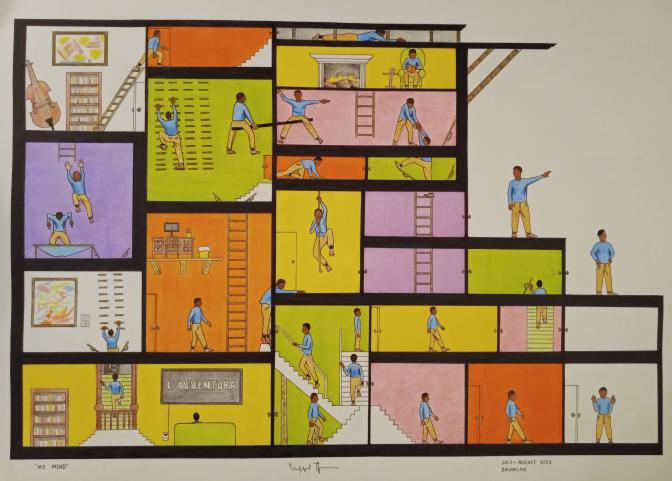
These works are not necessarily laments over time and death’s approach—only acknowledgments—and those are not the only subjects in Color and Mystery. The painting Life contemplates exactly what its title suggests, and other pieces in the show do that as well. The ten segments in Apartment House are—yes—apartments, their inhabitants’ actions conveying love, friendship, creativity, family, boredom, loneliness, and celebration, as well as life’s inevitable end. My Mind, a counterpart to My Body, shows twenty-seven identical, curious (in two senses of that word) human figures in different parts of an oddly constructed dwelling, in constant or near-constant movement—climbing, descending, or wandering, passing parts of the structure that symbolize visual art, music, film, or literature. Whereas Apartment House and My Mind suggest activities happening simultaneously, The Center of My Life traces actions sequentially, each of its twenty-five panels capturing a moment in the day of the central figure, who is a family man and office worker. That drawing is the most autobiographical of the works in Color and Mystery, in two ways. First, it depicts a period that was both the chronological and emotional center of my own existence, when I managed a staff in an office, pulled out my notebook during lunch each day to write fiction or essays, and came home each evening to my wife and young children; and second, it is the only work in the show that resembles a page of comics—and thus represents a return to the first art form I ever embraced.
As a young boy growing up in Washington D.C. in the early 1970s, I found two kinds of treasure in my family’s basement, where my older brother lived: his collections of Charles M. Schulz’s Peanuts comic strips and his Superman comic books. I later left behind Superman for the Marvel heroes—Spider-Man, The Fantastic Four, and the rest—because of what those superheroes had in common with Charlie Brown, i.e., vulnerability.
I was inspired, first by Peanuts and then by Marvel, to make comics of my own. My strip “Jerome,” which debuted when I was eight, was essentially Peanuts with a darker-skinned main character and punch lines that must have once made sense to me. The Christmas when I was fourteen, my family gave me the wonderful gift of a wooden drafting table, which I placed between the dining and living rooms of our small, semidetached house, and where I was to spend hundreds upon hundreds of evenings hunched over as I drew. At fifteen, sitting at that table, I created “The Telstar,” which was very much like a Marvel series, if you ignored the wildly disproportionate body parts of its earliest stories. As I reached my upper teens, the quality of the drawings grew, along with my realization that—in those years before the explosion of graphic novels of many different styles—said drawings would most likely not, despite my long-held dream, get me hired at Marvel.
But that was okay, because I was also moving toward the decision that I was really a writer. The theme of the vulnerable, confused young man, which I had found so compelling in Peanuts and Marvel and also discovered in J. D. Salinger’s novel The Catcher in the Rye and Mike Nichols’s film The Graduate, informed my early efforts at fiction, which carried me through my years at a liberal-arts college in the Midwest. In my late twenties and early thirties, my focus shifted largely to essays, which began to appear in literary journals, their subjects and themes including family and so-called race as well as the art forms close to my heart—literature, music, and film—sometimes in combination.
Still, the other half of the original drive to create comics—the visual-art impulse—had not died. It came back in the form of intermittent bursts of painting, which began to flower again beginning in my mid-forties. After dinners in our family’s Brooklyn apartment, I would convert our dining room table into a studio, with scraps of wood bound together by twine initially serving as my easel. That method got an upgrade one Christmas, when my wife gave me an honest-to-goodness easel, the greatest gift I had received since the drafting table of my teen years. I joined Blue Mountain in 2020 and mounted my first solo show there, Painting Story—a name inspired by the narrative elements in a lot of the pieces—in 2023.
Meanwhile, the writing and visual art compulsions had a reunion. The graphic novel Big Man and the Little Men, which I wrote and illustrated, appeared in 2022. Last year, the online magazine Cleaver began publishing my pseudonoir graphic narrative series Connecticus Diggs, Cultural Detective. In these stories, walk-in clients from all walks come to the office of the middle-aged, paunchy, balding, fedora-sporting Connecticus—Connie to his friends—with their problems, for which the detective, as often as not, finds solutions in his ever-growing knowledge of literature, film, and music. The episodes of Connecticus, which tend to run between six and eight pages, usually contain an emotional as well as an intellectual component. The series as a whole represents, for me, a culmination of decades of my own efforts to learn as much as I could about the aforementioned art forms—as well as my observations about people, the kind we have all made simply from having reached a certain point in life.
A perpetual challenge in drawing Connecticus is figuring out how much to write in a given panel and how much can be understood from a drawing and the reader’s own intelligence and observation. Sometimes words are superfluous; an image is all you need.
Most of the works in Color and Mystery are not segmented, and in many, the mystery is concrete rather than existential. Pondering the paintings of lone figures, including Day Fades, Late in the Day, and Man in Hat Looks Backstage, one may ask: Who are these guys? What are they doing? It is my hope that viewers will bring their own imaginations and experiences to interpreting the works. That is true of other pieces in the show as well. Seeing paintings with two figures, such as On the Waterfront and Scarlet and Black, the viewer might wonder: Who are these two figures, and what are they to each other? Other paintings, such as At the Diner, Words in a Bar, and Up on the Roof, are populated with more figures of various skin colors and implicitly ask the heartfelt question put to us decades ago by an exasperated Rodney King: Can we all get along?
While most of the works in Color and Mystery are representational, some, like Life, are abstract. Growing Up is my attempt to visually convey the process of the title; the blocks of colors at the base of the painting stand for themes that are prominent as a person’s life begins, only to become more complicated as the person ages, multiplying and combining with other colors (themes) as our eye moves up the painting; at a certain point, however, those themes become simpler again, as priorities emerge, or re-emerge, in later life. Life of a Nation from the Bottom Up is the societal equivalent of Growing Up; this black-and-white work shows the growing pains of a nation as its ideological factions clash. State of the Union, comprising five colors, is a different take on the various parts of society and how they interact.
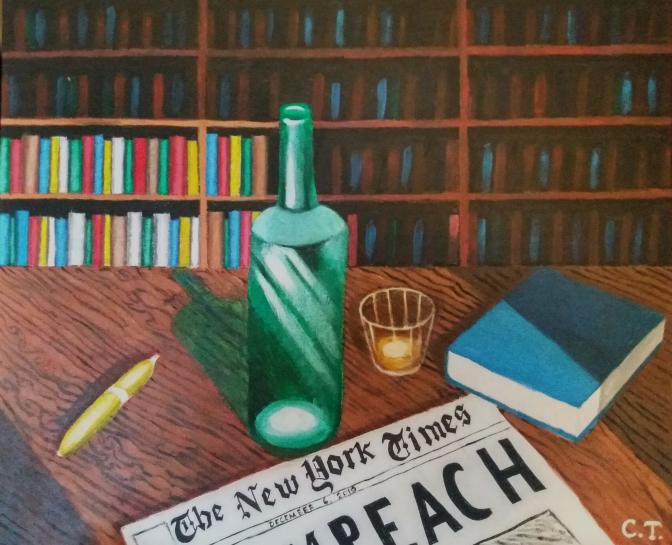
Two still lifes hang side-by-side. Sign of the Times contains a nod to our current political era. The Elements has symbols of artistic pursuits that are important to me, including jazz and writing; the watch near the center suggests—to return to the theme at the beginning of this essay—an awareness of the time left to enjoy these things. That theme of time and mortality, our shared and ultimate vulnerability, also animates the most recent work in the show, Toward Oblivion, which is unusual among my paintings for having both representational and abstract elements. What I seek to convey through it is a desire to resist the ceaselessness of time and where time’s passing eventually leads; I feel it is possible both to accept, intellectually, the inevitability and rightness of constant change and to want, on a gut level, to reach back toward life.
That work perhaps exemplifies one difference between writing and painting. As a teacher of creative nonfiction writing, I continually tell my students that it is not enough to chronicle events or to explain a situation, because what the reader ultimately wants is for us to make some sense of those events and situations, to convey what they mean to us. My approach to painting is different. Painters apply such skill as they have to attempting to capture a scene, a feeling, a moment, a truth, perhaps—as I have expressed here—with intentionality, but, in the end, with the understanding that viewers will take it from there, supplying their own meaning, determined mainly by who they are and what they see.