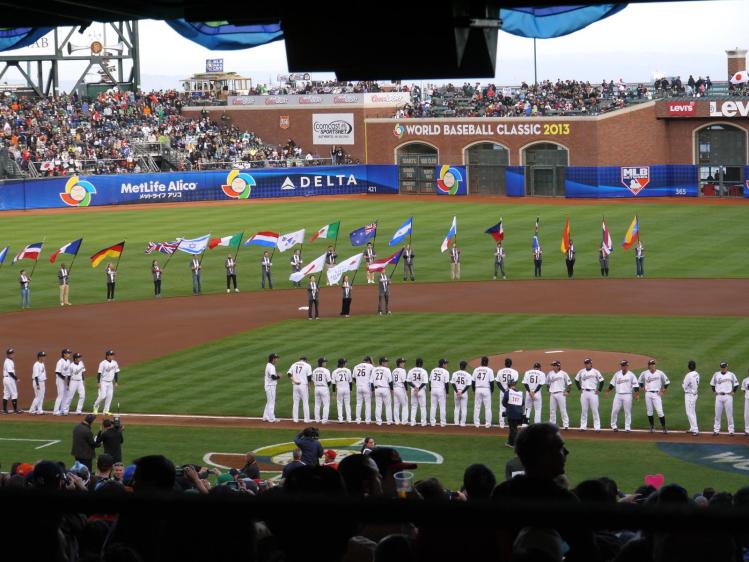
In this 250th anniversary year of U.S. independence, Opening Day of our national pastime is March 25. But before that, March 5–17, baseball fans are getting to enjoy the sixth World Baseball Classic. This coincidence offers a timely opportunity to explore what the “All-American Game” means in our current geopolitical climate.
Begun in 2006, the World Baseball Classic (WBC) is an international tournament featuring professional ballplayers competing on national teams. This year, there are twenty qualifying teams representing eighteen nations and two “independent sporting nations,” Puerto Rico and Chinese Taipei. While initial rounds are playing out in stadiums in Tokyo, San Juan, Houston and Miami, the final rounds are scheduled to be held on the U.S. mainland. Whether international athletes and fans will be willing to come to the U.S. venues as the mercurial Trump administration escalates hostilities and fosters xenophobic violence remains to be seen.
But who gets to claim baseball as “theirs”? A look at the teams that qualified for the first round or pool stage challenges presumptions about exactly whose national pastime baseball really is. Searching the rosters of each national team for MLB players—who gets to represent each country and on what basis—raises further questions about exactly what constitutes citizenship.
The history of baseball as an international sport begins earlier than many fans may realize. From the 1860s on, baseball was growing, especially in countries bordering the Caribbean Sea, and Cubans were credited with being los apóstoles del béisbol. The first Latin American to play professionally in the United States was the Cuban Esteban Bellán with the Troy, NY, Haymakers in 1871. He picked up baseball as a student at St. John’s College in the Bronx, now known as Fordham Prep and Fordham University, where he excelled in both his studies and the sport. Upon returning home, Bellán was instrumental in the promotion and development of baseball on the island. Ironically, at the time, baseball was perceived as resistance to Cuba’s colonizer, Spain.
Returning students, including others from Fordham, proved foundational in establishing baseball in Venezuela and Nicaragua as well. A descendant of one of those pioneering students, historian Jorge Eduardo Arellano, explained his motivation for chronicling the sport in his classic tome El Beisbol en Nicaragua (Rescate histórico y cultural 1889-1948). He wanted to demonstrate “que los gringos nada tienen que ver con la introducción del béisbol en Nicaragua”—that the gringos had nothing to do with the introduction of baseball. By claiming baseball as part of their own national story, Arellano sought to establish the earlier provenance of the sport with Nicaraguans, not a later U.S. invasion.
Even so, it cannot be denied that baseball accompanied the U.S. military in its territorial expansions, invasions, and occupations in Latin America from 1846 to 2026. The troubling history of U.S. interventions in las Americas is visible in the list of WBC 2026 qualifying nations: nine of the twenty competing countries—México, Colombia, Cuba, Puerto Rico, Dominican Republic, Nicaragua, Venezuela, Panama, Brazil—have experienced interventions by the U.S. military. Beating teams from occupying forces at baseball also became a kind of creative resistance to U.S. occupation and colonization, which found expression through distinctive styles of play. At the same time, these béisbol-loving nations developed professional leagues that attracted players from the major leagues and Negro Leagues, especially in the off-season. These deep roots help explain why the overwhelming majority of today’s MLB players from outside of the fifty U.S. states hail from Latin America.
U.S. imperialism also thrived on commercial ventures, spreading baseball even further. In 1888–9, former baseball player, team owner, and sporting-goods entrepreneur Albert G. Spalding assembled a group of U.S. National League players for an international barnstorming tour. The point of the World Tour of Base Ball was the promotion of the sport, as well as Spalding’s sporting-goods company. In his book Ambassadors in Pinstripes, historian Thomas Zeiler described the tour as Spalding “selling America to the world during a working vacation.” Citing the first WBC in 2006, he concluded, “Globalization brought baseball players to American shores to play the national pastime while sixteen nations took part in the first truly world series in March 2006. Unlike the fabled Casey, Albert Spalding did not strike out.” Three of today’s twenty WBC national teams come from stops on that tour: Australia, Italy, and Great Britain.
On the twenty-fifth anniversary of Spalding’s tour, Charles Comiskey and John McGraw took the Chicago White Sox and the New York Giants on a similar world tour in 1913–4. The expanded itinerary included nations in Asia—reflected in the 2026 WBC with the presence of Japan and Chinese Taipei.
For the U.S. tourists traveling the globe on the cusp of World War I, the discovery of the pervasiveness of baseball in Japan was a surprise. Once again, it was students who had popularized the sport. Masaru Ikei, author of Yakyū to Nihonjin (Baseball and the Japanese People) explains how baseball was introduced in 1873 by U.S. educators like Horace Wilson, who taught at Kaisei Gakkō, now Tokyo University. Relatively unknown, even to his own descendants, Wilson is enshrined in the Japanese Baseball Hall of Fame. The sport spread from school teams to “a national obsession,” so much so that the barnstormers were met with crowds and knowledgeable sportswriters, and they played Japan’s best team: Keio University students.
At this year’s World Baseball Classic, the number of athletes playing for teams other than their own is striking. WBC defines eligibility in terms of a player’s ability to qualify for citizenship in that country: on the basis of actual citizenship (verified by a passport), birth, residency, heritage, or marriage. This is an expansive concept of citizenship and representation, one in which a person can have multiple claims to belonging. It’s also a marked contrast to the Trump administration’s restrictive view of what qualifies one as a citizen—perhaps not even birth, if the birthright citizenship case goes the administration’s way. The U.S. team is made up entirely of players born in the United States. But many U.S.-born players in the tournament are playing for other teams: they make up 97 percent of Israel’s team, 80 percent of Italy’s, 77 percent of Great Britain’s, and 43 percent of México’s. Colonial histories peek through in the compositions of the teams from the Netherlands, where 77 percent of the players were born in Aruba or Curaçao, former Dutch colonies; and Great Britain, where 20 percent hail from the Bahamas. The participation of team Puerto Rico under the euphemism “independent sporting nation” hints at the conflicted colonial relationship between the Commonwealth and the United States.
“El béisbol es casi religión.” Baseball is nearly religion, proclaimed a digital billboard, one of a series of messages projected at Bad Bunny concerts during his 2025 residency in Puerto Rico. The sign commemorated the 2017 WBC, when “Puerto Rico derrotó a EE.UU.” That victory over team USA propelled the Puerto Ricans into the semifinal round and eventually the finals, where they faced team USA again, only to lose the championship game.
His appearance at the NFL Super Bowl notwithstanding, El Conejo Malo es un fanático de béisbol. Across the songs in his 2023 album Nadie Sabe Lo Que Va a Pasar Mañana, nine MLB players are named, Roberto Clemente among them. The Pirates star, who died tragically in 1973 on a humanitarian mission, also makes an appearance at Bad Bunny’s 2023 Grammy performance as one of the Boricua legends represented as cabezudos, disproportionately large papier-mâché heads typically found at parades and fiestas. In his 2025 opening track NUEVAYoL, New York baseball gets a shoutout via MLB All-Star Juan Soto, who played for the Yankees and is now with the Mets. For the 2026 WBC, Bad Bunny gifted team Puerto Rico with player-exclusive baseball cleats inspired by his signature Adidas shoe. For this Puerto Rican artist, baseball is not only culturally embedded both at home and in diaspora; it is resistance performed, worn, and retold. Even a single victory over the colonial power is worth remembering and celebrating on a billboard.
In this U.S. semiquincentennial, the WBC may well be a twenty-first-century iteration of the previous world tours, with promotional and commercial outcomes. But it may also serve as a link to far more compelling stories: where Cubans were los apóstoles del béisbol and students at play shaped a global phenomenon, where defeating a colonizer is akin to a religious experience and citizenship affirms multiple belongings.
Pool play began in Tokyo on March 6 with Chinese Taipei facing Japan. Shohei Ohtani hit a grand slam and came up a triple shy of the cycle. There in the crowd, sporting a team Puerto Rico cap, Bad Bunny bore witness.
We welcome your comments about this article. Please send your response to [email protected].