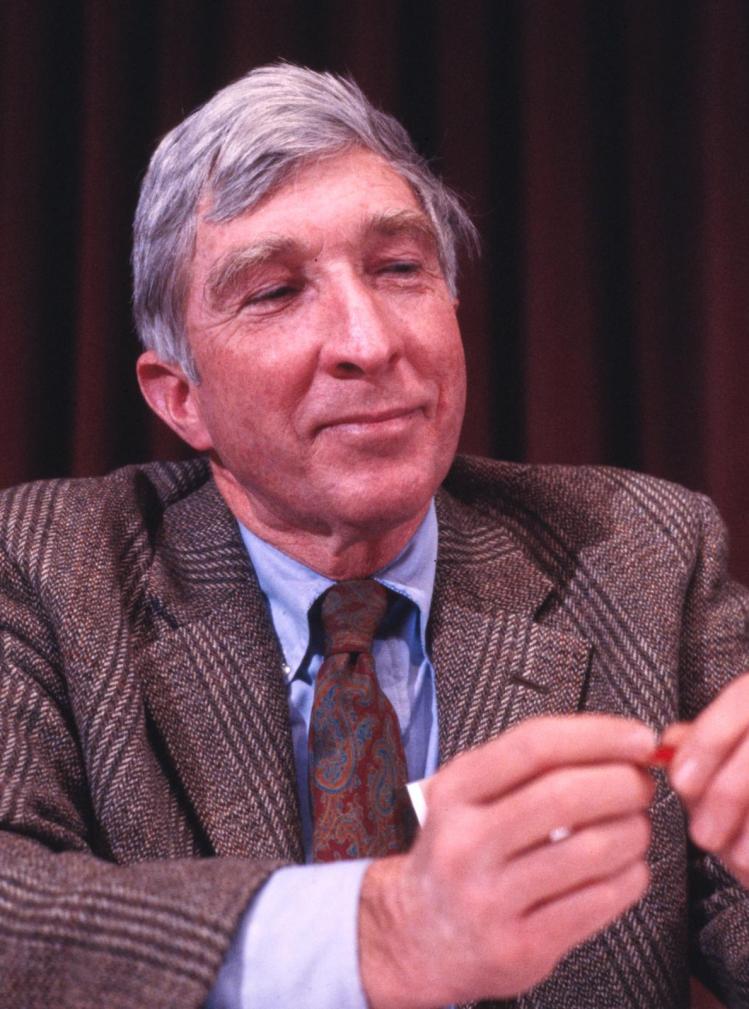
I recently read the Selected Letters of John Updike, which was published in October. My wife thought the title was one of the funniest things she’d ever seen, since the book is more than nine hundred pages long. In his introduction, the book’s editor, James Schiff, estimated that the notoriously prolific Updike (1932–2009) wrote more than twenty-five thousand letters or postcards, in addition to his many books of fiction, criticism, and poetry. He wrote as effortlessly as most of us breathe and much of what he wrote attempted to capture what is ineffably precious as well as intangible about life. In a famous passage from the story “Pigeon Feathers,” the young protagonist, David, is sent to the family’s barn to shoot some bothersome pigeons. With a sense of wonder as well as loss, he examines the dead birds with their beautiful feathers, and is overcome with the certainty “that the God who had lavished such craft upon these worthless birds would not destroy His whole Creation by refusing to let David live forever.” Updike seemed to harbor the same hope.
After reading the bound galley of the letters for a review I was writing, I went to our local bookstore looking for a finished copy (I wanted to see the photographs that were not included in the galley). I searched the extensive fiction section and discovered that they did not have a single novel or story collection by Updike, who was once a bestselling author. When I asked at the information desk if the store had a copy of the Selected Letters, it was clear that the twenty-something woman behind the counter had never heard of him. I understand why someone in their twenties might not have heard of Updike, but I was shocked that someone working in a bookstore was unacquainted with one of America’s most esteemed novelists and man of letters. Updike won many of the most prestigious literary awards, including two Pulitzer Prizes for Rabbit Is Rich (1981) and Rabbit at Rest (1990), the third and fourth novels in his tetralogy about the American everyman Harry “Rabbit” Angstrom. Updike also won the National Book Award for The Centaur (1963), an ingenious mythological treatment of his father’s beleaguered life as a high-school teacher.
I’ve read quite a lot of Updike over the years, probably more of his criticism than his fiction. But one can read quite a lot of his work and still have read only a small fraction of it. For decades he was the principal book reviewer for The New Yorker, and his collected nonfiction runs to five massive volumes. I suppose the work of most writers is destined for oblivion, including the work of writers popular during their own lives. That seems especially true if their work is not included in high-school and college curriculums. The sexual frankness—some considered it pornographic—of Updike’s most famous novels and stories explains why high schools avoid teaching the books, despite their literary quality. He made a name for himself as a chronicler of 1960s and ’70s suburban adultery, especially in his controversial novel Couples (1968). When not hopping in and out of bed with other people’s spouses, his characters spend a good deal of time brooding over theological questions. Updike was an admirer of Karl Barth, the great Protestant theologian who famously wrote, “One cannot speak of God simply by speaking of man in a loud voice.” There is also some religion talk in the Letters, but a good deal more seduction of his various sexual partners. He remained a churchgoer, but one obviously comfortable with the idea that sin is unavoidable in a fallen world where God’s presence is felt intermittently at best. Reading Updike’s letters leaves one with the impression that for all his charm, wit, and intelligence, there was something intransigent and ego-focused in his personality, which undoubtedly was essential to his fearlessness and outsize ambition as a writer.
Updike grew up poor in southeastern Pennsylvania and went to Harvard on a scholarship. His freshman-year roommate was Christopher Lasch, the future historian and cultural critic, author of the bestseller The Culture of Narcissism (1979). Evidently it was a competitive and not always easy relationship. Lasch, a Commonweal contributor, became a stern critic of American consumerism, economic inequality, and moral drift, while Updike celebrated American affluence and its unprecedented personal freedoms. Updike’s story “The Christian Roommates” is reputed to be based on his relationship with Lasch. The Lasch character is piously preoccupied with social-justice questions, while the Updike character is perplexed and disoriented by his roommate’s concerns, social justice being peripheral to his own more personal and existential religious preoccupations. There are a couple of cordial if perfunctory letters to Lasch in the collection, but, curiously, no mention of Lasch’s death at the age of sixty-one. Similarly, the death from alcoholism of Updike’s son-in-law is remarked on in an almost clinical fashion. The novelist, critic, and former Commonweal editor Wilfrid Sheed once wrote that Updike “is not a humanist.” The letters bear that out, although that does not necessarily detract from Updike’s many attractive and challenging qualities.
As it happens, when I was an editor at Commonweal I received two postcards from Updike, neither of which is included in Selected Letters. We had sent him an issue of the magazine featuring an essay by Rand Cooper on the Rabbit Angstrom books (“Rabbit Loses the Race,” May 17, 1991)—a customary courtesy extended to the subject of reviews. It was a very positive assessment of the novels and naturally Updike was appreciative. Cooper had written that Angstrom’s religious aspirations seemed to largely dissipate in Rabbit at Rest. Updike demurred. “In the last book, God does seem to be less overtly present, and yet I found the hero’s rendezvous in Florida not without its transcendent comforts; he is drawing close to the source, and God perhaps is less an idea and more a presence at last.” He ended the postcard thanking Commonweal for printing a few of his poems decades earlier. I responded as any editor would—by asking if he might consider writing something again for Commonweal, but he graciously begged off, thanking me for “thinking I could do the job”(!). Perhaps he was joking.
One Christmas when our children were little, a former college professor of mine and his wife sent us a copy of Updike’s A Child’s Calendar (1965), charmingly illustrated by Nancy Ekholm Burkert. We cherish the twelve poems with their alternating rhymes, and I now read them to my grandchildren. I often pick up the book when I’m in the mood for the sort of unalloyed pleasure that only the perfectly turned phrase can deliver. The December poem ends with a familiar Christian expression of gratitude, a sentiment that pervades Updike’s work.
The shepherds wait,
The kings, the tree—
All wait for something
Yet to be,
Some miracle
And then it’s here,
Wrapped up in hope—
Another year!