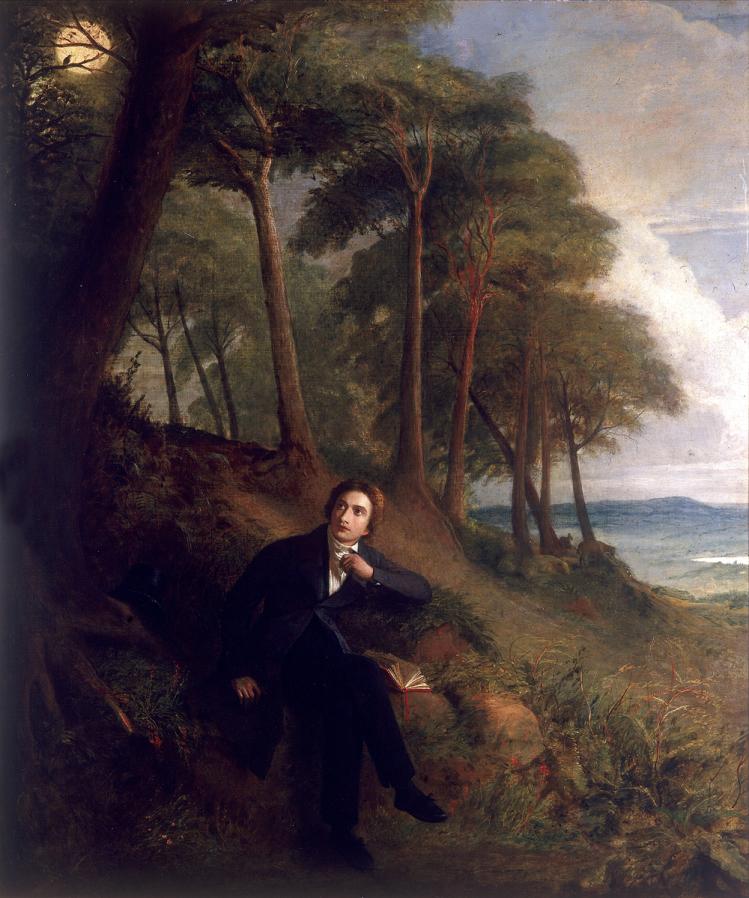
More than any of the other canonical Romantic poets, Keats still functions as an inspirational figure, and not only for writers. His unbreakable bond with youth culture was apparent in 1969, when Mick Jagger commemorated the death of Brian Jones by reciting lines from “Adonais,” Shelley’s elegy to Keats. The Keatsian aura is compatible with poetry that strays very far from his usually decorous subject matter. The American poet Diane Seuss, whose 2024 collection Modern Poetry includes “Ballad That Ends with Bitch” and other poems that trade heavily in what Keats calls “disagreeables,” is a devoted admirer, opening her book with a quote from Keats’s letters and ending it with a note of gratitude to “the Young English Poet who loved violets, and now sleeps beneath them.”
In his letters, which are as famous as his poetry, Keats interrogates his own sense of vocation, floats various definitions of poetry, divides poets into classes, and does other things that deceptively resemble literary criticism, philosophy, and even theology. Read chronologically rather than selectively, the letters, like most good letters perhaps, do not betray aspirations to a system of thought. At the same time, they give a strong impression of unity, which is only partly the product of a unique personality. Behind the over-discussed passages on “Negative Capability,” the “Vale of Soul-Making,” and other set pieces is Keats’s persistent worry about objectivity—or how poets, and by extension everyone else, should negotiate with the real world.
Keats envies earlier writers such as Milton and Shakespeare their exemption from this problem and finds fault with how certain contemporaries, above all Wordsworth, choose to handle it. Wordsworth closes the gap between mind and nature by proposing that the two “with blended might” are cocreators of reality. This solution appears not to have satisfied Keats, who is more alive to the pain of being handed back and forth between mind and reality. Wordsworth’s solution seems to Keats like either a form of quietism or a way of making everything about oneself. As he puts it in a complaint about Wordsworth, “For the sake of a few fine imaginative or domestic passages, are we to be bullied into a certain Philosophy engendered in the whims of an egotist?”
The letters start in 1816, when Keats at twenty-one was starting to rebel against his first literary mentor Leigh Hunt, whose solution to the problem of mind and nature was largely to ignore the former. The overripe aestheticism of the Hunt circle survives in many of Keats’s early poems and remains, even today, an option for artists. Another solution to objectivity, also rejected by Keats, was that of Byron, who combined self-conscious worldliness with adulation of Alexander Pope and other poets of brilliant surfaces. Finally, though he regarded himself as a liberal, he refused politics as a way to connect his poetry with reality, a solution he felt Shelley had adopted too readily.
Having rejected these ways of saving poetry from irrelevance, he was thrown on his own resources, which he sometimes doubted. “I am three and twenty with little knowledge and middling intellect,” he wrote to a friend in 1819. This did not stop him from trying to bridge the gap between mind and reality by constructing his own mythology. He was well in advance of T. S. Eliot, who, in praising Joyce’s Ulysses, recommended myth not as a guide to reality but simply a “method” of organizing it. “Instead of narrative method,” Eliot wrote, “we may now use the mythical method,” which he called “a step toward making the modern world possible for art.”
The notion of myth as an organizing tool for writers with no meaning beyond their work also failed to satisfy Keats, who is often associated with the beginnings of “art for art’s sake.” The sharp, almost dangerous clarity of his images made him attractive to modern poets and even New Critics who found the other Romantics vague or insufficiently pictorial. The notion of Keats as a thoroughgoing aesthete, however, is flatly contradicted by many of the letters, including the famous one in which, with no obvious literary agenda, he opposes “the Christian religion” with his view of the world as “the Vale of Soul-Making.” The pure aesthetes of the late nineteenth century are mostly forgotten, while his attempt to forge a vantage point beyond poetry is one of many things that keep him alive.
Like his hero Shakespeare, Keats is a fairly dark writer. He is drawn to morbid subjects but swayed, unlike Seuss and other contemporary followers, by conservative formal instincts in handling them. He is more decorous than Shakespeare; if this weren’t the case, he wouldn’t have been a Victorian favorite. Unriddling Keats as a cultural phenomenon is perhaps impossible (though many have tried), yet his adherence to a more or less traditional view of literary decorum combined with an attraction to extreme subjects gives his career the quality of a cultural turning point. Though he is stranded on the far side of the Romantic movement without a clearly articulated program for poetry like that of Wordsworth and Coleridge, he shares their reticence when it comes to “disagreeables.”
Keats has a do-it-yourself vocabulary for talking about poetry that takes common words like “disagreeables” and “intensity” and gives them unusual meanings. These two words, for example, occur in the lead-up to his famous definition of Negative Capability. “The excellence of every Art is its intensity, capable of making all disagreeables evaporate from their being in close relationship with Beauty and Truth.” According to this definition, intensity imposes a hierarchy in which Beauty and Truth keep disagreeables from turning into “unpleasantness,” another of his less-than-rigorous terms.
Examples of what he means by “disagreeables” are easily gathered by opening his work almost at random. They are prominently featured in “Ode to a Nightingale”:
Here, where men sit and hear each other groan;
Where palsy shakes a few, sad, last gray hairs,
Where youth grows pale, and spectre-thin, and dies;
Where but to think is to be full of sorrow
And leaden-eyed despairs
“Here” is the real world, brutally at odds with the world of poetry. Earlier Romantics were intolerant of this opposition and waged theoretical battle against it in works like Coleridge’s Biographia Literaria or Wordsworth’s famous Preface to Lyrical Ballads. The Keatsian concept of Negative Capability intends, in some ways, to negate their theories. That may be an overstatement, yet the elusive phrase is in fact presented as a riposte to Coleridge’s alleged mania for system-building. Coleridge, Keats says, would “let go by” a wayward or “isolated” moment of insight if it resisted inclusion in an ordered train of thought.
Keats does not defend or try to sharpen the opposition between life and poetry. He appears as its innocent victim, which is perhaps what Walter Jackson Bate meant when he wrote of Keats in 1957 that “he is a part of our literary conscience.” His use of the word “disagreeables” as an evasive substitute for “evil” indicates his solidarity with modern ways of thinking. “Evil” belongs to the world of Shakespeare, Milton, and the other “objective” writers he alternately admired and envied. Unlike evil, disagreeables have an on-again, off-again relationship to “Beauty and Truth.” As the nineteenth century wore on, they slowly won the right to appear in public unrestrained by those two capitalized entities, and it is worth wondering how Keats would have viewed this emancipation. Not being a prude, he might have found it bracing, though the real issue is how much of the real world survives in a work of art once Beauty and Truth are deleted from the equation. Ugliness is powerful and can even be beautiful, but it lacks the organizational energy of its opposite.
Ironically, Keats’s poetry, which has more than its share of ragged or fragmentary qualities, exhibits more fundamental unity than even Wordsworth’s. Keats’s own sense of this unbreakable quality appears in his honest-sounding criticisms of his own work, such as Endymion, which he didn’t like much but assigned to a necessary phase of his development. His poetry is ultimately “one entire and perfect chrysolite,” to quote his favorite author. His thought in the letters has nothing like this quality, though connecting the philosophical dots as they appear scattered over the whole correspondence is another obsessive critical activity that has kept Keats alive. When Keats talks about poetry, it is probably best to shut up and listen, but when he talks about a few other things a raised eyebrow might not be amiss. Here and there, blatant antisemitism interrupts the reign of Truth and Beauty, and when he traipses onto the topic of theology (a word he uses) a kind of blind spot appears. His concept of God is undernourished, resembling the “Methodism” he sometimes makes fun of. He ascribes to God an unproblematic objectivity that makes “the Christian religion” seem like a board game. He properly rejects this as childish but seems unaware of alternatives, one being that God is at least as elusive or recalcitrant to conscious manipulation as “poetry.”
Keats tries to solve the problem of objectivity, or poetry’s relationship to the real world, by eroding or even destroying the boundaries between himself and his subjects. “If a sparrow come before my Window I take part in its existence and pick about the gravel,” he tells one friend by way of distinguishing himself from “egotistical” writers like Wordsworth, who maintain a reflective distance. To another friend, he says, simply, “I have no nature.” Another contemporary Keats disciple, the English poet Lavinia Greenlaw, opens a 2012 prose poem with the sentence, “I have spent most of my life between Keats and Rimbaud,” and the remark about having no nature puts Keats in the vicinity of Rimbaud’s “Je est un autre.” The idea of a hovering authorial presence is anathema to Keats, whether it takes the form of Wordsworth’s “bullying” or Byron’s posing. The desire to unobtrusively merge with what he is writing about leads to brilliant aphorisms like that on Negative Capability and others that flirt with pseudoprofundity—for example: “A Poet is the most unpoetical of any thing in existence; because he has no Identity.”
Turning from these statements in the letters to his poems, a turn that sometimes brings a sense of relief, one notices that the desire for trancelike absorption in physical objects is often undercut by something like Platonism in lines like “heard melodies are sweet, but those unheard are sweeter” or the vision of “an immortal sickness which kills not” in the second version of his unfinished epic Hyperion. The “intensity” he aims at may have something to do with Beauty and Truth, but he often reaches it by showing physical objects under the sinister influence of something intangible, as in “the hare limp’d trembling through the frozen grass” in The Eve of St. Agnes or, most famously, “The sedge is wither’d from the lake, and no birds sing.”
These poems drift on the energy of Romantic thought without embodying it. Wordsworth’s greatest poetry, which Keats venerated yet also found frustrating, rests on a body of thought that Keats comes close to patronizing in his letters. The Keatsian outburst “O for a life of Sensations rather than of Thoughts!” has a divided quality of defiance and regret. It is impossible to write an epic, as he tried to do, without a body of thought, and he did his best to throw one together. His doctrine of Negative Capability attempts, not quite successfully, to dismiss the notion of thought, systematic or otherwise, as congenial to poetry. The doctrine was formulated in direct opposition to Coleridge, with whom Keats shares an occult bond. The sharp pictorialism of Coleridge’s supernatural poetry is continued in Keats, and this quality saved both writers from being pilloried by modern critics. They are both, in short, symbolists, though they are other things as well.
Keats’s survival rests on his adaptability to a wide range of sensibilities from the Victorians through the Decadents to the exacting era of T. S. Eliot and the New Critics and beyond. Even the deconstructionist Paul de Man seems, perhaps absurdly, to have been a fan. As Seuss affirms, Keats loved flowers and now sleeps beneath them, but the flowers of Keats are Mapplethorpian as well as Pre-Raphaelite. They are not, however, the flowers of Baudelaire, Paul Celan, or other mostly atheist poets who cherished the idea of evil and were able, as Keats was not, to draw artistic strength from it. His “disagreeables” exist on a sliding scale, and his sense of the real world fluctuates accordingly. There was a time when critics almost resorted to fisticuffs over the philosophical status of his equation of Truth and Beauty, but English departments no longer seem rocked by that question.
In one letter, he writes, “I am certain of nothing but of the holiness of the Heart’s affections and the truth of Imagination—what the imagination seizes as Beauty must be truth.” Such statements, which bind art to the real world, record a state of feeling rather than a settled view of life. He never found the latter, and walks among his early and later disciples as a promising, persistent ghost.