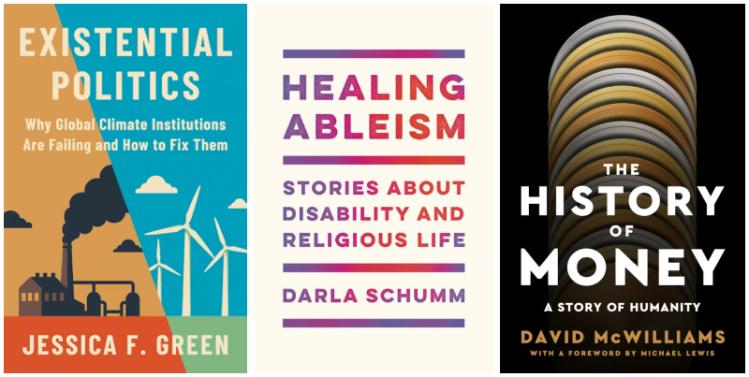
Every year, international climate meetings expand, attracting everyone from activists to oil lobbyists. The finer points of carbon taxes and offsets are debated, regulations are enacted, new goals are set. And yet, decades in, we are nowhere near limiting warming to 1.5 degrees Celsius. In Existential Politics, Jessica F. Green helps explain why: we’re using the wrong metrics. Forget managing tons of carbon emissions—they’re complicated to measure, easily gamed by industry, and they frontload costs. Instead, we need to hit the fossil asset owners where it hurts: their wallets. Embracing what she calls radical pragmatism, Green makes a forceful, technical argument for why and how we should strip fossil assets of their power and build the power of green assets instead.
Existential Politics
Why Global Climate Institutions Are Failing and How to Fix Them
Jessica F. Green
Princeton University Press
$29.95 | 224 pp.
*
“If I can imagine a disabled God,” writes Darla Schumm, “I am able to imagine that my disabled body is also created in the divine image.” Healing Ableism considers how religious communities could fully embrace “the radical notion that every body is created in the image of God” and explores why they struggle to welcome disabled people into full participation. Schumm provides an approachable entry point for readers unfamiliar with disability studies, drawing on theoretical concepts to propose practical solutions like placing pew cuts for wheelchairs in church sanctuaries. Weaving together stories from other disabled people and experiences from Schumm’s own life, Healing Ableism calls on each of us to make our religious communities more accessible for all of God’s people.
Healing Ableism
Stories About Disability and Religious Life
Darla Schumm
Rutgers University Press
$27.95 | 192 pp.
*
“Most economists do not really understand money,” economist David McWilliams writes. His new book The History of Money is a bold attempt to capture what his fellow “high priests” of capital miss. Rather than so much dead stuff traded for other stuff, money is a technology, a tool developed “to help us negotiate an increasingly complex and interrelated world.” Society flourishes when more people have access to money as a technology to enact and experiment, and it suffers when money is inaccessible. Despite a few unfair generalizations about historical eras and an unquestioned penchant for referring to money in religious terms, McWilliams’s stab at helping us rethink money entertains and challenges.
The History of Money
A Story of Humanity
David McWilliams
Henry Holt and Co.
$32.99 | 416 pp.