How does a mainstream institution whose very name screams “establishment” present an exhibition of a major artist who has been somewhat marginalized within the canon of modern art? In assessing the challenge for the Museum of Modern Art with its exhibition “Wifredo Lam: When I Don’t Sleep, I Dream” (on view through April 11, 2026), one may recall the title of Albert Memmi’s 1957 book, The Colonizer and the Colonized. This is the fifth retrospective or solo exhibition that the museum has dedicated to a Latin American artist; the first was Diego Rivera’s in 1931, followed by Armando Reverón of Venezuela in 2007, Rivera’s portable murals in 2011, and, most recently, Tarsila do Amaral of Brazil in 2018. MoMA had a great opportunity to confirm Lam’s place within the history of modernism by using innovative curatorial practices and revisionist scholarship. Instead, we get the usual formalist Eurocentric (even New York–centric) perspective the institution is known for, imposed on an artist from the developing world. Perhaps the “colonizer” cannot help itself.
When it was announced that MoMA would present an exhibition of Lam, I asked myself: Does the world even need another Lam show? The McMullen Museum at Boston College, the Centre Pompidou, and the Tate Modern have all presented well-thought-out and serious exhibitions of the Cuban-born surrealist in recent years. The only missing component has been Lam’s extraordinary graphic work. Although some marvelous aquatints are included here, the exhibition does not cover the practice comprehensively.
MoMA’s exhibition is located on the museum’s third floor, a space of some importance. The exhibition occupies several galleries, taking the visitor through Lam’s work from the 1930s to the 1970s. The installation is mounted on walls painted a pale, neutral gray, with the exception of a wine-red space containing works from the late 1940s to the mid-1950s. A total of more than 130 works—paintings, drawings, prints, illustrated books, and ceramics—adds up to an aesthetic experience of remarkable quality, especially among works ranging from 1937 to 1958.
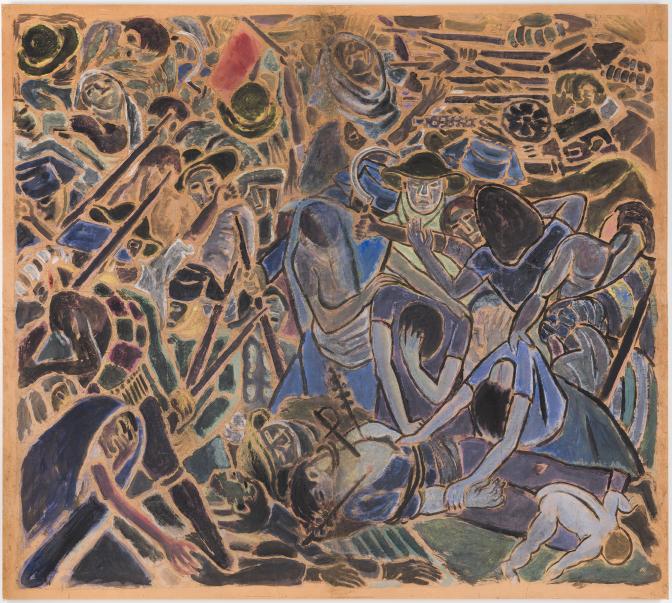
Lam was born in 1902 in Sagua la Grande, Cuba, the youngest child (and only son) of an octogenarian Chinese man and a much younger Afro-Cuban woman. He studied at the San Alejandro Fine Arts Academy in Havana and the San Fernando Fine Arts Academy in Madrid. While the Boston exhibit, organized by Elizabeth T. Goizueta in September 2016, documented a group of oils and drawings from Lam’s early years—work from 1923 to 1935 that displayed the extraordinary craft he developed—MoMA’s exhibition is limited to a single pre-1937 work in a decorative style. The monumental work on paper, La Guerra Civil (The Spanish Civil War) (1937), is a fine example of a politicized artist who learned to compose by studying the paintings of Bosch and Bruegel in the Prado. Lam participated in the Spanish Civil War and was associated with a diverse group of Communists on the Loyalist side. Toward the end of the war, he went to Paris, met Picasso and André Breton, joined the surrealists, and associated with Cuban Trotskyists such as Emilio Brea and his wife Mary Low. His work fully embraced modernity through his African roots and Picasso’s vocabulary, absorbing the intense shapes of African sculpture and Cubism’s fragmentation of figure and space into his personal idiom. He is arguably one of a handful of Latin American artists (alongside early Mexican muralists, Joaquín Torres-García, Tarsila do Amaral, Roberto Matta, and Lam’s fellow Cubans Amelia Peláez, Carlos Enríquez, and Fidelio Ponce de León) who developed an original, even idiosyncratic version of a “new world” or American modernism. During that time, his painting matured.
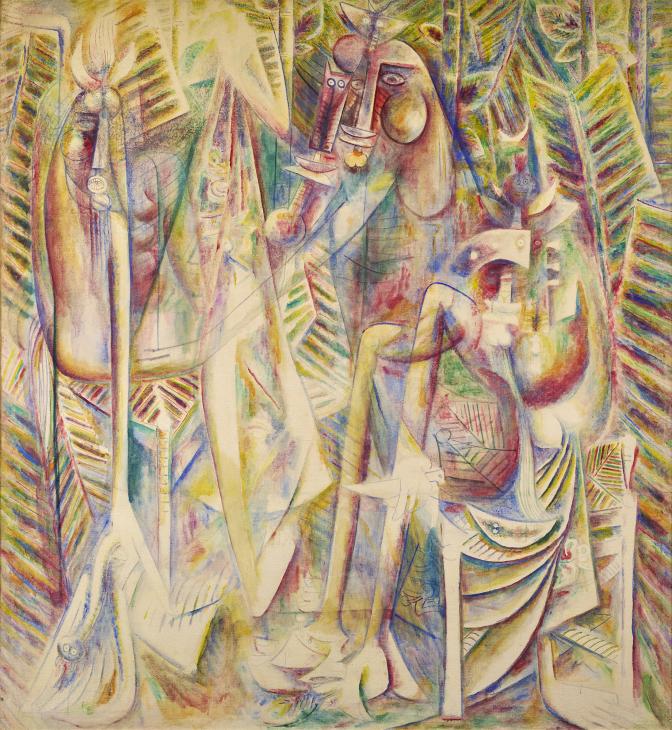
World War II and the Nazi invasion of France forced Lam to leave the country (he escaped on the same ship as Breton and Victor Serge) and return to Cuba. In 1940s Cuba—amid the wartime economy and under the constitutional governments of Batista, Ramón Grau, and Carlos Prío—he clarified the imagery and meaning of his pictorial vocabulary. At the same time, he explored different painting techniques, from watered-down oil to India ink to rich blue-and-green color structures resulting in explosions that reflect the light, humidity, and sensuality of the Caribbean. His exquisite drawing is characterized by subtle lines defining little devils and horsewomen, the trickster deity Eleguá, and lush manigua abundant with vegetation that fuse sugarcane stalks and tobacco leaves, filling the surfaces of his papers and canvases with visual pulsations. Important works from this period include La jungla (The Jungle) (1942-43) and La silla (The Chair) (1943) (Cuba did not lend the latter to the MoMA), as well as the masterpiece Harpe astrale (Astral Harp) (1944), whose chromatic richness seems like a tropical version of pointillism. Then there is the monumental painting Grande Composition (Large Composition) from 1949. Painted on kraft paper in ochres, grays, and browns, this complex work features elongated figures engaged with masked animals in a mysterious and sacred conversation.
The exhibition demonstrates how consistently extraordinary Lam’s work was up through the 1950s. What the show doesn’t include are biographical details from the later part of Lam’s life. Shortly after Batista’s coup d’état in 1952, Lam returned to Europe, remarried, had children, and spent time between Paris and Albissola Marina, Italy. He visited Cuba in 1963 at the invitation of journalist Carlos Franqui and went back again in 1965 to paint his last great work, El Tercer Mundo (The Third World), which he gifted to the National Museum of Fine Arts in Havana. With Franqui, he co-organized the May Salon exhibition in Havana in 1967 and helped paint the mural Cuba Colectiva with Cuban and European colleagues. In January of the following year, he participated in the Cultural Congress of Havana. His last visit to the island was in 1980, when (now in a wheelchair) he publicly repudiated the Marielitos (those who fled in the Mariel boatlift of 1980) and supported the revolution. These incidents are not directly reflected in his art, nor are they mentioned in the wall labels, where doing so would have provided welcome contextual and biographical details.
The penultimate gallery of the exhibition contains three huge horizontal canvases from the late 1950s, which show Lam in dialogue with Jackson Pollock’s abstract expressionism. He is clearly still a bold painter, taking risks and transforming influences into something of his own, dynamic and open. But the final gallery makes for a pathetic experience: the oils and ceramics are examples of Lam plagiarizing himself, his art now a mannered and mechanical self-caricature, something like the late work of his one-time mentor Picasso. Yet unlike Picasso, Lam still produced quality work at the end of his life—in his case, graphics, especially in a series of etchings from 1969 and in multimedia drawings made before his death in 1982.
In the end, the MoMA has mounted an uneven and incomplete exhibition. The scholarly depth the institution demonstrated in previous exhibitions, like Reverón’s and the portable frescoes of Diego Rivera, is lacking here. Perhaps this is due to the speed with which it was organized, or the lack of expertise of the curators. With the exceptions of Martin Tsang’s essay on Lam’s Chinese identity, Damasia Lacroze’s essay on Grande Composition, and a section devoted to a technical and conservationist analysis of The Jungle, the catalog (though, like all MoMA publications, beautifully designed) adds nothing new. Still, the exhibition is important and well worth a visit; we do not get to see so many of Lam’s wonderful pictures in one place. One hopes that in the future, the “colonizer” institution will learn to “decolonize” its curatorial practice when exhibiting a significant artist like Wifredo Lam.