O God, come to my assistance. The DHS detention center is in an industrial part of Newark, in between some warehouses and the county prison, a few hundred yards from where the Passaic River flows into the bay. This area must have been estuary before it was concrete—they tell me the stink was terrible when they had protests here in the summer. But on a January afternoon, there was only an occasional smell of gas when some valve was opened in the fuel depot across the street. Behind the fence, above the barbed wire, large letters stuck to the gray cinderblocks told us this was Delaney Hall, the main immigration detention facility in the New York area.
On the fence itself, smaller signs warned us that the prison is private property: Delaney Hall is owned and operated by the GEO Group, whose millions of dollars of political contributions to Republicans in 2024 were rewarded in 2025 with a billion-dollar contract to reopen and operate the facility. Stories of poor conditions have been trickling out of the prison since then, from detainees themselves, from visitors and aid workers, and from the rare oversight visits that local politicians have been able to make. In December, the first death in custody at Delaney Hall was reported—of Jean Wilson Brutus, a Haitian asylum-seeker.
O Lord, make haste to help me. There have been protests and demonstrations at Delaney Hall ever since the facility reopened. Last May, the mayor of Newark was arrested at a protest demanding transparency about detention conditions; in June, the local congresswoman was indicted in federal court for interfering with the mayor’s arrest.
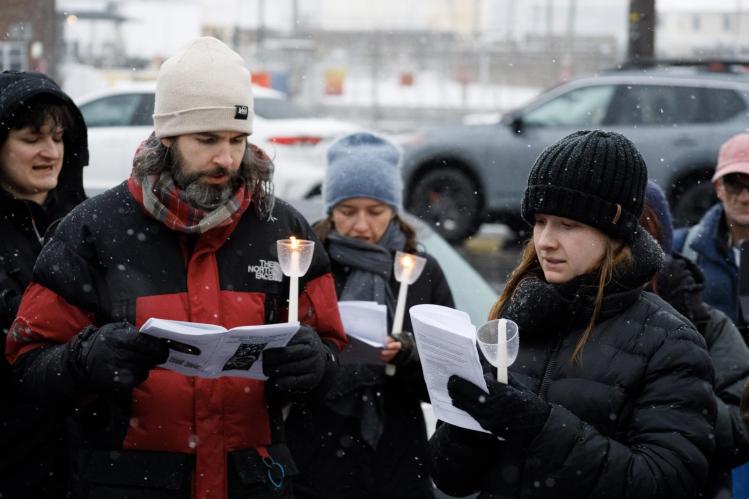
On January 18, I joined a small crowd in front of the prison gates for a prayer service organized by a group called the “New Personalist Movement,” in memory of Brutus and of all others who have died at the hands of DHS. A little more than fifty people came out to pray in the cold and damp, as a light snow fell out of a gray sky. The Sisters of Charity were represented, and there were a couple Franciscan friars with rope cinctures hanging down below their parkas. But it was mostly laypeople in the crowd, and mostly young people. A few small children fidgeted and snuggled up to their parents against the cold. As we lined up along the sidewalk for the prayer service, another crowd was gathering on the other side of the driveway: visitors hoping to meet with their loved ones inside. They waited next to the checkpoint in a kind of covered pen built of corrugated steel half-walls. Next to us on the sidewalk was a tent where some regular volunteers offered hot drinks and food to the waiting visitors—they also had a basket of chocolates for the children.
He put a new song into my mouth. We began to pray from the booklets that had been handed out, fumbling with our gloves to turn the pages as they got soggy from the thickening snow. Candles had been passed around, but with the snow and the wind, they didn’t stay lit for long. The texts of the prayer service were based on the office of readings and vespers for the dead, followed by compline and a litany. Some of the prayers and readings had a political edge that was clearly not taken from any officially published breviary, but the forms of prayer were strictly traditional. We formed two choirs, separated by the line of concrete barrier blocks at the property’s edge, reciting the psalm verses and responsories to each other.
During most of the prayer service, an alarm sounded from inside the prison fence, not loud enough to drown out our voices, but too loud to ignore. I wondered for a moment whether this was an attempt to disrupt our prayers, but a friend explained: some prisoners escaped from the detention center in June, breaking through a poorly constructed wall. In response, the prison administration installed motion detectors all around the building. These were so sensitively calibrated that snow or heavy rain was enough to set them off. Eventually a guard tinkered with some mechanism behind the fence, and the alarm stopped. The snow kept falling as we made our way through the psalms. Occasionally the guards stepped out to open or close a gate; a few vehicles entered and left. The prison staff and ICE agents showed no interest in what we were doing. They’ve seen many demonstrations, and ours was an especially peaceful one.
I have not hidden your love and your truth from the great assembly. The texts of the liturgy focused my thoughts, as the chants or speeches might at a political rally. Over the barrier blocks, we exchanged verses meditating on the pain of injustice, the duty to bear witness, the faith that no earthly force will impede God’s vindication of the oppressed. Centuries collapsed together in these prayers: the travails of Iron Age Canaan, the fears and defiance of early Christians under empire, and our own horror and indignation at what was happening behind the walls a few yards away. From the perspective of these ancient words, we are able to see every prison, every tyrant, every kingdom as a temporary thing, already placed under judgment, predestined to fail. Our prayers did not bring down the prison walls, but in these days of cynicism and cruelty, of wars and of rumors of wars, the eschatological perspective embodied in the Church’s prayers is a medicine against despair.
The “New Personalist” group that organized this prayer service has a strongly pronounced Catholic character, but it’s hard to pin down. They have no formal institutional affiliation, and there are non-Catholics enthusiastically involved. Like many other Christian groups in New York, they meet for prayer and discussion and to organize charitable works, but they claim a set of theological and political influences far from the American Catholic mainstream. The group’s name evokes the “personalism” of Emmanuel Mounier, and the other figures participants cite as intellectual inspirations—Marc Sangnier, Cardinal Cardijn, Óscar Romero, Ezechiele Ramin, Herbert McCabe—amount to an alternative story of the twentieth-century Church, or a different way of telling that story, in which the anticommunism and culture war that have dominated the agenda of the American Church (and sometimes also of the Holy See) are not the only or even the main concern. Few of those figures were ever officially condemned by the Church, and some were famous and influential in their time. But, at least in the United States, the tradition they represent has become marginal to Catholic thought and practice. To the extent that the New Personalist Movement has a defined position, it seems to be that this half-forgotten current in Catholic history is not an aberration wisely abandoned by the hierarchy but a source of intellectual and moral renewal, and a model for fidelity to the Gospel in the modern world.
My enemies revile me, saying to me all the day long: “Where is your God?” As we prayed in the cold outside Delaney Hall, there was no time for lectures on the legacy of lesser-known twentieth-century Catholic thinkers. But the very fact of a prayer service at a DHS detention center constitutes an intervention in debates about the political implications of the Gospel. The past year has seen a relentless, almost unprecedented effort on the part of the federal government to claim Christian authority for its policies. In intellectual venues, there are arguments that a policy of mass deportation simply reflects an Augustinian ordo amoris. A few days after the prayer service at Delaney Hall, an organization called “Catholics for Catholics” held a gala event for donors and fundraisers, at which “Border Czar” Tom Homan was honored with a “Protector of America” award. For the masses, there are DHS hype videos in which the text of the Beatitudes is accompanied by footage of ICE agents breaking in doors. It is clear that in the eyes of many of our contemporaries and coreligionists, this juxtaposition is no blasphemy, nor even a contradiction.
This is not the first time an attempt has been made to marry Christianity to a politics of cruelty, and it has not been the most successful. While their statements tend to be measured, carefully balanced, and anxious to emphasize that there are good intentions on all sides, the Catholic bishops and the pope have made it clear to anyone with ears to hear that they don’t approve of what’s going on. With or without official ecclesiastical backing, Christian organizations and volunteers remain on the front lines of the struggle against the mistreatment and demonization of immigrants across the country.
The prayer service outside Delaney Hall is not going to silence those loud, well-funded, and powerful voices that abuse Christian tradition to justify the cruelties of the federal government, and I doubt it will win the “New Personalists” access to fundraising or to influence in Catholic media. But despite the foul weather and the grim setting, everyone at the prayer service seemed heartened by it. We’ve done some spiritual good by praying for the dead. We’ve borne witness that those Catholics who claim religious sanction for evil will not go uncontested. And we’ve been reminded by the texts we recited that we believe in the advent of a kingdom in which every tear will be wiped away and every wall separating families torn down. For the old order has passed away.
My own eyes have seen the salvation which you have prepared in the sight of every people. Once the prayers were over, the group dispersed quickly. It was cold and getting colder, and everyone wanted their dinner. A few people were still standing in the pen next to the prison gate, hoping the guards would let them in before visiting hours ended. Around the country, a few journalists were taking note of a DHS press release announcing the death of yet another detainee in Texas. Behind the fences and walls of Delaney Hall, a few hundred people wait, and suffer, and perhaps say their own prayers. On television, political strategists explain that “Abolish ICE” is an irresponsible and election-losing slogan. And over the dirty slush along the sidewalk, a new layer of clean snow is still falling. ℣. From all evil: ℟. Lord, save your people.