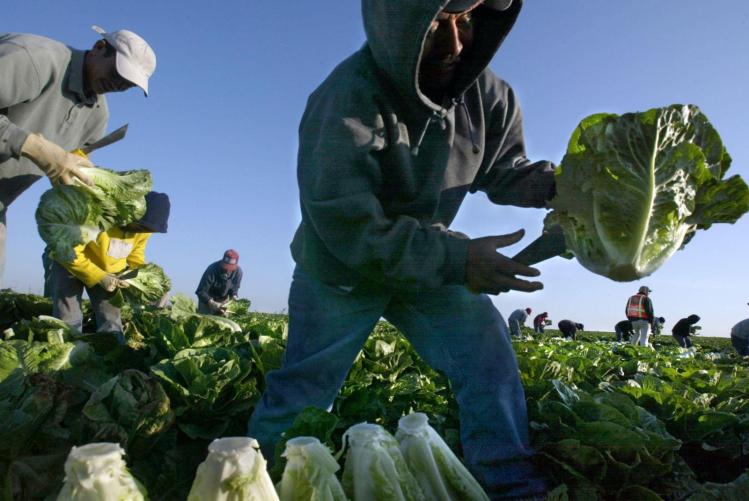
At dawn, the Salinas Valley is a long breath: fog lies low over the fields as the highway cuts through and work crews move in rhythm. When I lived on California’s central coast—America’s Salad Bowl—I drove that road most mornings. Long before grocery lights blinked awake, the day’s lettuce, spinach, strawberries, and celery were being cut by hands I came to recognize.
Contrary to the picture many Americans carry of “undocumented life,” the work is not hidden. It is done in the open—in sun and wet fog—with bodies bent to the task and knives flashing cleanly. The foreman’s call travels down the line. Pallets stack. Semitrucks idle, ready to carry the morning’s picking wherever it’s bound.
Here is the simple truth I learned quickly: we run an economy that depends on these neighbors while denying them basic recognition and, too often, due process. We rely on their steadiness, build supply chains on their callused hands, and then look away at the point where protection should meet labor. We harvest the food and the moral discount at the same time.
I cannot think about those mornings apart from Catholic social teaching, which insists that work has dignity because the worker does. The rights of workers—to safe conditions, just recognition, and legal protections—are not extras added to an economy when convenient; they flow from the person’s God-given worth. Solidarity is the bond that already exists between eater and picker, neighbor and neighbor. And welcoming the stranger is not sentiment; it is the test of whether our loves are large enough to be called Christian. These principles point toward both a public and a personal posture: a stance that seeks recognition in law, due-process protections in enforcement, and realistic paths to regularize lives. To see those fields is to be led into an examination of conscience: Do our habits and policies honor the people whose hands feed us?
Over time, I came to know some of the men and women who bent to those rows. We talked outside shops and during brief occasions when my work intersected with their lives. I was welcomed onto porches where the coffee was strong and conversation moved between family, church, and work hours. Faith and money were both counted carefully. There was tired laughter at day’s end and the handshake that tells you where a person earns his living—thickened palms, barked knuckles, the grip of someone who trusts what he can hold.
One December, my future wife and I were invited to a holiday party. The room was warm with tamales and talk. In the corner, a small Christmas tree wore construction-paper ornaments, each a folded wish from a child in a nearby migrant community. Guests were invited to choose a card and return with the gift, wrapped, so it could find its way to the right door by Christmas morning.
I reached for three. I expected the usual litany of childhood desires—action figures, dolls, a game someone’s cousin already had. The first card said “blanket.” The second said “jacket.” The third said “wool socks,” the letters careful, jagged. I showed them to my partner. “They’re cold,” I managed. We gathered more cards, did what we could, and drove gifts around town with the bewildered gratitude of learning how little it takes to be useful. I have not forgotten the weight of those cards in my hand.
So, when the evening news shows raids—when stories surface of fathers gone before breakfast, or a mother pressed through a legal thresher without a lawyer, an interpreter, or a real hearing—I do not see strangers. I see the men who met my gaze with quiet amusement while I mangled a verb. I see the women who corrected me kindly and sent us home with pan dulce. I see the children who asked not for toys but for warmth. And I see how easily a nation convinces itself that the people who pick its food are somehow less than the people who eat it.
I do not pretend the policy questions are simple. Borders and laws matter. But some things are not complicated at all. A person who works beside you in the field, buys groceries in your store, prays in your church, and sends her child to your school is your neighbor. A nation that counts on that neighbor’s work owes her more than suspicion. If we want a standard to guide us, we already have one: honor the dignity of labor, secure the rights that flow from that dignity, act in solidarity with those whose work keeps us alive, meet the stranger with justice and welcome. None of this requires a revolution of feeling. It requires telling the truth about our actual economy and aligning our laws with what we demand every morning at first light.
Now and then, in conversations with friends and colleagues, I hear the same quiet unease. We know enough history to recognize the shape of a contradiction while we are living inside it. Even one of our early statesmen, Thomas Jefferson, implicated as he was in the central evil of his age, admitted that a nation cannot expect to dodge the moral consequences forever because justice does not finally belong to us. “Indeed, I tremble for my country when I reflect that God is just.” That confession still rakes like a plow.
John Steinbeck, who knew this valley and its people, gave us a line in The Grapes of Wrath: “In the souls of the people the grapes of wrath are filling and growing heavy, growing heavy for the vintage.” Grapes do not choose to be heavy; seasons make them so. When a people’s labor is needed but their humanity is not acknowledged—when we profit from the hands we refuse to see—pressure gathers. It ripens slowly and then all at once.
What, then, is left to us? First, to see what is plainly before our eyes. The work is not in the shadows; it is in the sun. Second, to let that sight move us past abstraction. It is not enough to praise “hard work” while structuring an economy that keeps a worker’s legal life precarious because our prices are lower that way. And it is not enough to say “law and order” if, in practice, the father in the next trailer is funneled through a process too swift for counsel or translation. The bill is paid by bringing what has been tacit into the open: recognizing the people we already rely on and protecting them with the due process we claim to guarantee.
Finally, we can act like Christians in public. That does not mean baptizing a party platform. It means letting our neighbor’s claim set the terms of our imagination. It means resisting the easy habit of harvesting both the food and the moral discount. It means insisting that the hands that feed us do not do it unseen.
The fields at dawn are a mirror. They reflect back the country we are and the country we say we are, and they make it harder to pretend the difference is small. Mirrors do not bargain; they simply tell the truth. The vintage will come—it always does. We can harvest bitterness, or we can repent while there is time and make a different bargain, one in which our laws match our economy and our gratitude finally becomes justice.