More than eight centuries ago, St. Francis of Assisi filled a cave with live animals, a manger and hay, and real people portraying the Holy Family to help Christians visualize the humble circumstances of Jesus’ birth. But that first nativity scene had another purpose: to stand in contrast to the materialism and greed of Italian society at that time. From the beginning, then, Christmas crèches have included a prophetic purpose.
So I’ve been surprised by the backlash to a handful of churches in the United States that have used their public nativity scenes this year to highlight the dignity of immigrants. As part of the Trump administration’s mass deportation by Immigration and Customs Enforcement (ICE), unidentified masked agents have kidnapped and brutalized people, including those with legal status, detained them without due process, and violently attacked protesters, sometimes using chemical agents. Some churches, using public art to do public theology, have chosen to be prophetic about this key political and moral issue of our time.
Yet the Archdiocese of Boston recently demanded that a local church take down its controversial manger scene and restore it to “its proper sacred purpose.” The display at St. Susanna Parish in Dedham, Massachusetts includes the traditional wise men, shepherds, and animals, but Mary, Joseph, and baby Jesus have been replaced by a sign saying “ICE WAS HERE.” A smaller note directs viewers who witness immigration agents in their community to contact an advocacy group that tracks deportation activity in the state.
The parish has received angry responses from callers and on social media, but the pastor says the fact that the crèche makes some uncomfortable does not make it sacrilegious. Its intent, says the pastor, Fr. Stephen Josoma, is to “evoke dialogue.”
The archdiocese maintains that the crèche display “departs from a canonical norm” about sacred objects. “The people of God have the right to expect that, when they come to church, they will encounter genuine opportunities for prayer and Catholic worship—not divisive political messaging,” said an archdiocesan spokesperson.
One wonders whether parishes would be allowed to disseminate the U.S. bishops’ conference’s recent statement expressing concern about mass deportations, although that statement was careful not to mention ICE or Donald Trump specifically. Of course, images can be more powerful than words, which may be why these controversial crèches seem so threatening.
Even the Department of Homeland Security (DHS) has been critical of the nativity scenes, suggesting that they are contributing to assaults against ICE officers. The depictions are “offensive to Christians,” said DHS’s assistant secretary of public affairs, adding that those who set them up should “get a grip and seek help.”
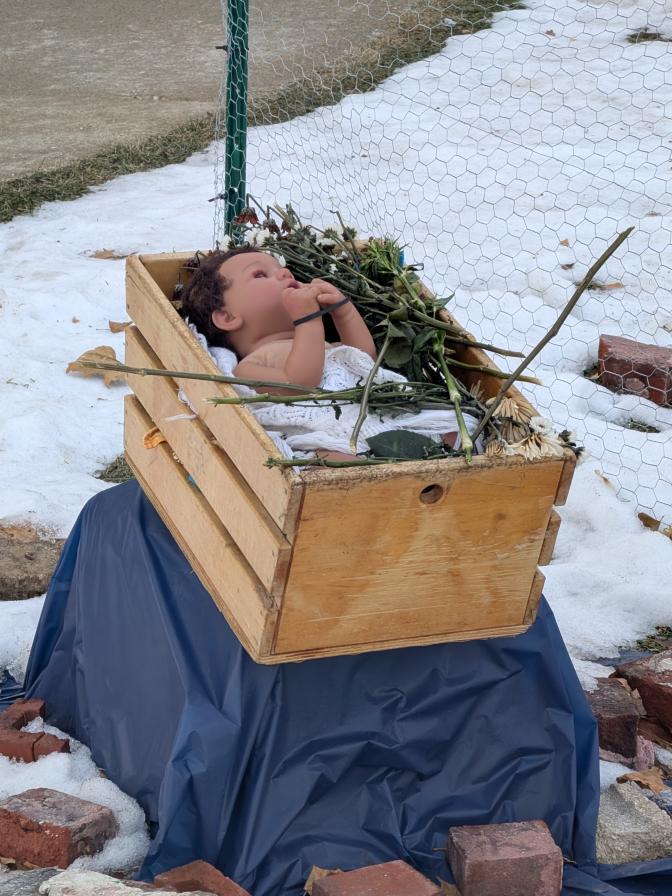
DHS was specifically upset about a nativity in the Chicago suburb of Evanston, where a zip-tied baby Jesus is stalked by masked centurions dressed as ICE and border-patrol agents. Mary and Joseph are missing, with signs indicating that Joseph “didn’t make it” and Mary was “beaten and dragged away in front of her son” and is now in detention.
The black plastic zip ties around the baby Jesus’ wrists are shocking. But then so were the eyewitness reports that children were zip-tied during a violent immigration-enforcement operation at a Chicago apartment building in October. Agents rappelled from a Black Hawk helicopter and pulled residents, including U.S. citizens, from their homes in the middle of the night and detained them for hours. Although thirty-seven undocumented people alleged to be Venezuelan gang members were arrested, no criminal charges have been filed against any of them. DHS denies that ICE uses zip-ties on infants or children.
The Rev. Michael Woolf, pastor of the American Baptist Lake Street Church, said their nativity answers the question “What would it be like if Jesus were born today in Chicagoland?” More than 1,500 people were arrested during Operation Midway Blitz in Illinois, and operations seem to have resumed the week before Christmas.
There is no question that the Church’s social teaching calls us to welcome the strangers in our midst, especially those fleeing dangerous situations in their homelands. The Holy Family itself is seen as a migrant family, forced to flee to Egypt as refugees to escape King Herod’s murderous threat. Pope Francis made care for migrants a key theme of his papacy, and his encyclical Fratelli tutti directly addressed the failure of countries to treat migrants with dignity.
“No one will ever openly deny that they are human beings, yet in practice, by our decisions and the way we treat them, we can show that we consider them less worthy, less important, less human,” Francis wrote. “For Christians, this way of thinking and acting is unacceptable, since it sets certain political preferences above deep convictions of our faith: the inalienable dignity of each human person regardless of origin, race or religion, and the supreme law of fraternal love.”
In 2019, to mark the eight-hundredth anniversary of the first crèche created by his namesake, Pope Francis visited the grotto in Greccio, Italy, that was the site of St. Francis’s original nativity and signed an apostolic letter on “the meaning and importance of the nativity scene.” In that letter, Francis stresses that the purpose of a crèche is not just to look back at history.
“The nativity scene shows God as he came into our world, but it also makes us reflect on how our life is part of God’s own life. It invites us to become his disciples if we want to attain ultimate meaning in life,” Francis writes in Admirabile signum.
It does not matter how the nativity scene is arranged: it can always be the same or it can change from year to year. What matters is that it speaks to our lives. Wherever it is, and whatever form it takes, the Christmas crèche speaks to us of the love of God, the God who became a child in order to make us know how close he is to every man, woman and child, regardless of their condition.
This, of course, is part of the whole meaning of the Incarnation, which we celebrate at Christmas. God came into the world, became human, so that we might see a “God with skin on.” But it also means that we must be part of salvation history ourselves and follow the teachings of Jesus that require us to bring mercy to those hurting in our world.
A nativity scene makes Emmanuel, “God with us,” real. But crèches are not just cute holiday decorations. They call us to practice mercy and love for the most vulnerable in our world. There is nothing more appropriate than using a Christmas crèche to remind people of that.