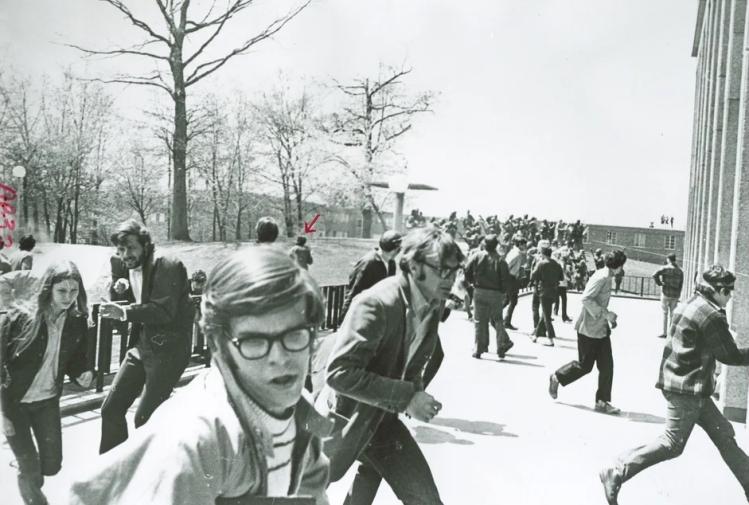
The New York Times recently ran a lengthy obituary for John Cleary, one of the students wounded by Ohio National Guardsmen during an anti–Vietnam War protest at Kent State University in May 1970. Four students were killed and nine wounded when twenty-seven soldiers fired their powerful automatic M1 rifles into the unarmed crowd of protesters and onlookers. The soldiers fired sixty-seven shots in thirteen seconds. One of those killed, William Schroeder, an R.O.T.C. student, was 127 yards from the soldiers. Another student was 250 yards away when he was wounded.
Cleary, a nineteen-year-old freshman, was hit in the chest. A photograph of him lying on the ground and bleeding profusely appeared on the cover of Life, once the largest-circulation magazine in the country. It was like being “hit with a sledgehammer,” he later recalled. The singer/songwriter Neil Young memorialized the killings in his popular rock lament, “Ohio,” with the riveting refrain “Four dead in O-hi-o.” I was a college freshman at the time, and the killings seemed to make plain the depth of the Nixon administration’s cruelty and cynical expansion of the war into Cambodia that spring. A nationwide student strike closed hundreds of college campuses, including my own. After years of mounting opposition to a seemingly futile war, the nation was even more divided—and more violent—than it is now under Trump, who is clearly emulating Nixon’s divide-and-conquer brand of politics.
Nixon’s popularity among what he called the “silent majority” of Americans was in some respects the original MAGA movement. For many Americans—perhaps even most—the dead and wounded students deserved what they got. It didn’t matter that two of the students killed were mere spectators, and, like Cleary, not involved in the protest. Sadly, it didn’t matter to Cleary’s parents either. The Times obituary quotes historian Brian VanDeMark, author of Kent State: An American Tragedy (2024): “In the aftermath of the shooting, [Cleary’s] conservative family and neighbors in upstate New York pressured him to say nothing critical about the guardsmen who had shot him and 12 others. He began not just hiding his involvement but denying it.”
As it happens, I reviewed VanDeMark’s book for National Review. The book is an impressive feat of research; it seems to cover all the extensive literature and documentation on the Kent State killings. Were the soldiers ordered to open fire on the protesters, or did they panic and do so on their own? That question has never been answered conclusively, although an FBI investigation found that the soldiers were never in any danger from the students. “We have some reason to believe,” the FBI reported, “that the claim by the National Guard that their lives were endangered by the students was fabricated subsequent to events.”
No officer admitted giving an order to fire on the protesters, and no guardsman was held legally accountable for the killings. In a 2020 interview conducted by VanDeMark, a National Guard sergeant commanding the soldiers who fired their weapons confessed his complicity in the shootings. He claimed that when he saw troops lowering their weapons and aiming at the crowd, he tried to avert the slaughter by running toward his troops while firing his shotgun into the air and yelling, “Fire one round in the air!” But his shotgun blast unintentionally set off the deadly volley.
The sergeant’s testimony does not seem very plausible. Why fire your weapon if you are trying to stop others from firing? And how reliable is even first-person testimony after fifty years? In the past, the same sergeant had lied or misled investigators about his role in the shootings. The Times obituary for Cleary quotes Thomas Grace, another wounded student survivor. Grace is the author of Kent State: Death and Dissent in the Long Sixties and has played a significant role in keeping alive the memory of those events. “John became the public face of the price of protest without even having been a protester himself,” he told the Times. “It shows how complicated and complex the past can be.”
I spoke with Grace before writing my review of VanDeMark’s book. He was relatively near the guardsmen when he was wounded and is convinced that a direct order was given. In assessing the motivations of the protesters, he stresses that as many as ten percent of the Kent State male student population were in fact Vietnam veterans. “I’ve documented the whereabouts of dozens of former soldiers who experienced the moment of the killings, who aided the wounded, watched the ambulances leave the campus and then depart the university grounds,” Grace wrote in a 2019 paper. For the most part, the school’s students were from nearby towns and cities and from working-class backgrounds, unlike protesters at Harvard, Columbia, and Berkeley. Any depiction of them as spoiled hippies or dangerous communists is wide of the mark. “As long as the war would last, so would the opposition to it by veterans at Kent State,” Grace wrote. “Having first fought the war, then fighting against it, veterans also ensured that they would not only honor those they lost in Southeast Asia, but those whose lives were taken at Kent State.”
Reading Cleary’s obituary, I was struck by how similar our current political moment is, and how familiar Trump’s tactics are. Ohio’s belligerent right-wing governor, James A. Rhodes, ordered nearly a thousand troops onto the Kent State campus after an R.O.T.C. building was burned down. Rhodes had a reputation for deploying the National Guard at the slightest provocation, a political strategy Trump has carried out on a national level. At the time, Rhodes was in a primary battle for a U.S. Senate seat with a more mainstream Republican. Like Trump, his instinct was to inflame every confrontation. He called protesters “worse than the Brown Shirts and the Communist element” and vowed to “eradicate” the problem. “Use whatever force necessary to break up a protest on campus,” he told Guard commanders. Trump, who clearly understands contemporary American politics as a continuation of the tumultuous 1960s and ’70s, is a zombie-like reincarnation of “silent majority” politicians like Rhodes. “Can’t you just shoot them? Just shoot them in the legs or something?” he asked his Defense Secretary about demonstrators outside the White House during his first term.
But as Rhodes learned the hard way, sending soldiers armed with high-powered weapons to control a political protest is extremely dangerous; far from restoring law and order, it often leads to violence. The Ohio National Guard had experience in suppressing urban riots, not in disbanding rowdy but mostly peaceful crowds. VanDeMark argues that the Guard’s commanders were out of their depth and lost control of their troops. By unleashing ICE agents on the guilty and the innocent alike and sending the National Guard to cities such as Los Angeles and Chicago, Trump is trying to foment conflict, not defuse it. Like Rhodes before him, he is recklessly making a show of his toughness.
In the aftermath of Kent State, Nixon created the Scranton Commission to investigate widespread student protests against the war in Vietnam. The Commission’s report summarized the FBI’s own investigation of the Kent State shootings, describing the actions of the Ohio National Guard as “[i]ndiscriminate…unnecessary, unwarranted and inexcusable.” That is also a fair description of what Trump has been up to during the first year of his second term.