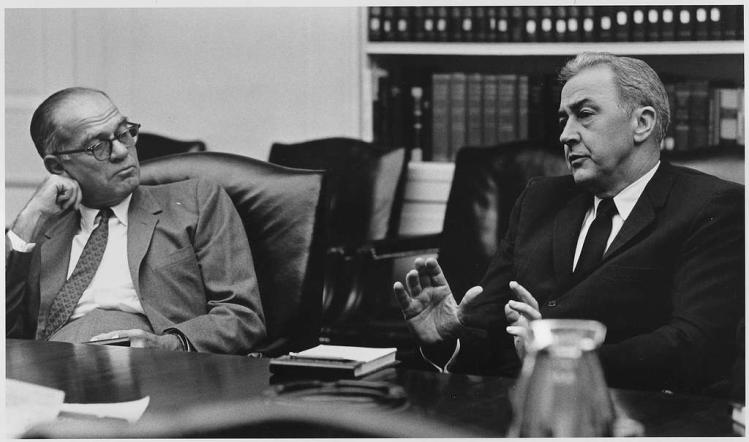
Each summer, I receive requests from students asking for a letter of recommendation for their Fulbright applications. I always agree, of course, since I firmly support the mission of the Fulbright. The program was founded in 1946 by Sen. J. William Fulbright, who, having observed the horrors of World War II, hoped to prevent another such war by fostering cultural exchange between the United States and other countries. He believed that deeper mutual understanding would promote peace. Fulbright Awards allow American students who have recently graduated with a BA to spend a year abroad at a foreign university; the Fulbright program also provides funding to foreign students for research at U.S. universities.
Of course, the wider political context of the Fulbright was the emerging Cold War between the United States and the Soviet Union, and the desire to contain Communism not just militarily but also through the “soft power” of diplomacy and cultural influence. As a new superpower, the U.S. government felt the weight of its global responsibility, which entailed large investments in education for the purposes of defending the “free world.”
In view of this history, it would be easy to criticize the Fulbright Program as simply a product of the Cold War university, one easily taken advantage of by the State Department and the Central Intelligence Agency. Yet clearly, the Fulbright’s ideal of “mutual understanding” cannot be reduced to national interests—cultural exchanges have their own dynamics that often stand at odds with whatever policies the U.S. government may be promoting at any given time. Fulbright Awards have transformed the lives of those who have received them and produced groundbreaking scholarship in the process. At a moment when the Trump administration has scrapped other Cold War initiatives such as USAID, strongarmed U.S. universities, and targeted international students, we should be grateful that the Fulbright program has somehow managed to survive.
I do wonder, though, whether it might be time to reform and expand the program so that it that takes into consideration the need for mutual understanding not only between the United States and other countries, but also within the United States. After all, the biggest threat facing the United States today is arguably not a foreign enemy, but rather enmity between the right and the left here at home. Millions of Americans now view about half of their fellow citizens as a threat to what they conceive to be the American way of life. Indeed, for the past ten years Democrats and Republicans have both warned that the country is facing an imminent civil war—and scores of movies, books, and newspaper articles have contemplated this grim scenario.
I think it’s still highly unlikely that Americans will take to the street with guns and knives to resolve their grievances with one another. One should always keep in mind that the perceived “enemies” that many Americans have in mind are actually family members with whom they bitterly disagree about Trump. I’m teaching a class this semester on the intellectual history of conservatism. The syllabus starts with William F. Buckley Jr. and ends with the MAGA movement. When I asked my predominately liberal students at the beginning of the course why they are taking it, a majority of them said something like: “To know and defeat the enemy.” It has become all too apparent that when they talk about the “enemy,” many of my students are referring to family squabbles over politics—the same kind of squabbles that exist among members of my own family, and of families all over the United States.
Often, at the heart of such squabbles lies the issue of education. I have Trump-supporting family members, acquaintances, and old friends who see elite higher education as catering to the most privileged. What other conclusion could one reach, they wonder, when it now costs nearly $100,000 a year to attend some colleges and universities? From there, the argument quickly turns to culture-war issues. The same friends and family members claim that liberal professors and students deny conservatives the freedom to express their views without the threat of being shunned or excluded. These arguments often conclude with the claim that wealthy, elite academic institutions promote ways of life and philosophies that are undermining Western “Judeo-Christian” values and the American way of life.
Many of the people who make these arguments either have never attended college or haven’t stepped foot in a college classroom in decades. Of course, that does not mean their complaints are entirely unfounded. They are right, for instance, that tuition at many elite universities is far too expensive, and that the high cost of higher education tends to entrench class privilege. If we assume that even private universities have a responsibility to serve the public good—the assumption behind the federal government’s financial support of such universities—then we must ask whether they can really do this while also contributing to America’s staggering wealth inequality.
What could bridge the gap between the culture of elite higher education and red America? One possibility involves extending the logic of the Fulbright program. As an undergraduate, I first attended a conservative Evangelical institution called Portland Bible College, where I received a bachelor’s degree in theology. A few years later, I attended Reed College—whose unofficial motto is “Communism, atheism, free love”—where I received an MA in Liberal Studies. To go from a bible college to the very liberal Reed College was a rather dizzying experience, as the reader can imagine. But it was also incredibly enriching. Going to Reed helped me understand for the first time the thinking and sentiment of liberal progressives, just as going to a Bible college had deepened my understanding of my religious background and the ideas that shaped it. Indeed, though I never had a Fulbright Scholarship, in my case the combination of Portland Bible College and Reed College served to fulfill the Fulbright’s mission of bringing students into contact with new cultures.
Cultural blind spots can be at least partly a function of geography. It seems strange to me that many of my liberal friends and students have never travelled to the South and have little knowledge of the Midwest apart from maybe having visited Chicago. They appear to have much more interest in places like China or Japan, and, in many instances, know more about these places than they do about, say, Mississippi or Arkansas. During Trump’s first term, it became conventional wisdom that the Democratic Party had become too coastal and was neglecting the heartland, which it would need if it was going to defeat MAGA in the future. This is not the place to assess all the electoral implications of our cultural divides; what interests me here is the way these divides relate to higher education.
Growing up on the Alabama-Florida border, I always found it strange that none of the smartest kids at my conservative high school had any desire to apply to places like Harvard, Stanford, or the University of Chicago. Despite having good enough grades and test scores to get into these schools, they instead dreamed of attending Florida State or Auburn—schools better known for football than for academic rigor. Interestingly, almost all of these old friends of mine are now Trump supporters and have welcomed his attacks on elite universities. They have little desire to achieve some kind of mutual understanding with the products of such institutions—or with Democrats more generally. Then again, they have rarely spent much time with such people.
This brings me back to Senator Fulbright’s vision. What if a scholarship existed that would fund a program of academic exchange between, for instance, students who attend SEC schools and students who attend the Ivy League? What kind of mutual understanding might result if a liberal student from U.C. Berkeley and a conservative student from Hillsdale College switched places for a year? It’s highly unlikely that everyone who participated in such a program would give up their most cherished convictions. But one might hope it would allow for those convictions to be tested and recalibrated, and for participants to acquire a new appreciation for ideas very different from their own.
If, as many on both sides of the political spectrum claim to believe, civil war is truly a threat in the United States, then perhaps a domestic program of cultural exchange is needed as much as the international program we already have. The goal of such of program would not be “to know your enemy” but rather to create an educational space where students could become better acquainted with fellow Americans from across the yawning cultural divide and thereby strengthen the civic bonds that hold this country together.