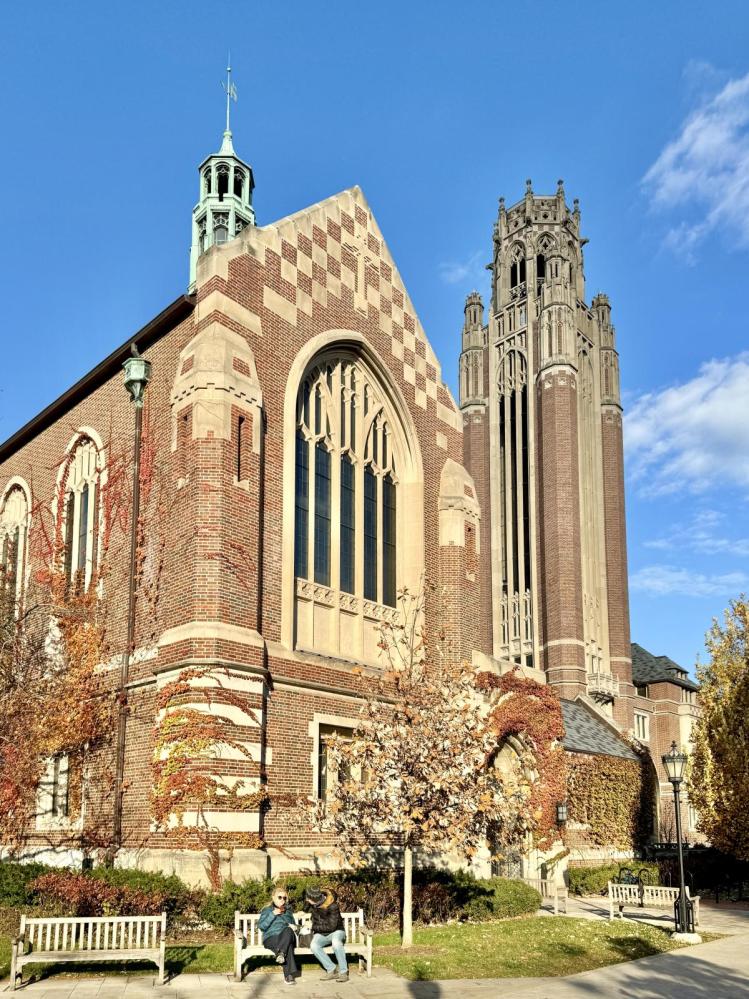
Not too long ago, I had the privilege of spending a summer carrying out research at the University of Chicago for a book I am writing about the French sociologist Raymond Aron. Working in the archives at the Regenstein library, I would take short breaks to explore the sprawling university campus and its gothic architecture. As a bibliophile, the clear highlight of the campus for me was the Seminary Co-op bookstore, one of the best academic bookstores in the United States.
On one visit, I met up with a faculty friend for coffee. He told me the bookstore used to be located in the basement of the Chicago Theological Seminary—hence its name. He added that some people weren’t too happy when it relocated; its original location at the seminary had been a fixture at the University of Chicago—a place of intellectual exploration, discovery, and community. He then asked me if I had visited the new economics-department building at the university. I hadn’t and wasn’t sure why I should have. With a grin, he explained that the university had purchased the old seminary building and given it to the Department of Economics. This had happened a while ago, but it was news to me, and the irony was unavoidable. One of the country’s most progressive Protestant seminaries had become the home of an economic department famous for ushering in the neoliberal revolution.
The following day, I made sure to visit the Department of Economics. What I found there seemed like something akin to a replacement religion. The first thing that immediately was apparent is that this is no ordinary economics-department building but almost a campus unto itself—a kind of Vatican City. I first made my way into an octagonal room that bills itself as showcasing the “Chicago Economics Experience.” It served as a kind of iconostasis of the great saints of the Chicago School of Economics—notably, Milton Friedman, Gary Becker, and George Stigler—while also offering a pious potted history of neoliberalism.
I then noticed that the chapel, where students had once worshiped something greater than themselves, had been turned into a kind of study hall for the entrepreneurial self. The collegiate-Gothic classrooms, beautified with stained-glass windows, had once been the place where divinity students were taught Christian ethics, whose first rule is to love thy neighbor as thyself. Now they are little neoliberal laboratories for research premised on an assumption that competition is basic to all human relations.
In short, the Department of Economics at Chicago is now a kind of secular cathedral. And although Friedrich Hayek was no fan of the Saint-Simonians—who saw themselves as priests of industrial modernity—that’s who came to mind when I reflected on what I had seen: the economists replacing the theologians, taking over their seat of learning, becoming a new clergy in a godless cult.
A very similar transformation has occurred in Canada. The Gothic building that once housed the Vancouver School of Theology was bought by University of British Columbia for $28 million, and has since been turned into the UBC economics department. There are, I am sure, other instances of divinity schools being taken over by other academic departments or otherwise repurposed. Union Theological Seminary in New York City was so cash-strapped that it allowed a developer to build a forty-one-story condominium tower on its campus.
It is no coincidence that the rise of neoliberalism in the 1970s took place at the same time as the decline of mainline liberal Protestantism and of enrollment at mainline divinity schools and seminaries. One of the sources of moral support for the welfare state that emerged during the New Deal, mainline liberal Protestantism no doubt had its warts. Too often it served the ends of the Cold War security state and compromised its distinctiveness in the process. Entire theological movements emerged in reaction to this particular shortcoming—most notably, perhaps, the one associated in the 1990s and 2000s with the work of Duke theologian Stanley Hauerwas, who denounced the accommodation of liberal Protestantism to America’s imperial power.
Liberalism in this country is now in a state of crisis worse than any it has seen in roughly a century. This crisis was precipitated by the failures of neoliberalism, whose political spear-carriers relied heavily on the family-values discourse of the religious right: depend for your welfare on your faith, your family, and your personal virtues rather than on the state. Much of this ideology, which prevailed in the 1990s, 2000s, and early 2010s, is ill-equipped for addressing a world in major transition: the decline of the American empire, China’s rise, the possible end of NATO, and the sudden emergence of AI.
Liberalism must now be something more than a doctrine of minimal consensus, mind-your-own-business pluralism, or the administration of things. The crisis of liberalism today is in part a crisis of moral formation. Confronted with the passionate certainty of a new generation of authoritarians, liberalism must offer a vision of human flourishing—what the philosopher Alexandre Lefebvre calls “liberalism as a way of life.”
Here is where I think that the old mainline liberal divinity schools could play a role, however small. There are robust moral insights in liberal Protestant thought—such as the understanding of progress as an ever-expanding moral consciousness or the emphasis on stewardship—that can help us think creatively about what a renewed liberalism might entail. If liberalism often struggles to address values and morality, as many political theorists have complained, maybe it wouldn’t be a bad idea to reconsider the role of divinity schools, which once played an integral role at many universities but are now marginal, if not defunct.
Such a project of renewal and reintegration would need to be ecumenical, involving various religious communities. But there’s no reason to turn the churchlike buildings that once housed divinity schools into sanctuaries for a neoliberal project that is clearly failing. Instead, the universities that have divinity schools—often the most elite schools in the country—should draw closer to them, treating them as a treasure trove of moral and existential resources for students who are struggling to understand and find their place in the new world that is emerging.
We welcome your comments about this article. Please send your response to [email protected].