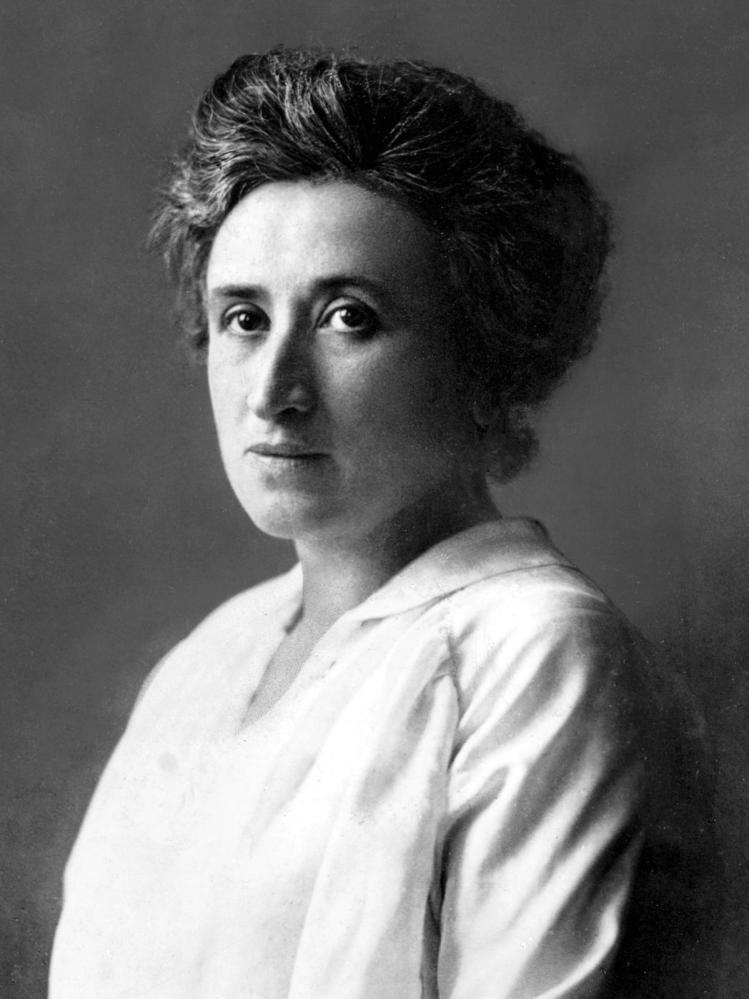
The Marxist revolutionary Rosa Luxemburg did not get the epitaph she wanted. Writing from a prison that would later be used as a Nazi concentration camp, Luxemburg—one of the preeminent intellects in the history of the revolutionary left—hoped that her grave might carry the call of a bird. To her friend and secretary Mathilde Jacob, she declared:
Only two syllables will be allowed to appear on my gravestone: “Tsvee-tsvee.” That is the call made by the large blue titmouse, which I can imitate so well that they all immediately come running. And just think, in this call, which is usually quite clear and thin, sparkling like a steel needle, in the last few days there has been quite a low, little trill, a tiny chesty sound. And do you know what that means, Miss Jacob? That is the first soft stirring of the coming spring. —In spite of the snow and frost and the loneliness, we believe—the titmice and I—in the coming of spring!
Today, in Berlin’s Friedrichsfelde Cemetery, you can visit her grave and read a very different but equally brief epitaph. It reads: “ROSA LUXEMBURG, ERMORDET.” Murdered. Dragged from a Berlin flat by a division of Freikorps—proto-Nazi paramilitiaries—beaten, knocked unconscious with the butt of a rifle, hauled into a car, shot in the head, and tossed into the January waters of the Landwehr Canal.
These two epitaphs—the one Luxemburg wanted and the one she got—correspond to two discordant ways of remembering the Polish-German radical. There’s “Red Rosa,” the revolutionary martyr at the barricades, who died opposing the right-wing drift of the Western European labor movement and repression in the new Soviet Union. Red Rosa is the premier saint of anti-authoritarian Marxism, a woman likened to Joan of Arc even by her adversaries. But there’s also “Green Rosa,” the lover of botany, birds, and her cat, Mimi, who found resolve and serenity in prison by befriending a menagerie of creatures. These two images are cast in a sentimental glow—and indeed there is no more readily sentimentalized figure in the history of Marxism than Rosa Luxemburg. One can forgive the temptation: the shocking circumstances of her assassination, soon followed by the tragic Soviet domination of global Marxism, make the elegiac mode nearly irresistible.
But the canonization of Luxemburg the woman limits our vision of Luxemburg the theoretician. It also occludes a most compelling aspect of her character: her capacity for coldness and withdrawal, her personal loneliness, and her persistent struggle with despair. It is only in view of Luxemburg’s very human struggles that her life can be instructive for us today. After all, her sophisticated and gorgeous environmental sensibility was developed amid the blackest political despair of her life, following the assent of official German socialism to the barbarism of World War I. Green Rosa emerged from the agonies that follow any revolutionary life. Her environmental writings are more than a historical curio: they’re a treasure. Together, they present an ecological ethic that teaches us how to cultivate sympathetic relationships with nonhuman creatures—an ethic that helped secure her own psychic survival amid political catastrophe.
Ours is a moment that demands a revolutionary transformation in how human beings relate to nature. And any revolution needs revolutionaries: individuals who devote themselves to the reconstitution of our form of life. But despair, failure, betrayal, and even death persistently shadow revolutionaries, including contemporary environmental radicals. Luxemburg reported with startling honesty her confrontation with these trials; her letters testify to the experience of an individual teaching herself a deep form of revolutionary resolve. What’s more, she maintained this resolve through a set of practices focused on the good of her creaturely companions: bees, flowers, buffalo, and blue titmice. By the end of her life, she embodied precisely what we need today: a politics that seeks the flourishing of all creatures and recognizes the radicalism of that demand.
About Rosa Luxemburg’s early childhood, historians know relatively little, which gives her sudden appearance on the grand stages of history an uncanny quality. Seemingly out of nowhere, we encounter this diminutive woman in her very early twenties, already a fully formed revolutionary intellectual, eager to joust with the titans of prewar socialism. She confidently strides into the historical record with a limp: at age five, her hip was infected and incorrectly treated, leaving her bedridden for a year, during which time she taught herself to read and write. By age nine, this child of the Polish-Jewish middle class was translating German poetry into Polish; by the time she reached secondary school, she was a member of the Polish revolutionary underground. Her political presence in Poland soon became unwelcome—she was denied an academic honor at graduation due to her “rebellious attitude toward the authorities”—and she fled to Zurich with the help of a guileless local priest who came to Rosa’s assistance after he was told that she hoped to flee her disapproving Jewish family and marry a Catholic.
In Zurich, she received a PhD for a Marxist analysis of the Polish economy, developed political ties with a group of émigré Polish-Jewish intellectuals (including her sometime lover and longtime political partner Leo Jogiches), and published polemics in the leading socialist papers on Polish nationalism (which she opposed) and the possibility of revolution in the Russian Empire (which she supported). To describe Luxemburg as intense does her a disservice—she was a hurricane of activity, and Zurich soon became too confining. She resolved to travel to Germany, the epicenter of international socialism, and make a career for herself in the Social Democratic Party (SPD). In an early example of the fierce devotion Luxemburg inspired in her admirers, an older friend lent her very own son, a German national, for a sham marriage in order to facilitate Rosa’s travel to Berlin.
It can be hard for those on the contemporary left to imagine what life was like for members of the German SPD when Luxemburg arrived in 1898. Here was a party on the move, the jewel of Second International Marxism, with a genuine mass base among workers and dozens of newspapers and journals. This was a party where one could make socialism a vocation. Indeed, the first major controversy of Luxemburg’s German career, her critique of Eduard Bernstein’s “evolutionary” socialism, established her as a major figure in the SPD—as she intended. “She was out to make a career for herself,” writes Luxemburg’s biographer, J. P. Nettl. “The fact that she was a revolutionary, that she instinctively rejected Bernstein’s thesis, was a secondary consideration.”
For Luxemburg, being a political person meant publicity: hundreds of speeches, hundreds of newspaper contributions. She fought her fights—and there were many—in public. According to legend, Luxemburg once patiently took in an antagonistic speech from her French adversary Jean Jaurès and, realizing there was nobody prepared to translate it for the audience, stood before the hall and loudly repeated Jaurès’s critique of her position in German. This readiness to think, strategize, and argue out in the open was more than a quirk of her character—her vision of socialist leadership required it. For her, the role of a radical leader in a time of revolutionary change is to interpret, in public, the historical moment and to propagate a political vision that allows workers to understand their struggle with greater clarity. Lenin was obsessed with underground organizing; Luxemburg, by contrast, was obsessed with writing for socialist newspapers and magazines. “If we don’t want to forgo our advantage,” she characteristically declared during the first Russian Revolution, “we must now unleash a veritable shower of publications.”
Luxemburg was a revolutionary in a very precise sense. Her politics were oriented around the “complete overthrow of the economic and social foundations of society” and the establishment of a radically new form of life, one where workers freely determined the shape of their collective practices. Under capitalism, workers lack control over their own activity while on the job; they are subject to the personal dictates of the boss and the impersonal dictates of the market. Revolutionary activity describes the arduous process by which workers “learn to transform themselves into the free and independent directors” of public life. But if socialism describes the free, self-determining activity of all, it cannot be imposed from above. “Only the working class, through its own activity,” Luxemburg insists, “can make the word flesh.” Workers learn how to be free in the struggle to free themselves: there has been no greater champion of this central Marxian insight than Rosa Luxemburg. A genuinely revolutionary failure is always preferable to a political advance won through the suppression of free activity. It is on this point that Luxemburg contrasted herself most powerfully with the Bolsheviks. In her now-classic critique of Lenin and his collaborators, Luxemburg wrote:
Without general elections, without unrestricted freedom of press and assembly, without a free struggle of opinion, life dies out in every public institution…. A few dozen party leaders of inexhaustible energy and boundless experience direct and rule. Among them, in reality only a dozen outstanding heads do the leading and an elite of the working class is invited from time to time to meetings where they are to applaud the speeches of the leaders, and to approve proposed resolutions unanimously—at bottom, then, a clique affair—a dictatorship, to be sure, not the dictatorship of the proletariat but only the dictatorship of a handful of politicians.
It’s passages like these that make Luxemburg a hero to those whose socialism is rooted in democratic aspiration—and anathema to the Comintern during the Stalin years.
There’s a way of narrating Luxemburg’s career that makes her seem like some kind of revolutionary android. At each historical juncture, she limps resolutely into the fray, articulates the conscience of orthodox Marxism, and then scans the political landscape with Terminator Vision for her next target. First, she vanquishes the revisionists with a flick of her pen; next, she develops the definitive Marxist account of strike actions; then, she writes the Second International’s most important work of political economy (her tract on imperialism, “The Accumulation of Capital”); finally, scribbling away in prison amid the savagery of the First World War, she offers a prophetic warning against revolutionary repression in Russia. A hero’s death soon follows.
But this is not the description of a full human life. And Luxemburg, more than most of us, lived fully. (“See that you remain a human being,” Luxemburg once scolded a sulking associate. “To be a human being is the main thing, above all else.”) Underneath her monumental determination, there was the shadow of deep despair. For all her commitment to transparency, there was a deadly tendency for self-isolation, cruelty, and judgment. As much as she might hate the suggestion, Luxemburg presents us with an essentially fragile character, a personality constantly on the border between radical optimism and inexpressible suffering. For her entire career, she was haunted by a combination of psychic and physical symptoms that she labeled “nerves.” Modern psychiatric professionals might take the following admission as evidence for something like clinical depression: “There is a lethal apathy in spite of which I act and think like some kind of automaton…. I am lacking some part of life; I feel as if something had died within me, I feel neither fear nor pain, nor loneliness, I am like a corpse.”
During periods of both activity and despondency, Luxemburg experienced a harrowing combination of physical afflictions: yellowing skin, thinning hair, blinding headaches, a rebellious stomach. When assassins burst into her hideaway flat, they found her in bed, fighting off a migraine. In her very lowest moments, she even questioned her choice to pursue a political life, wondering whether botany might have made a more suitable vocation. In keeping with her political commitments, she demanded complete frankness from her closest companions; indeed, Nettl suggests that for Luxemburg, total transparency was the very definition of love. Unfortunately, her chosen life partner, Leo Jogiches, was a deeply secretive person whose real name was known only by a small group of collaborators. When he betrayed her with another woman, it was, Nettl writes, an upheaval that darkened Luxemburg’s “entire outlook on life and people.” “I am determined,” she wrote, “to bring even more severity, clarity, and reserve into my life.” In the following years, Luxemburg would combine deliberate self-isolation with political marginality, splitting with erstwhile allies and occupying an increasingly dissident role in the German socialist movement.
And then came a world war.
The SPD’s support for the German war effort was, after Leo’s infidelity, the second great betrayal of Rosa Luxemburg’s life. While millions of workers were shipped off to slaughter one another, Luxemburg headed off to prison, eventually to Breslau, a ghastly facility whose yard featured little more than “two narrow strips of ailing grass, heavily trampled by the prisoners.” Here, Luxemburg appeared truly abandoned. She had given her life to socialism, and now official socialism was marshalling its powers on behalf of barbarism. In prison, she wrote to a friend, “[I] go to pieces at the slightest shadow that falls across me, and then I suffer inexpressibly…. I cannot make a single word cross my lips.” Luxemburg was convinced that prison need not be the end of her story. But while she remained “‘on leave’ from World History,” she had to figure out how to survive.
The letters Luxemburg sent from prison reveal a woman undertaking a series of spiritual exercises of her own invention. Letter-writing itself was a component of the exercises; it was the only way she could stay in touch with her old friends. But she also needed company inside the prison, and she found it in birds, bugs, weeds, and other scraps of life. In the dilapidated Breslau prison yard, she drew near to whatever life she could find (“a dozen hawkweed…lifting up their sunny yellow heads!”) even in a “crippled condition.” The beauty of life itself—this was the main mantra of Luxemburg’s prison years. She aimed all her considerable intelligence and determination toward one goal: learning to see her prison surroundings as “a shimmering fairy tale,” achieving a loving form of attention that “raises up the most ordinary and insignificant detail and sets it around with diamonds.” When this worked (it didn’t always), it left her in a “joyful state of exultation” even when she was lying in her “dark cell on a stone-hard mattress,” wrapped in “black veils of darkness, boredom, lack of freedom, and winter.” To anyone with eyes to see, the beauty of the natural world was visible even in a prison:
I believe that the secret is nothing other than life itself; the deep darkness of night is so beautiful and as soft as velvet, if one only looks at it the right way; and in the crunching of the damp sand beneath the slow, heavy steps of the sentries a beautiful small song of life is being sung—if one only knows how to listen properly.
If you squint, you can read the prison letters as if they were traditional nature writings. They feature one woman’s careful observations of tender gray clouds (subtly glowing like “a gentle smile”), crows squawking back and forth (as if “at play, tossing one another little metal balls that arc gently through the air”), and soft breezes (which “fluttered the bushes like a whispered promise that the coolness of evening would soon come”). But the quietism we may associate with nature writing, the fastidious air of detached observation, is absent here. These letters vibrate with urgency. The urgency is twofold: Luxemburg desperately hopes that her strenuous observation of the environment might keep madness at bay. She also wants to understand the nonhuman creatures that surround her in prison and to form a kind of ad hoc society with them.
When one of her comrades requested a book recommendation about bird calls, Luxemburg wrote back: “For me the voice of the birds is inseparable from their habitat and their life as a whole, it is only the whole that interests me, rather than any detached detail.” The prison letters are full of the Latin names of birds and tediously long descriptions of plant morphology (it’s hard not to sympathize with the recipients of some of these letters). Luxemburg considered taxonomical precision a matter of respect for the diversity of the natural world. She frequently imagines plants and animals in human terms—and vice versa. She rescues a trapped bumblebee wearing a “little gray fur coat and gold waistband.” She attempts to mimic bird calls, hoping that her (surely comical) attempts to hold a conversation with her avian comrades will win their respect and loyalty. She insists that it works, describing with joy the walks around the prison yard she takes with bird pals (“Today the birdie looked so windblown, wet, and bedraggled, and no doubt I did too, but we were both feeling fine!”). With animals as with people, genuine understanding is the fruit of love and sympathy. “Only to the rude ear of one who is quite indifferent does the song of a bird seem always the same,” Luxemburg writes. “If one has a love of animals, and a sympathetic understanding of them, one finds great diversity of expression, an entire ‘language.’”
Achieving sympathy for animals is not without costs: it opens one up to a new world of suffering. What is surely Luxemburg’s most famous letter contains an agonizing description of animal pain, featuring a bleeding buffalo arriving at Breslau carrying military supplies:
The one that was bleeding had an expression on its black face and in its soft black eyes like that of a weeping child—one that has been severely thrashed and does not know why, nor how to escape from the torment of ill-treatment. I stood in front of the team; the beast looked at me: the tears welled from my own eyes. The suffering of a dearly loved brother could hardly have nursed me more profoundly, than I was moved by my impotence in face of this mute agony…the hideous street, the fetid stable, the rank hay mingled with moldy straw, the strange and terrible men—blow upon blow, and blood running from gaping wounds. Poor wretch, I am as powerless, as dumb, as yourself; I am at one with you in my pain, my weakness, and my longing.
But witnessing the suffering of particular creatures had an important psychic function for Rosa. No human being can absorb the full horror of a world war; attempting to do so is suicide. Luxemburg’s duties of love and sympathy are to the creatures at hand, human and nonhuman.
Her goal was to grasp ongoing historical developments with “the calmness of a research scientist.” Observing her own surroundings with that same calmness was a kind of training. Her revolutionary passion became a cooler passion for empirical understanding, searching for glimmers of liberatory possibility in the midst of catastrophe. “It is ridiculous to become indignant against humanity as a whole,” she writes in one letter. Her more ordinary ethical obligations are to her friends. “I can grieve or feel bad if [her cat] Mimi is sick, or if you are not well,” she wrote to Luise Kautsky. “But when the whole world is out of joint, then I merely seek to understand what is going on and why, and then I have done my duty.”
One might think of Luxemburg as a person torn between two sets of largely incompatible goods. On the one hand, she vigorously pursued the goods of revolutionary struggle; on the other, she sought a kind of contemplative repose in nature. Political goods are set against spiritual goods; the good of human beings is set against the good of animals and plants. Red Rosa and the Green Rosa of the prison letters may look like two faces of a split personality.
But underlying both Luxemburg’s revolutionary zeal and her environmental spirituality is a deeper commitment that unifies them: a commitment to life—all life—and a desire to see its more complete flourishing. “From earliest youth,” Vivian Gornick once wrote about Luxemburg, “Rosa had looked upon radical politics as a means of living life fully.” Her enemy was a system in which workers are treated as little more than “dead machines,” deprived of the freedom to take their lives into their own hands. To be a radical was to insist, in defiance of that system, that one was in fact alive—proclaiming, as Luxemburg did, one day before her death, “I was, I am, I shall be!” But it is not only human lives that deserve to flourish: so too does the bleeding beast of burden, forced into service by people who treat it like a machine. So does the bumblebee trapped in a prison cell, stinging Luxemburg as she tries to help it escape (“It thought its short life was about to end, poor thing, and it was weeping!”). Luxemburg’s fundamental ambition was to help construct a form of life that’s friendly to all the living. A radical demand if there ever was one.