Americans are not hopeful about their democracy. Imagining a future more free and equal than the past feels difficult; imagining twenty-first-century Americans authoring such a future feels nearly impossible. The atrophied democratic imagination is, of course, connected to broader trends in our culture. It’s obvious that some cultural practices can sustain democratic hope, while others—scrolling, posting, mindless shopping, disappearing into virtual worlds—leave it to decline or, worse, actively damage it. Of course, much was deplorable about the people who founded the United States, but we can credit them for seeking to build a literary culture that could animate a project of self-government, however limited. As the American project staggers into its 250th year, we might consult their example.
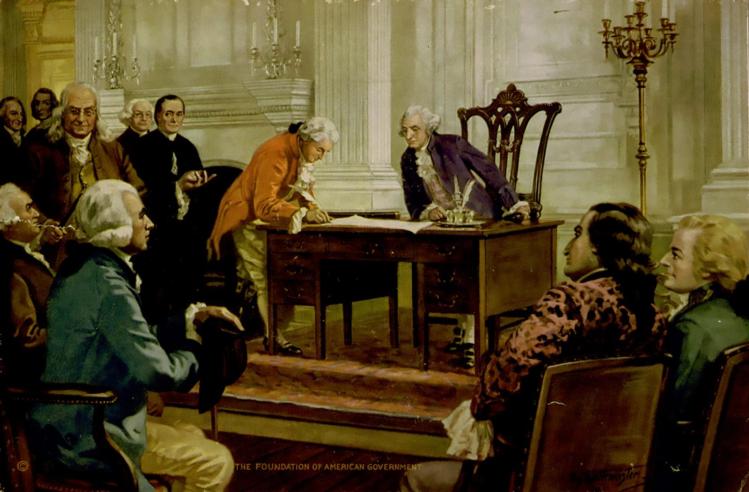
The men and women of the revolutionary generation loved to write. “Whatever deficiencies the leaders of the American revolution may have had,” observes historian Bernard Bailyn, “reticence, fortunately, was not one of them.” Neither was literary conservatism. The pamphlet—the preferred form during that period—could admit of astonishing variety and was frequently an occasion for play. Take, for example, Ebenezer Chaplin’s The Civil State Compared to Rivers, a jeremiad against “grievous” administration powered by an extended meditation on the fluvial. Or the Dialogue between the Ghost of General Montgomery and an American Delegate, a dramatized debate between a slain Continental Army leader and a squeamish colonist seeking reconciliation with the Crown (“I am SENT here upon an important errand,” the spectral general booms, “to warn you against listening to terms of accommodation from the court of Britain”). The revolutionists debated matters of solemn importance: God, tyranny, liberty, and law. But their writing, at its best, also expressed something like delight.
The pamphlet is a form well-suited to a democratic sensibility. Its power comes from the “I” of a citizen convinced he has something to say and eager to get it out there quickly, cheaply, and widely. The pamphlet is a “one-man show,” George Orwell once wrote. Most of the revolutionaries who wrote them were amateurs, whose literary pursuits began following days working as merchants, lawyers, and farmers. They were not afraid to submit their ideas to the judgment of neighbors, nor to appeal to the authority of public opinion over public affairs. The form honors both self-government’s individual and social demands: to take seriously our capacity for judgment while remaining prepared to credit the judgments of others. The literature of the American Revolution cultivated, in readers and writers alike, a bracing openness to the political future.
Patriotism has never come particularly easy for me, but revolutionary-era American print culture can arouse feelings of pride. It was playful, demotic, and syncretic—in the way of all the great culture this country has produced. Think, for example, of the way Thomas Pynchon writes novels, Andre 3000 makes music, or Stephen Curry plays basketball. Bailyn writes that the best writing of the American founding “had a rare combination of spontaneity and solidity, of dash and detail, of casualness and care.” A similar appraisal can be offered of the writing of Dorothy Day, a Servant of God who was also an American journalist. She set out to publish a newspaper, The Catholic Worker, that stitched together polemic and poetry and sold for a penny in a rowdy city square. This lineage of writing and art—just one of many influences, some of them noxious, on American history—is worthy of the democratic ideal. At its best, it can sustain democratic hope.
Where the country’s founders loved to write, the men and women presently running this country love to make videos. As Mitch Therieau has ably tracked for The Drift, the MAGA regime produces a deluge of frightful and baffling slop, disseminated across the official channels of state. These videos overwhelm by splicing together visual references that are alternately repulsive, nostalgic, and inane. A penguin wanders into an empty horizon; masked agents smash through locked doors; the big man himself offers a limp thumbs-up. In an effort to gin up support for an incoherent war against Iran, government accounts released sizzle reels of drone-strike footage interspersed with clips of Barry Bonds, Russell Crowe in “Gladiator,” and SpongeBob SquarePants (featuring music from the Australian rockers AC/DC and Canadian rapper Drake). Of the overall effect of the MAGA visual culture, Therieau writes:
It is clear that the construction of a new, right-wing dreamworld is a priority for the government. And yet without a clear vision of a better future, the dreams the propaganda machine is straining to produce feel especially murky and confused, less like oracular revelations than the convulsive firings of an addled collective mind in the grips of a terminal fever.
These videos mirror—in a debased, demonic form—many aspects of America’s democratic cultural lineage. But here, you find play without joy, visual variation without creativity, and mass political appeals intended less to mobilize than to anesthetize. Despite their brio, the videos strike one as rather sad, hopeless documents. In response to the specter of American decline, they propose we turn up AC/DC’s “Thunderstruck” and watch some snuff videos.
The United States, on its 250th birthday, is a country in decline. Our creaky constitutional order is incapable of managing social conflict; our billionaire problem is becoming a trillionaire problem; and some third of the electorate seems permanently stuck in right-wing fantasyland. Is the decline inexorable? Can democracy survive the flood of slop? Does anyone, really, want 250 more years of this? Have we any reason for hope?
I recently came across a 1969 reflection from Dorothy Day on leading a Christian life amid the seeming decline of the American Church, and I think she may have something to say to American Catholics on this semiquincentennial of a democracy on the brink. Asked by the editor whether she is pessimistic about the future of the Church, Day is breezy:
Oh yes, why worry about empty schools, seminars and even rectories? Maybe the Lord is giving us a little reminder that there has been too much building going on, and that it is time to use some of these buildings for the poor, for families…“This corruption must put on incorruption,” as St. Paul wrote, and while the outer body is falling apart, the inner is being renewed!
Day’s answer connects the basis for Christian hope—the faith in the Resurrection—with the day-to-day experience of navigating hollowed-out Church institutions. We should read decline, she suggests, as an occasion for discernment. We should call to mind the good news that it is precisely amid death that we find new life.
The United States is not the Church, of course, and the Christian faith can’t guarantee that this country won’t shed what remains of its democratic character. But democracy demands its own kind of faith: a consistent orientation toward an ideal—that human societies might be guided by communication among equals rather than by force or fraud—even when our backs are against the wall and evidence for such ideals is difficult to see.
Many twenty-first-century American Catholics are already practiced at sustaining something like faith amid the appearance of decline. We recite the creed after limpid homilies in sparsely populated sanctuaries and remind ourselves that the Eucharist is equally present in a vital parish as a decrepit one. Liberal and radical American Catholics may discover that the capacity to sustain a difficult faith will come in handy in the political struggles ahead. We might take after Day and embrace this sour semiquincentennial as a moment for discernment. The outer body is falling apart; perhaps it’s time for the inner to be renewed.
We welcome your comments about this article. Please send your response to [email protected].