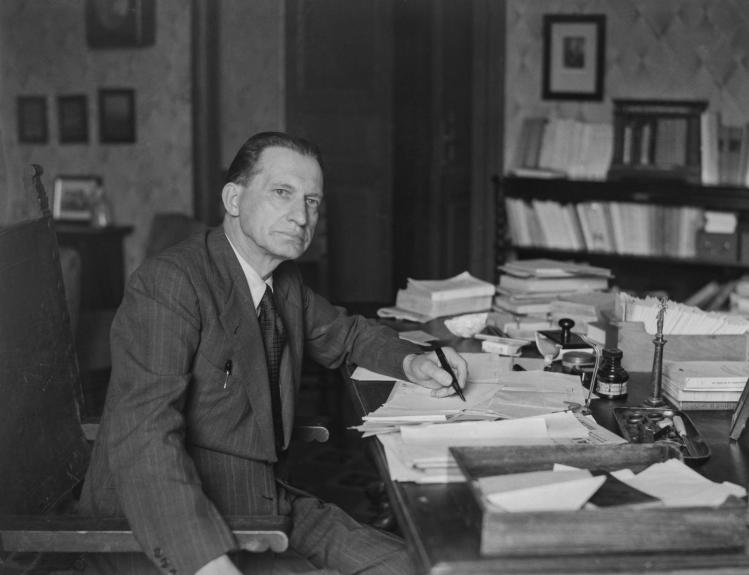
An Italian politician might soon become a saint. The jokes write themselves. A politician? From Italy? But it’s true. The Archdiocese of Trento in northern Italy announced this spring that it has concluded the first phase of the canonization process for a native son, Alcide De Gasperi. This included assembling twenty-two thousand documents, all now resting in twenty-three boxes at the Dicastery for the Causes of Saints in Rome.
They will make for interesting reading. De Gasperi was born in a small village near Trento in 1881. The village was then part of the Habsburg Empire, and De Gasperi spoke German and Italian with equal fluency, a fact later used against him by political opponents. After World War I, the village became part of Italy, and De Gasperi became one of the founders of the Partito Popolare Italiano (PPI), the highly successful Italian Catholic political party. Mussolini dissolved all political parties including the PPI in the mid-1920s, and De Gasperi was imprisoned in Rome’s notorious Regina Coeli prison for his antifascist activities. De Gasperi’s archbishop bargained for his release and eventually persuaded the Vatican to hire him as a cataloguer at the Vatican Library, where he quietly labored until 1943. The salary was miserable—barely enough to support De Gasperi’s wife and four daughters—but the hours were congenial. The library was open only from 8:30 a.m. to 1 p.m., giving De Gasperi time to read, research, and write (under a pseudonym). We know he read both America and Commonweal. During the war, De Gasperi covertly worked with activists from all backgrounds to prepare for the conflict’s aftermath. He founded the Christian Democratic party with a handful of like-minded colleagues and served as Italy’s prime minister from 1945 to 1953, the longest consecutive tenure in that role of any postwar Italian politician. He helped draft the country’s 1947 constitution, which is still in force.
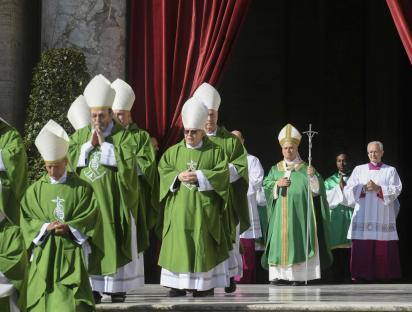
The announcement that the first phase of the archdiocesan investigation was complete came not just from Trento but, significantly, also from Vatican officials in Rome. The effusive communiqué on De Gasperi’s cause—given that ecclesiastical bureaucrats manage hundreds of case files for potential saints at any one time—suggests a new relevance. It praises De Gasperi as one of the founders of the European Union, along with other Catholic politicians of that era, including West Germany’s Konrad Adenauer and France’s Robert Schuman. (De Gasperi and Adenauer first met at a conference of Catholic politicians in 1921.) Cardinal Baldassare Reina, one of the two Roman cardinals present at the small ceremony—another portent—lauded De Gasperi’s commitment to both Catholicism and democracy. “At a moment in history when credible and coherent leaders are needed,” he explained, “De Gasperi appears as a relevant model, capable of offering valid lessons for people engaged in politics and social work.” We live in a “crisis of political representation,” Reina continued. Perhaps the “De Gasperi method” could offer new pathways for an “era marked by polarization and populism.”
Until recently, claiming a “De Gasperi method” for democracy would have amused commentators on postwar Italian politics. The dominant scholarly assessment has been left-leaning and anticlerical. These scholars viewed the Christian Democrats through the corruption and clientelism that marked the party’s collapse in the 1990s, and they lamented that Christian democratic parties in Italy, West Germany, the Netherlands, and, later, Chile, Venezuela, and El Salvador became so closely tied to the United States during the Cold War, squeezing out socialist and communist alternatives. They derisively termed the fervently anticommunist Pope Pius XII “NATO’s chaplain.” They lavished praise on the Italian Communist Party (PCI) and its charismatic leader Palmiro Togliatti.
The appearance of Mark Gilbert’s lucid and learned Italy Reborn: From Fascism to Democracy in this context is notable. Gilbert teaches at the Johns Hopkins–affiliated School of Advanced International Studies in Bologna, and knows how to untie Italian historiographical knots. He lightly dismisses the idea of De Gasperi’s sanctity—Italian politics in the late 1940s was a bloodsport—but emphasizes De Gasperi’s significance. Not a single English-language biography of De Gasperi exists, yet no person was more responsible for Italy’s transition from fascism to democracy in the 1940s.
Nothing about this transition should be taken for granted. The deplorable economic situation in Italy during World War II—as Allied armies inched up the peninsula and partisan guerrillas waged war against the Nazis and, occasionally, each other—strains the imagination. In 1945, government rations for healthy adults in most of Italy were fewer than a thousand calories per day.
That these emaciated citizens would build a sustainable democracy seemed unlikely. The roots of self-government in Italy dated from the nineteenth century, but they were not deep, and Mussolini’s takeover in 1922 had created a generational gap on the basics of democratic practice. In addition, the commitment to democracy of some key external actors in Italian politics was provisional. Pius XII had written a much-touted 1944 letter cautiously endorsing democracy, but he proved willing to accept a form of Catholic authoritarianism on the Iberian Peninsula. One U.S. observer cited by Gilbert worried that the natural endpoint of a Christian Democratic government was Salazar (in Portugal) or Franco (in Spain). President Harry Truman wanted the Christian Democrats to take power in Italy, and De Gasperi toured the United States to great acclaim in 1947 as he negotiated Italian participation in the Marshall Plan. Still, Truman also placed pressure on De Gasperi to formally prohibit the participation of the PCI in any Italian government, even when PCI vote totals merited it.
Gilbert is quietly polemical, and compelling, on the topic of Togliatti and the PCI. Revelations from Russian archives demonstrate the tight links between Stalin, the Comintern, and Togliatti, disproving assertions in the historical literature that the PCI was a homegrown and innocent form of democratic socialism. In 1944, Stalin still favored cooperation with parties such as the Christian Democrats, a strategy called “parliamentarism,” and so did Togliatti. But in 1947, Stalin abandoned such cooperation, refused to participate in the Marshall Plan, and ordered Italian Communists to “recognize the guiding role of the Bolshevik Party of the Soviet Union.” So, too, did Togliatti.
De Gasperi navigated all these currents. Gilbert judges the Italian election of 1948 as the most important in all of postwar Europe. It was a stunning triumph for De Gasperi and the Christian Democrats, but it’s often presented as a tragedy because of financial assistance provided to the Christian Democrats by the CIA, support mobilized within the Italian diaspora by figures such as New York’s Cardinal Francis Spellman and even Frank Sinatra, and denunciations of Communists by Pius XII.
Gilbert takes a different view. Certainly the Christian Democrats and the PCI exchanged savage rhetorical blows over several months of intense campaigning, and these speeches, posters, and radio broadcasts gave the election an apocalyptic feel. Foreign assistance to the Christian Democrats, though, was not decisive. (The Soviets gave financial support to the PCI, too.) War-weary Italians wanted peace more than anything else. But they also wanted democracy, as demonstrated by their extraordinary turnout. More than 92 percent of eligible voters cast a ballot.
In the end, one party was more committed to democratic practice than its opponent. By 1948, De Gasperi could point to the coup in Czechoslovakia and repression in Poland as evidence of where the Communist “people’s democracies” of Eastern Europe were headed. De Gasperi recognized the importance of Communists and liberals along with Christian Democrats in postwar Italy—he referred to them as the three “streams of opinion” in Italian political life—but he had a realistic sense of the natural limits to power-sharing with the PCI at the height of the Cold War. By contrast, he stressed his own democratic commitments. As he told a large crowd in Bologna during the 1948 election: “For democracy I fought against Fascism;…for democracy I made a common front…with socialists, freemasons, and liberals; for democracy I struggled to survive.”
The topic is beyond Gilbert’s remit, but his book prompts reflection on the connections between Catholicism and politics. Rerum novarum (1891), Leo XIII’s encyclical on labor and the working class, was formative for a young De Gasperi, and he plumbed the archives and investigated the document’s origins when working at the Vatican library. Leo XIII used the term “human dignity” in Rerum novarum and propelled it into wide circulation in the Catholic world. After World War II, De Gasperi, Adenauer, and Christian Democrats across Europe and Latin America placed “human dignity” in national constitutions, the Universal Declaration of Human Rights, and founding documents for the nascent European Union.
What had been missing before World War II in Catholic political thought, though, was not a defense of human dignity. Salazar (in Portugal) and Franco (in Spain) also inserted the term “human dignity” into their respective constitutions, even as they dismantled any political opposition. What was missing was a defense of democracy. The word is not mentioned in Rerum novarum. As De Gasperi well knew, the Vatican’s tepid support for the PPI and its willingness to negotiate with Mussolini had eased the transition from democracy to fascism in Italy in the 1920s. In the 1930s, Catholic political parties and politicians veered into authoritarianism in countries as diverse as Austria, Portugal, Spain, Brazil, and Argentina.
The central figure in the effort to provide a Catholic grounding for democracy was the French philosopher Jacques Maritain, who profoundly influenced De Gasperi and his Catholic contemporaries. De Gasperi encountered Maritain by reading his essays and manifestos in the Vatican library. Maritain toured Europe, North America, and Latin America in the 1930s and ’40s, rallying his peers around a deeper Catholic commitment to democracy. Even at the height of the Second World War, Italian Catholics in De Gasperi’s orbit discussed Maritain’s writings in clandestine reading groups, absorbing his claim that democracy was a natural outgrowth of the gospels and the writings of Thomas Aquinas.
Maritain’s grasp of day-to-day politics was hazy. He never joined a political party, spent a decade removed from even academic politics at the Princeton Institute for Advanced Study, and retired to a monastery in France after the death of his wife, Raïssa. His triumph was the formal endorsement of democracy by the world’s bishops at the Second Vatican Council (1962–1965). But what Maritain lacked in practical wisdom, a generation of Catholic politicians around the world provided. In Italy, that politician, as Gilbert ably demonstrates, was De Gasperi.
Do we have such politicians now? The role of the Catholic Church in European and Canadian politics is much diminished, although recognizably Catholic politicians exist in the Philippines and parts of sub-Saharan Africa and Latin America. In the United States, our second Catholic president, Joe Biden, told David Brooks that his father had read Maritain in the 1950s, but whatever the truth of that assertion, the link between faith and politics for Biden was personal rather than philosophical. Our most prominent Catholic politician now, Vice President J. D. Vance, invokes democracy and free speech in order to chastise European allies for putative limits on right-wing populist parties, but also peddles the demonstrably false claim that the 2020 presidential election was stolen. The neo-integralist movement associated with Vance is distinguished by its focus on a sovereign executive or an empowered judiciary, not by its commitment to electoral politics and legislative representation.
In 1947, when De Gasperi visited the Lincoln Memorial in Washington D.C., he emphasized the need for European Catholics such as himself to better understand “the enduring blend of pragmatism and idealism that dominates American life.” He noted Lincoln’s invocation of God in his second inaugural—“with firmness in the right as God sees the right”—and promised Italians would rise to the challenge of their moment as Lincoln had risen to the challenge of his. Shedding much of the anti-Americanism just beneath the surface of European Catholic writing in the early twentieth century, De Gasperi, Maritain (who lived in New York during the war), and their contemporaries hoped Americans could help them craft their own version of a politics and society infused with religion, certainly, but also committed to pluralist democracy.
Now, another American, Leo XIV, has been elected pope. His politics are unknown, but he has lived in settings as diverse as Chicago during the era of two (Catholic) Mayor Daleys and a rural Peru shaped by advocates of both liberation theology and Opus Dei. He could do worse than to study the De Gasperi canonization file, not only to assess his sanctity but to better understand how a different Catholic in a different time provided a worthy model of how to blend faith with a political life.
Italy Reborn
From Fascism to Democracy
Mark Gilbert
W. W. Norton & Company
$35.99 | 544 pp.