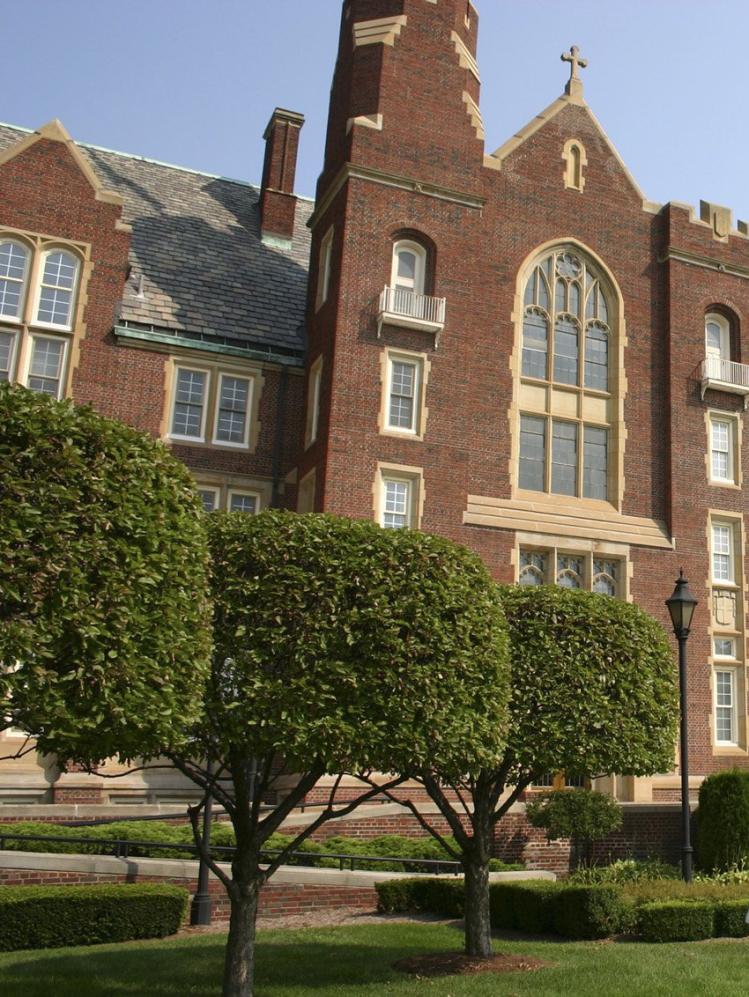
Detroit Archbishop Edward Weisenburger’s removal of three professors from Sacred Heart Major Seminary in July was bound to stir controversy. The seminary, which has long been described as a “Francis-free zone,” is known for its theologically conservative curriculum, which includes some fairly fringe ideas. Ralph Martin, one of the faculty members who was fired, has written extensively on the question of salvation of non-Catholics; he’s argued that Vatican II did not encourage an inclusivist attitude but in fact affirmed the longer tradition’s exclusivist view—that for non-Catholics, salvation is extremely unlikely. Priests-in-training at the seminary have been absorbing this kind of thing for years, bringing it to parishes around the country.
The firings have generated wide and predictable criticism from conservative Catholics, among them Eric Sammons at the website Crisis. Had the incident occurred a few months earlier, it could perhaps have been mistaken as guerilla marketing for Mark S. Massa’s latest book, Catholic Fundamentalism in America, published in the spring. The Sacred Heart situation dovetails with two of the subjects that Massa explicitly examines. One is the case of Fr. Leonard Feeney, the mid-twentieth-century Harvard chaplain whose strong exclusivist views on salvation earned him excommunication in 1953. The other is the influence of contemporary right-wing Catholic media, including EWTN, ChurchMilitant.org, and Crisis (and Sammons). EWTN is the most powerful and well known of these, but ChurchMilitant was so extreme that a far more conservative Detroit archbishop forced founder Michael Voris to stop using its previous name, “RealCatholicTV.” Meanwhile, Crisis flags issues that often find their way to EWTN-sponsored outlets and identifies authors who go on to appear in more elevated venues, such as First Things, that play a key role in right-leaning American Catholic discourse. They are skilled at turning teapot tempests (like Weisenburger’s seminary firings) into culture-war flashpoints that fire up Catholics around the country.
Massa requires little introduction as an authoritative chronicler of American Catholicism in the later twentieth century, always with a historian’s eye to how the past plays out in the present. He constructs the notion of “Catholic fundamentalism” by focusing on militant, sectarian movements that mimic the dynamics of fundamentalist Protestantism, from which he derives the term. The movements he ties together span over almost eighty years, from the late 1940s to now. The examples he chooses (and links together with H. Richard Niebuhr’s models from the classic Christ and Culture) are aligned more by affect than anything else, with many of the players likely unaware of others. Catholic fundamentalism is not an organized movement but a loose coalition of the disaffected. What keeps it from being a mere gallery of oddities is how some of these individual, once-marginal elements have gained access to political and cultural power in the United States, particularly in the second Trump administration.
Among the Catholic fundamentalists that Massa examines are the rogue Belgian priest Gommar de Pauw and the Society of St. Pius X community in St. Mary’s, Kansas. De Pauw—who started a Latin Mass chapel on New York’s Long Island in the late 1960s—was at the leading edge of what has since become a significant American traditionalist movement following Pope Benedict XVI’s loosening of restrictions on the older Mass. As for St. Mary’s, its members live out Rod Dreher’s articulation of the “Benedict Option” for Christian retreat from a hostile public square. Beyond liturgy, the St. Mary’s enclave embraces ideas that have become central to the conservative moment in the Trump era, particularly a pronatalist vision of large, patriarchal families. Dreher himself has relocated to Hungary, where Viktor Orbán’s policies have explicitly influenced and inspired many of those championed by Catholic convert and vice president J. D. Vance in the Trump administration.
The Feeney episode itself still has contemporary relevance; his theological denunciations of non-Catholics, as Massa lays out, echo in today’s conservative culture-warrior attitudes toward higher education, where students must be saved from the perils of bogeymen like “wokeness,” “critical race theory,” and “gender ideology.” Massa also looks at Christendom College in Front Royal, Virginia. In a sense, it represents an oasis—like St. Mary’s, a place of retreat from larger society, though somewhat closer to the mainstream. Founded in 1977, Christendom was an early example of what has become the “Newman Guide” network of schools offering curricula and campus environments appealing to conservative Catholics. Its politics presaged Wyoming Catholic College, the fellow Newman Guide school fictionalized in Will Arbery’s 2019 play Heroes of the Fourth Turning, a still-relevant portrait of the young Catholic hard right. Educational approaches that once seemed edgy and anachronistic, particularly to liberal Catholics, are now a force to be reckoned with, inspiring efforts to transform educational policy for the rest of the country.
Massa is generally fair to his subjects, even when they come across unsympathetically. In some cases, such as that of Michael Voris, Massa underplays the pathos of the situation. Voris rose to prominence on a “recovered homosexual” narrative that synchronized perfectly with the increased salience of same-sex marriage as a culture-war splinter issue in the late aughts and early 2010s. His sensationalistic style, including on-camera confrontations and other hijinks, made him toxic even to many conservative Catholics. While he aspired to the provocateur status of someone like Milo Yiannopolous (who himself has become Catholic), Voris was brought down by his personal trespass of company-conduct policies. He lacked the ironic combination of shamelessness and discipline that powers Trump-era icons. Yet his brash video style was ahead of its time and has been embraced with greater finesse by far more mainstream figures in the age of TikTok.
The contemporary examples Massa covers—with the exception of EWTN and to a much lesser extent Crisis—perhaps undersell the power and spread of the tendencies he identifies with Catholic fundamentalism. The Society of St. Pius X, for example, is fringe even as traditionalist movements go, and St. Mary’s is an exceedingly small town no matter its birthrate. Christendom, in name and throne-and-altar ethos, comes across as one of the more closed-in of the Newman Guide schools to outsiders. ChurchMilitant’s sell-by date passed long before Voris was ousted.
Yet expanding the circle of Catholic fundamentalism to encompass broader sectarian approaches reveals a more troubling reality. Few Catholics will ever find themselves drawn to live in St. Mary’s (too extremist); relatively few will even read a former Crisis author’s essay in First Things (too elite). Many more will engage with mainstream venues like the Hallow app or Word on Fire or encounter figures who push Catholic fundamentalism with a friendlier face. Their parish directors of religious education, school principals, and priests may well have been trained at Newman Guide schools into a theology and culture often quite jarring to Catholics raised in the postconciliar Church. Some Catholics are entirely turned off of the Church by this formation, and a smaller number embrace liberal Catholic movements, but those who are otherwise ideologically uncommitted have accepted this softer fundamentalism as a normal or positive expression of contemporary Catholicism. These new faces of the Church must be taken seriously and literally, and they have much in common with the phenomena Massa centers in his book. Indeed, a book by Ralph Martin on the specific question of salvation was blurbed by, among others, Cardinals Timothy Dolan and Peter Turkson—who were at least somewhat serious papabile in the 2013 conclave (it should be noted that Martin has been an almost obsessive critic of Bishop Robert Barron on this issue).
Massa thus charts the evolution of a phenomenon that has seen perhaps unanticipated success. But how aforementioned agendas (e.g. pronatalism) favored at least in name by the Trump administration fare against the inevitable backlash—or against the very different antihumanist “tech right” (exemplified by people like Peter Thiel), which has far more money and soft power—will indicate whether Massa’s treatment is a snapshot of the marginal past of a movement on the rise, or an epitaph for one doomed to the fringes.
Bishop Weisenburger’s move may have pleasantly surprised observers who’ve watched with concern as American bishops cultivated such elements even as they maintained their distance (ChurchMilitant was able to do what it did for a long time before facing discipline). Coming early in the Pope Leo era, from a bishop he had a hand in appointing, it may signal a gradual shift in the approach taken by American Catholic bishops to the culture wars. Leo is someone whose formation and ministry unfolded in “mainstream” postconciliar Church institutions, but he must have encountered some of those that Massa writes about, particularly EWTN. His approach to them, and to the younger clergy they helped form, will be one of the defining aspects of his pontificate vis-à-vis his native soil.