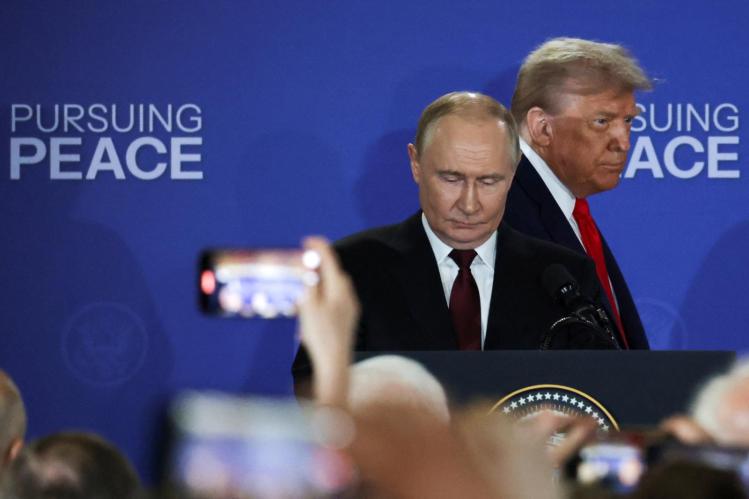
All too predictably, Donald Trump’s short, shambolic summit in Alaska with Vladimir Putin does not seem to have advanced any kind of resolution to the war in Ukraine. As with the recent European trade negotiations, the Alaska summit was more show than substance, designed to commandeer the world’s attention and shift the press’s focus from the ongoing Epstein scandal. It will be remembered mainly as a series of clips: Trump rolling out a literal red carpet for a smiling war criminal; his incoherent, delusional ravings about how Putin encouraged him to get rid of mail-in voting; and the joint press conference in which Trump seemed eager to hand over whatever is left of U.S. leverage and credibility in foreign policy. He appeared distracted and disappointed, even demoralized. No doubt he had a lot on his mind: falling poll numbers, lagging economic indicators on jobs and inflation, and those Epstein files his administration promised to release. But others, including Chinese officials, were watching closely. What were they thinking as they listened to Trump wax sentimental about Putin’s “warmth,” even as the Russian leader continues to defy Trump’s demand for a ceasefire?
It didn’t have to be this way. Trump has tools for increasing U.S. leverage against Russia—sanctions, but also coordination with Europe to bolster Ukrainian military defenses—if only he would use them. But Trump has grown impatient; he just wants the war to end, no matter how. As J. D. Vance recently crowed on Fox, “We’re done with the funding of the Ukraine war business. We want to bring about a peaceful settlement to this thing.” If only wishing made it so: one wonders how Trump, Vance, and U.S. special envoy Steve Witkoff expect to achieve any kind of peaceful settlement after months of giveaways to Russia, including loosening sanctions, erratic policy reversals on Ukrainian aid, and shifting messaging surrounding a ceasefire. If Trump didn’t completely sell out Ukraine—a Russian West Bank–style occupation of the Donbas was apparently in the offing—it’s thanks to European leaders’ emergency trip to Washington three days after the Alaska summit to support Zelensky. Mindful of their own security interests, they managed to stop the bleeding but couldn’t extract more from Trump than vague promises of peacekeeping and the prospect of a “trilateral” meeting, which Russia immediately shot down.
The upshot of Trump’s great-power cosplay is that Russia now has a free hand to continue the gruesome status quo, which involves not only a grinding war of attrition but also attacks on Ukrainians in cities far from the front. Europe’s leaders now realize that Trump is just as untrustworthy as Putin, albeit far less sophisticated. It will fall to them to devise a strategy to assist Ukraine in a way that eventually forces Putin to get serious about negotiating. With or without American guarantees, they must make it clear that Kyiv will not accept Putin’s maximalist demands.
As with April’s tariff-induced crisis in the bond market, or the reemergence of the Epstein fiasco in July, this latest debacle has again exposed a key vulnerability of the Trump regime: it rests not on any coherent ideology or strategy, but on the diminished charisma of an unpopular and incompetent tyrant. The president’s laziness and lack of interest in policy impede him from actually realizing the full-scale autocracy he clearly intends.
That’s why, for all the real signs of creeping fascism—masked ICE agents illegally abducting immigrants, the extortion of leading law firms and universities, white-supremacist revisionism of American history in museums—the country’s politics has lately taken on a farcical quality, inspiring as much ridicule as fear and disgust. One example: the senseless federal takeover of law enforcement in Washington D.C., which was allegedly triggered by the mugging of nineteen-year-old former DOGE programmer Edward Coristine, better known by his online pseudonym, Big Balls. Another example: the prosecution, ordered by U.S. Attorney for D.C. Jeanine Pirro, a former Fox News host, of a man who “assaulted” an armed federal agent by throwing a sandwich at him while drunk. More National Guard troops are arriving in the capital every day. Their commanders have directed most of them to confine themselves to well-trod tourist areas and avoid the parts of the city where most of the crime actually takes place. Some of the troops are not even carrying weapons. They are extras in a made-for-TV spectacle.
Still, there are grave consequences for the Trump administration’s abandonment of serious governance in pursuit of stunts and petty score-settling. Smoky skies are now a fixture of summer, yet Lee Zeldin continues to dismantle the EPA; Trump’s spending bill exacerbates wealth inequality and increases the federal deficit as millions of Americans struggle to afford basic necessities, including food, housing, and health insurance; the extrajudicial brutality of ICE is set to intensify; and Robert F. Kennedy Jr. is pulling the plug on the development of advanced mRNA vaccines.
What would it take to get serious about these serious problems before it’s too late? Trump is a distracted man practicing the politics of distraction, and to some extent, it has been working: before we can adequately respond to one crisis that he has engineered, or permitted, a new one emerges. The success of any resistance to Trump will depend not only on courage or stamina (“outrage fatigue” is a luxury we can no longer afford) but on our collective ability to focus on the evils of this regime rather than on its many, many absurdities.