I stayed inside during the July 4 weekend. There is never any shortage of community events in Los Angeles for celebrating the holiday. But I, like many brown Angelenos, chose to limit my outings out of fear of being taken by ICE. I was born in California and raised in a small town in San Bernardino County, where I pledged allegiance to the flag and to the United States of America every morning throughout my public-school education. None of this seems relevant now—not with ICE and other federal agents in military gear storming public spaces; indiscriminately apprehending brown people regardless of criminal history, citizenship, or immigration status; and denying them due process.
One of those abducted off the streets was Andrea Velez, a U.S. citizen on her way to work downtown. Masked men with no identification grabbed her and pushed her to the pavement. She resisted, confused about what was happening and given no information about the authority of the men detaining her or why she was tackled to the ground. She was kept in custody for twenty-four hours. Her experience is not an isolated occurrence. Now, with people too scared to venture out, many typically bustling streets in Los Angeles are empty. Businesses are shuttered. Olvera Street, a popular tourist destination also loved by locals, was eerily quiet when I drove by on Sunday, July 6.
On July 2, a federal class-action lawsuit was filed in Los Angeles against the Department of Homeland Security and ICE alleging constitutional violations in their apprehending of people. The lawsuit was brought by the National Day Laborer Organizing Network, the Coalition for Humane Immigrant Rights, Immigrant Defenders Law Center, Public Counsel, ACLU affiliates across the state, the U.C.-Irvine Law School, and private firms. The lawsuit states that the region has been “under siege” and that the raids “follow a common, systematic pattern. Individuals with brown skin are approached or pulled aside by unidentified federal agents, suddenly and with a show of force, and made to answer questions about who they are and where they are from. If they hesitate, attempt to leave, or do not answer the questions to the satisfaction of the agents, they are detained, sometimes tackled, handcuffed, and/or taken into custody.” The suit goes on to describe the “dungeon-like” facilities used to hold people who have been denied access to legal counsel.
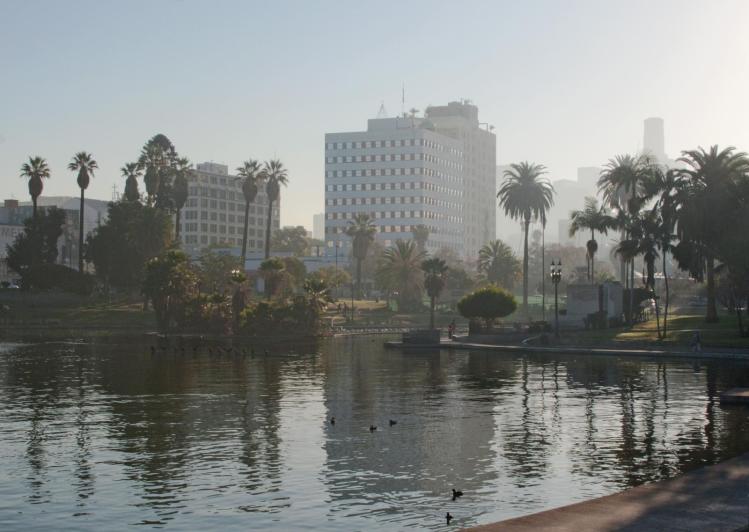
Despite the lawsuits, ICE and DHS have done little to change their tactics. Local communities were targeted throughout the July 4 weekend. Things reached a crescendo on July 7 with a raid on MacArthur Park, known as the Ellis Island of the West Coast. The park was mostly empty, except for some pedestrians at bus stops, a few street vendors, a St. John’s Clinic pop-up offering services to the unhoused, and children from a summer camp. Federal agents accompanied by members of the National Guard swept through on horses and in armored vehicles. The agents carried rifles and wore tactical gear. The only people they cleared out of the park were the children, who were taken inside to shield them from the trauma of a military invasion. Although agents arrived with a fleet of white vans used to transport detainees, they seemed to have made no arrests. It’s not clear that they had any intention of detaining anyone. “There is no plan other than fear, chaos, and politics,” Los Angeles mayor Karen Bass said at a press conference that afternoon. Instead, it appears photos and video were being taken of the agents in the park. FOX News was also on hand—“embedded” with ICE, as some pointed out. It seemed an opportunity for propaganda: sow misinformation about the “chaos” caused by migrants in Los Angeles. Local resident Mikema Nahmir, who was on his morning walk, joined other community members in a subsequent protest. “L.A. is ours, this is our city, this is what my morning walk turned into,” he told the Los Angeles Times “They’re terrorizing our neighborhood.”
Eunisses Hernandez, council member of District 1 of Los Angeles, spoke at a press conference following the takeover of MacArthur Park. “When we invade and surveil our own neighborhoods, when we scapegoat and demonize immigrants, when we disregard due process, we are no longer living under the rule of democracy, we are living under occupation and authoritarianism.” She ended with a national call to action and collaboration: “Please understand what’s happening here in the city of Los Angeles…. We are the canary in the coal mine…. What you see happening in MacArthur Park is coming to you.” Then, alluding to the July 4 passage of Donald Trump’s spending and policy bill, she added: “A $140 billion budget for ICE. What do you think that is going to do?”
On Monday July 7, seventeen additional states joined California in the lawsuit it filed last week, which is scheduled to be heard later this week. The states in their amicus filing are right to say that stops with no legitimate cause and ICE’s tactics have “shattered [the] rhythms of everyday life…and diminished public safety.” Though I am privileged in many ways, it is also true for me. I am afraid to run errands by myself, opting to bring my white Irish American husband along when I go to the market. I worry every day for my siblings, their families, and my parents, all U.S. citizens, but undeniably brown and of Mexican descent. What I see happening on a daily basis in my city and state pains me deeply. What is happening in Los Angeles is not normal. Every American in every state needs to understand this. It may not stop here.