Every June, I look forward to the blooming of the jacarandas. These quintessential Los Angeles trees line the streets, and gentle breezes send their lavender blooms falling gracefully to the pavement. It’s a sign that the Los Angeles summer will soon be in full swing, with outdoor concerts, plays, films, food festivals, sports, farmers markets, art crawls, swap-meets, flea markets, and family evenings spent eating tacos, desserts, and fresh fruit from street vendors. Families begin to plan their children’s summer stay-cations and celebrate their graduates with carne asadas (Mexican-style barbecue cookouts) and backyard and front-yard parties that fill the street with laughter and music. This month, for the first time since the January fires, a peace began to settle in Los Angeles—until it was abruptly interrupted by federal agents.
What happened is well known: masked men in unidentifiable uniforms indiscriminately raiding streets, schools, businesses, and homes, refusing to spare even young Latino U.S. citizens from detention in their mass deportation roundups. In response to the understandable outrage and protests that followed, Trump—with dubious legality—sent in first the National Guard and then the Marines, inflaming the tense situation even further. Governor Gavin Newsom was exactly right when he said: “Donald Trump’s government isn’t protecting our communities, they’re traumatizing our communities, and that seems to be the entire point.”
The misleading images of chaos and vandalism—perpetrated by a minority of the otherwise-peaceful protestors—that soon circulated through the news media failed to capture what life has been like here for the majority of Angelenos. Indeed, reporting has mostly neglected the fearful impact such a concentrated police and military presence has on people throughout the city. Richard Wood, President of USC’s Institute for Advanced Catholic Studies, described the evenings in southwest downtown “like life in a war zone or a police state: sometimes three or four law enforcement and National Guard helicopters flying back and forth or circling overhead; convoys of dozens of law enforcement and federal agents screaming by with sirens blaring.” Wood was among those gathered at an interfaith prayer vigil that became a part of the demonstration at the civic center downtown at Gloria Molina Grand Park; speakers included Roman Catholic archbishop José Gomez, Fr. Greg Boyle, SJ, of HomeBoy Industries, Joseph Tomás McKellar from PICO-California, Rev. Zachary Hoover from LA Voice, Rabbi Susan Goldberg of Nefesh, Fr. Brendan Busse, SJ, of Dolores Mission, Rabbi Sharon Brous of L.A.’s IKAR, Episcopal bishop John Harvey Taylor, Sikh leader Valerie Kaur, Aziza Hassan of NewGround, Pastor Carlos Rincon of El Centro de Vida Victoriosa, Rev. Najuma Smith, founding pastor of L.A.’s Word of Encouragement Church, and other community leaders. “Being at the vigil in downtown Los Angeles on June 10 felt right and it felt powerful in that deep Christian ‘power in prayer, power in vulnerability, power in community’ kind of way,” Wood told me.
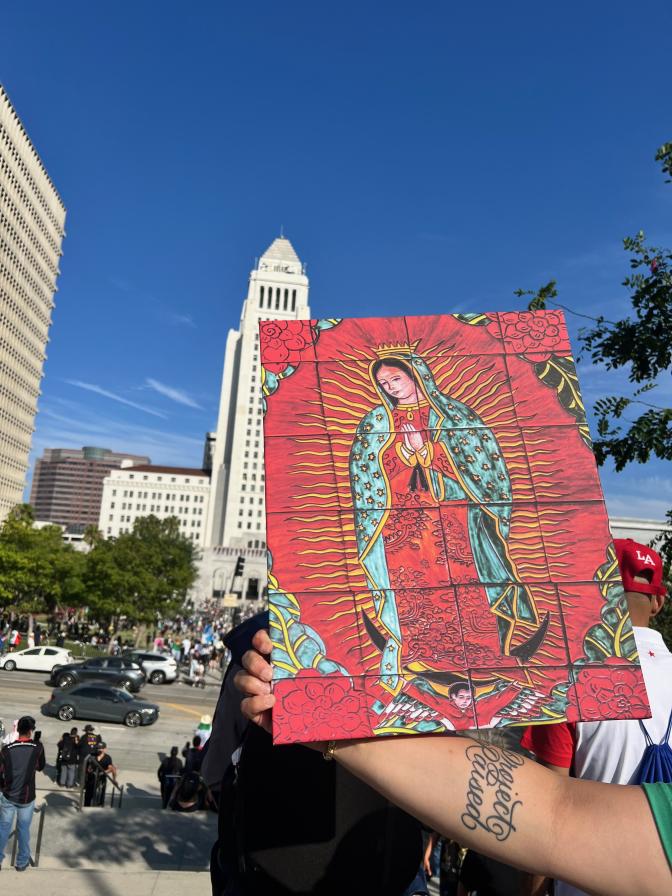
The Trump administration has made no secret of its intention to isolate and traumatize immigrant communities in Democratic-led cities. Thankfully, on June 14, millions of Americans across more than 2,100 cities and towns showed up in solidarity, participating in what may well have been the third-largest single day of protest in American history. While these cities and towns had only their local police departments present as peacekeepers, Los Angeles was again faced with heavy military presence—a presence that seems to have aggravated the LAPD, criticized in recent days by Trump for allegedly losing control of the situation. Perhaps they thought they had something to prove.
From what I saw that day, the LAPD was utterly uninterested in peace. I was standing with my husband on the steps of Gloria Molina Grand Park, watching the protest in front of City Hall, with the subway station behind us on Hill Street. We received a city-emergency notification on our phones warning us to stay away from Los Angeles and Temple streets because an unlawful assembly had been declared. Photographers and other protesters rested under the shade of trees; I took a few pictures of protest signs and prepared to leave soon.
At around 6:00 p.m., we heard rumblings that tear gas might have been deployed on protesters near City Hall. We decided to depart immediately. A Latino couple with two children (a little boy and girl) and a young adult woman walked huddled beside us, trying to remember where they had parked their car. As we approached the subway station, we saw a line of police in riot gear and demonstrators fleeing the station. We stopped in our tracks; seconds later, the family began approaching the officers for help with their hands raised. Worried for their safety, my husband decided to go with them. But before he could move, an officer aimed his weapon at all seven of us. The family turned back and ran. My husband and I also retreated.
We’d suddenly entered a survival mentality: if the LAPD had pointed a weapon at children, we were no longer safe regardless of our peacefulness. We were stuck, blocked by the mass of protestors, a street closure, and the line of police officers. The only way out, past the LA Law Library, was the one we’d sought to avoid all afternoon because of its heavy military and police presence.

We walked as quickly as possible so as not to cause a panic. We saw an elderly Asian man, strong for his age yet vulnerable, sitting peacefully alone under the shade of a tree watching the protest. I stopped and warned him emphatically to leave. Startled, he followed us, newly aware of the police line closing in behind us. We hurried, scared for our lives, convinced we might be hurt and arrested for protesting peacefully. I prayed to Our Lady of Guadalupe the entire time that another subway station, the one on First and Hill, would still be accessible. As we passed soldiers on the corner, a national guardsman flashed a secret peace sign at my husband. The street was clear and we made it just in time to board a train bound for North Hollywood.
As soon as we got off near our home, we met a pair of young Latina women in their early twenties who were entering the station. They held protest signs and were dressed to go downtown. We warned them to turn around, and they thanked us, but continued down the escalator. I can understand why. In Los Angeles, our protests have been acts of hope and courage, full of moments of joyful resistance expressed by dancing, singing, blessings, kind words, exchange of gifts, and soaring speeches. Members of the community are making themselves vulnerable for those who have no voice. They do it for themselves, too, fighting to find peace in the face of violence, to assert their rights in the face of egregious violations by law enforcement. They see the jacarandas bloom and remember the trees’ promise, daring to believe that a new season of joy lies ahead of us. I pray our local government and the LAPD remembers that, too.