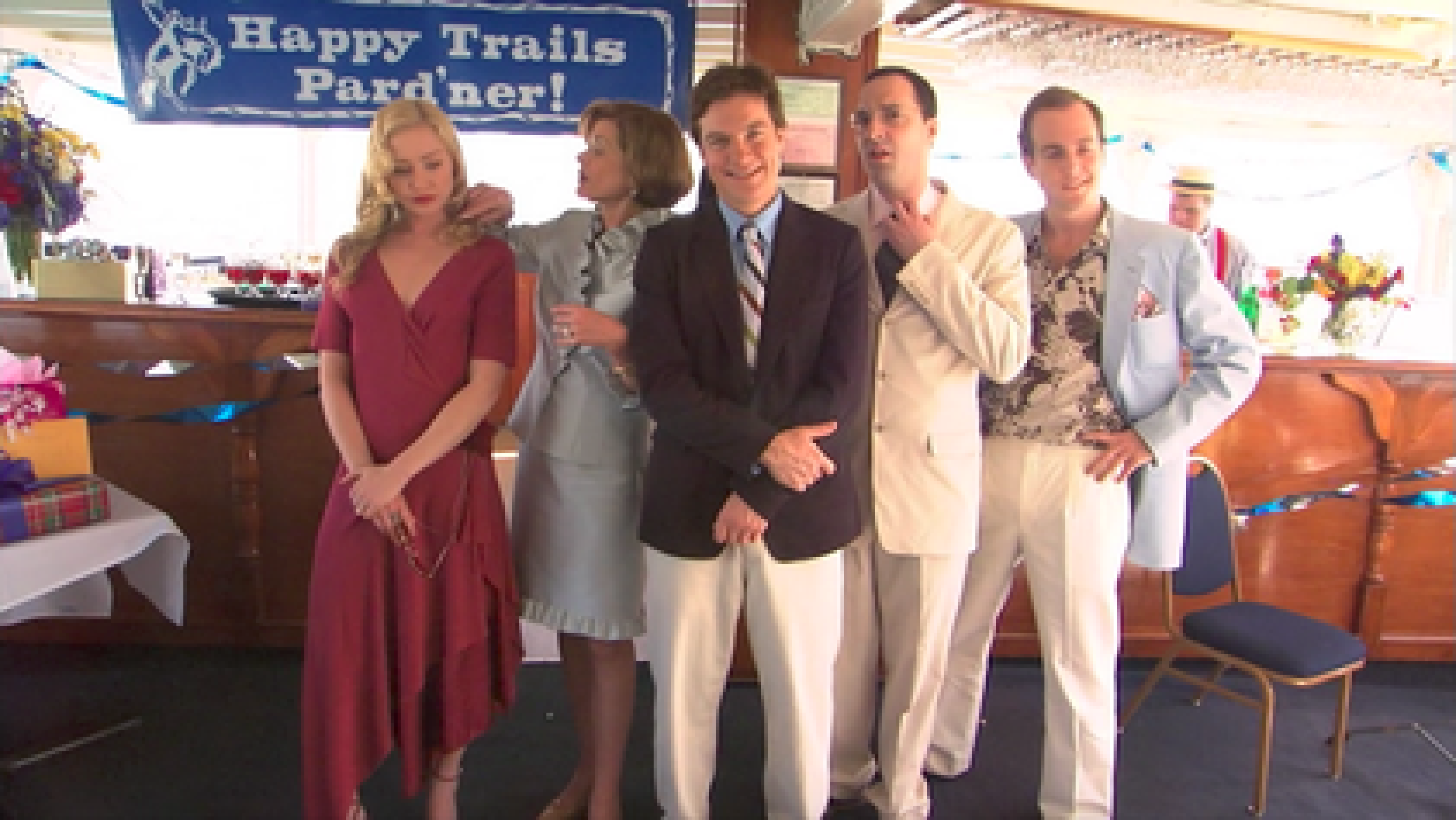
The Securities and Exchange Commission hardly seems a natural place for humor. But in the last few months, as the country’s legal system has tightened its grip on a host of corporate evil-doers—Martha Stewart, Dennis Kozlowski, Arthur Fastow—the SEC has surfaced as a comic foil in the edgy Fox comedy Arrested Development. The show is about a cartoonishly self-absorbed California clan with its hand in the family-business till. Nailing down Arrested Development’s premise in the first episode, in fact, was a loopy scene in which SEC operatives raided an aboard-yacht retirement party for the family patriarch, George Bluth Sr. (Jeffrey Tambor), arresting him for shady accounting practices at his housing-development company. The crook’s subsequent imprisonment allows for a plotline that meshes wicked social satire with the saga of a dysfunctional family. When the only responsible Bluth, Michael (Jason Bateman), attempts to set things right, he finds himself battling his eccentric relatives, including his brother Gob (Will Arnett),an incompetent magician; his sister Lindsay (Portia de Rossi), who dabbles in activist causes like an anticircumcision organization; and his ghastly, alcoholic mother Lucille (Jessica Walter), a virtuosa of offensive remarks (“That coat cost more than your house!” she tells her Hispanic housekeeper as the woman handles one of Lucille’s ostentatious furs).
A deeply cynical vision undergirds Arrested Development, whose characters—with the exception of the well-intentioned Michael and his awkward son, George Michael (Michael Cera)—disgrace themselves spectacularly week after week. Those that aren’t despicable, like Lucille, are bunglers: Lindsay’s goofy husband Tobias (David Cross), a would-be actor, who spends episode after episode frequenting auditions, delivering line readings in excruciating intonations. If Dickens were in Hollywood these days, churning out TV scripts, he might come up with grotesques like these. While the sheer awfulness of personalities is the engine driving the show’s humor, the writers have also penned in delightful moments of throwaway wackiness. In one recent episode, Lucille ordered a tuna dish at a fast-food joint; when asked by the perky waitress to pick between “plate or platter,” the Bluth matriarch rebutted in ice-queen tones, “I do not understand the question, and I will not respond to it.”
Arrested Development is distinctive in other ways. Unlike most sitcoms, which are shot on a single set, the Bluth family’s antics are filmed in various locations, inside and outside, often with a hand-held camera. Arrested Development also does without a laugh track—that unconvincing din that makes many a sitcom seem to peal with desperation.
And in a highly unusual move, a spare voiceover links the scenes, narrating the Bluth family story from the viewpoint of a dispassionate observer. These visual and auditory elements have something of a distancing effect. The use of a hand-held camera gives the scenes a mild resemblance to a documentary, a trait that’s perhaps all the more conspicuous because the rest of Fox’s schedule is crammed with reality shows featuring real-life behavior that’s almost as appalling as the Bluths’; the escapades of the vapid Paris Hilton and Nicole Richie in The Simple Life, for example, have certainly given the fictional clan a run for its money. The absence of a laugh track, meanwhile, seems to hone the humor’s savage edge—there’s no chorus of guffaws assuring us that the situations are funny—while the perspective and sense of continuity in the voiceover encourage us to put the characters’ behavior in a broader context.
One doesn’t have to look far to find a context, given the frequent references to the SEC (visit the Arrested Develop- ment Web site and you can read a sample Bluth Company newsletter, a publication that, early in 2004, bore a bright message: “Warm holiday greetings to our friends at the SEC who are most accommodating as we review the financial records of the Bluth Company”). Indeed, given the financial shenanigans of its characters, Arrested Development sometimes feels like a parable about the excesses of the 1990s and how that era’s lax business ethics have come home to roost. The beachside frozen-banana stand that’s been staffed by Bluth children for decades turns out to be a microcosm of the family’s financial corruption. Lucille’s determined doctoring of receipts, after the SEC demands an inventory of her possessions, is as resolutely criminal as anything that went on at Enron. A recent plotline in which Michael hired a publicist to burnish the family name recalled the way legal action against numerous corporate scoundrels has instigated tugs of war over imagery and public opinion. (Consider the coverage of Tyco mogul Kozlowski’s infamous party on Sardinia. Or the schadenfreude that has swelled around Martha Stewart, who has recently launched a Web site [www.marthatalks.com], to salvage her domestic-goddess reputation.)
This interpretation of Arrested Development can be extended a little further. One of Gob’s blundering magic tricks features an “Aztec Tomb,” an unreliable false-paneled booth (bought with embezzled money) that could easily be a metaphor for the innumerable dot-com stocks that have turned out to be hollow. Above all, Arrested Development makes hay out of its characters’ solipsism, recklessness, and failure to stay in touch with reality—the qualities that seem to have sparked an epidemic of corporate malfeasance in recent decades.