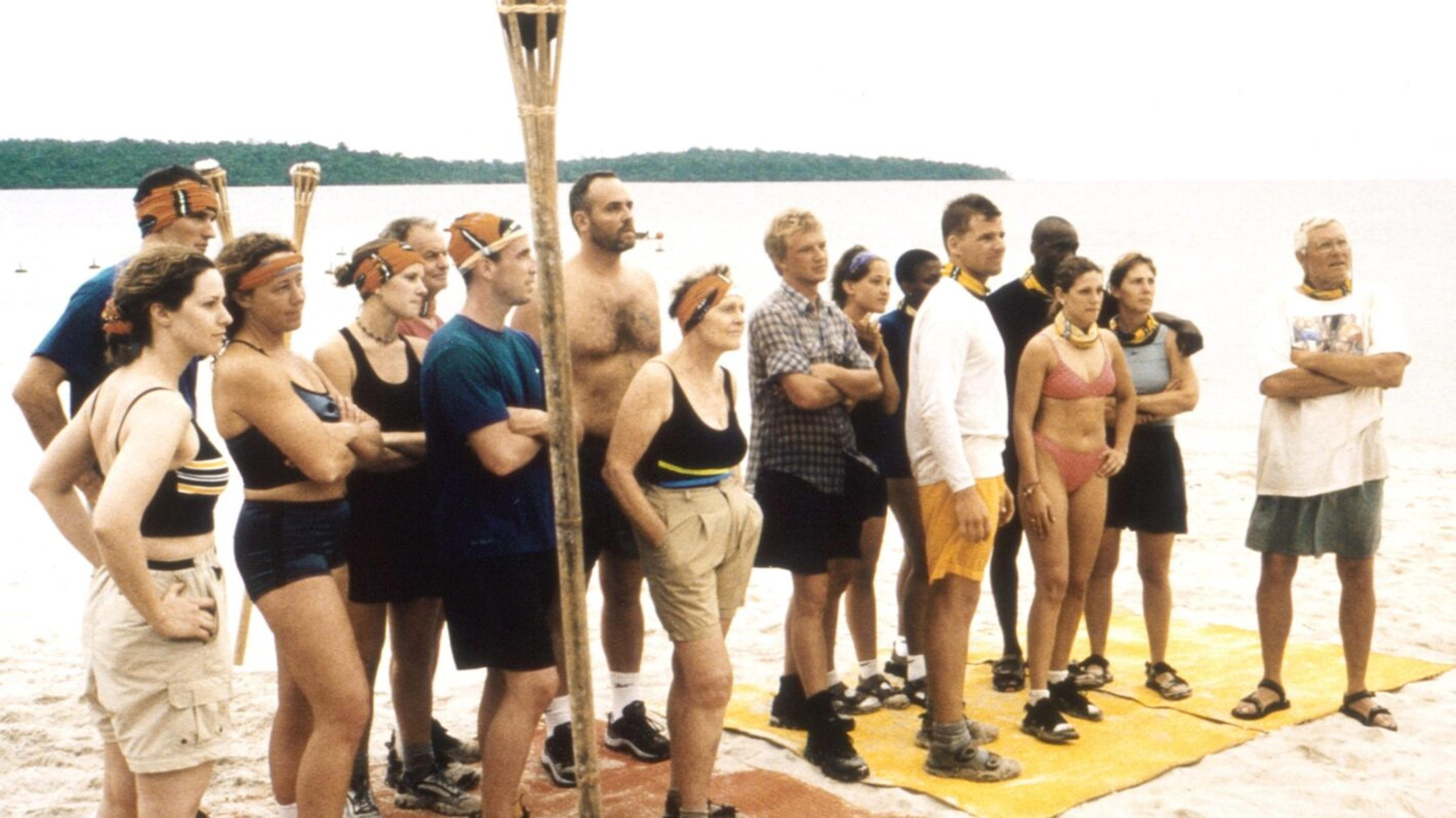
Summertime, and the living is easy—unless, that is, you’re one of the foolhardy folk who volunteered for TV’s new “reality” shows, in which case life is grueling, disgusting, claustrophobic, and broadcast to millions of viewers. The ten strangers who agreed to be immured in a house for CBS’s “Big Brother” have to endure camera surveillance twenty-four hours a day—even in the bathroom. Members of Britain’s Bowler family, enacting a Victorian lifestyle for PBS’s “The 1900 House,” have to read by gaslight and boil their laundry. Up in Canada, two married couples recently repaired to the prairie, pregnant sow in tow, to recreate the existence of 1870s pioneers for “Pioneer Quest: A Year in the Real West.” Canada’s History Channel will begin airing the program in October.
As for the anthropological experiment that was first out of the starting gate—CBS’s “Survivor,” which kicked off in May—its participants have had to eat barbecued rats and live maggots while stranded (with camera crews) on Pulau Tiga Island, near Borneo. As if the cuisine weren’t bad enough, now and then the smug TV host (Jeff Probst) summons them to a torch-lit “tribal council” … . “Survivor” is decked with more phony exotica than The Mikado—where they have to vote one of their number off the island. “It’s kind of like Judgment Day on earth,” the chemist Ramona Gray brightly remarked of this ordeal. Actually, it’s more like bonus month on Wall Street: whichever “Survivor” pawn is left after thirteen episodes will win a million dollars. Money rules, even when the best entertainment around is lathering in a mud volcano.
“Survivor” has been a ratings sensation for CBS, which is planning two more editions of the series, set in different wild locales, for 2001. Remarking on the phenomenon, business journalists have zestfully flourished demographics and Nielsen ratings (“Survivor” seems to be pulling even with the ABC juggernaut “Who Wants to be a Millionaire”), while more philosophical critics have brooded on the sociological significance of the new reality shows, which seem to cater to an insatiably voyeuristic public. PBS can pad “The 1900 House” all it likes with educational factoids about, say, Victorian wallpaper glue, but the salient revelation of this and similar programs is our willingness to accept the information age’s sure erosion of privacy.
The Club Med exoticism of “Survivor,” though, does seem a projection of our longing, on some level to escape the openness of the modern era. When the camera is not pinned on griping, gossiping contestants—who have been divided into two competing “tribes” for added suspense—it often bends toward atmospheric images that ooze a mysterious remoteness: sunset over a pristine beach, firelight dancing over naked flesh. More ludicrous is the pseudo-primitivism bandied about by Probst, who wields a googly-eyed “immunity idol” (picture a totem pole a little larger than your cell phone) as he bosses the tribes about, and who drops grandiose lines like “On the island, fire represents life.” Like the other new reality shows, “Survivor” may promise scientific objectivity—we can watch animosities grow and power relationships shift among the islanders, as if we were peering at bacteria through a microscope—but what the series delivers is classic myth: the idea that a seductive Otherness characterizes the East.
Viewers willing to give CBS an hour a week can watch this rather hackneyed legend do battle with a second one, of greater currency in contemporary American culture: the myth of corporate success. How do you thrive on an island in the South China Sea? The same way you thrive when you’re a high-powered business executive, it turns out: you think about “team building” and “morale” and how to “communicate” better, just as the “Survivor” contestants have done since day one. In fact, many of the show’s episodes resemble anecdotes from the better-business-management tomes that recently have swarmed into bookstores like a plague of locusts (Management Lessons from Pulau Tiga, after all, doesn’t sound much sillier than Leadership Secrets of Attila the Hun or Power Plays: Shakespeare’s Lessons on Management). For example, on Pulau Tiga, as in many ofrices, personality affects group wellbeing as much as effort and talent do. It was his constant bossiness, rather than any skill deficiency, that sealed the fate of retired contractor B.B. Andersen. At the second tribal council he had to snuff out his torch and make his desolate way to CBS’s “Early Show,” which interviews each survivor the morning after his or her exile. The moral? Develop your listening skills, so your co-workers (co-islanders) feel you value their opinions.
The corporate myth assumes that we can control our destiny and that the universe is ultimately comprehensible—an outlook that implicitly contradicts the orientalist strain of “Survivor,” with its promise of mystery (what other reason for that background chanting in the credit sequence?). Veering uneasily between one myth and the other, “Survivor” expresses our uneasiness with the better-business mindset that seems to be infiltrating all aspects of society—from politics, governed by focus groups and spin doctors, to the nonprofit theater, whose leaders now brood about long-range strategic plans and institutional renewal.
Not long ago, the movie Fight Club dramatized this ambivalence in a more expressionistic narrative. For the film’s corporate-drone protagonist, the only way to escape the numbness of the modern professional’s existence was to regress to primal violence; only when in physical pain could he really feel. Today’s crop of real-world hardship dramas appear to harp on a similar string. We’re tantalized by the sight of people eating live maggots, or a family boiling their laundry in Victorian-era washing soda, because those experiences seem, on one level, more authentic than our own luxurious, mediated existence. After all, in an increasingly cyber-oriented world, sometimes reality doesn’t feel real at all.