LIKE CITIES everywhere, Rome is changing fast. New buildings are arising on all sides, many of them incongruously moderne in these surroundings. But the biggest, most insistent change of all is the traffic. It was always true that any two Italian drivers could cause a crisis. The Romans must drive according to some rule or other, but it has never been decipherable by visiting foreigners. Now, with the whole population outfitted with Fiats, or so it seems—the putt-putt of the Vespa is becoming ever more rare—the clogged streets look like speeded-up movies. Stop-and-go lights are totally inadequate. On busy corners there are cops going through ballet movements, but, however graceful their dance, they seem hopelessly ineffectual as directors of traffic.
You get the feeling that, say, five hundred more automobiles would bring the whole city to a halt. Traffic, my companion said, is a greater threat to the traditional character of Rome than all the would-be conquests through the ages. You wonder if anyone is really worrying about it. The harassed drivers themselves seem to take their cue from the name of their favorite car.
… On this trip, I don’t think I have seen a single shoe-shine boy. Another sign of the new prosperity, the “Italian Miracle,” as it is called. When I first came here after the war, the shoe-shine boys were ubiquitous. What, incidentally, has happened to those kids whose plight was depicted in the films of Rossellini and De Sica? Sophia Loren grew up in the biting wartime poverty of Naples. We know what happened to her. La dolce vita. In Rome this time, studying the modish young matrons and their well turned-out husbands, my mind keeps turning back to the harsh days when the street boys could arrange anything, including a rendezvous with older sisters. Things looked fairly hopeless then, but life has turned out to be much better than they thought it could. One thing is sure, their kids are off the streets.
The daughters of joy—a manner of speaking—are still to be found, but they are neither as numerous nor as desperate as they used to be. There are gaggles of them around the railroad station and occasionally you see a single midnight patrol on a silent street, but here too there are indications that a new day has dawned. Most now drive in pairs and solicit from shiny new automobiles.
We used to explain the Catholic Communist voters of Italy as “belly Communists,” people whose politics was founded less on ideology than on hunger pangs. The same explanation was offered for the street-walkers. But in the wake of the Italian Miracle there is still a huge Communist vote and a private enterprise system still thrives near the railroad station. I asked a friend about this, a writer who used to propound the Don Camillo thesis. “I guess it just got to be a habit in both cases,” he said.
RETURNED TO THIS question of the Communist vote, at a journalist’s home last evening. Was Pope John to blame for the increased vote after Pacem in Terris came out? That is the general charge of Il Borghese and other right-wing spokesmen in Rome. “Was Pius XII, who excommunicated Communists, responsible for the earlier large votes?”, my friend asked in return. With the Italians, he claimed, what the Pope does or says about such matters is simply treated as irrelevant. Many people who vote Communist refuse to accept the notion that there is any contradiction between their political votes and baptismal vows. They think of their vote in negative terms, as a means of protesting against economic conditions, political abuses, the anomalies of the Christian Democratic rule, American foreign policy—all kinds of things. It isn’t that they believe in the Communist creed so much as that they feel bitter about some aspect of the status quo and take this way of showing it. In most cases, they would be stunned to have the Communists actually win. The mentality is not peculiar to Italians, though there is much more of it here in Italy than in America. But don’t forget all the people who boast of having voted for Norman Thomas as a protest against both parties during the Depression. Most of them would have been flabbergasted had the Socialists won a national election.
I am reminded of a friend who, in 1960, felt that both Nixon and Kennedy were tainted by whatever it is that people of this kind think practicing politicians are tainted by. He voted for the Prohibitionist candidate. The Prohibitionist candidate, recall, was later murdered by the outraged husband of his alcoholic mistress, whom he met, throughout the campaign, in cocktail lounges. Ironical. But my friend need not worry about being charged with irresponsibility. He knew all the time that his candidate would not win, so it did not make much difference who headed up the third party. The Catholic Communists of Italy believe they have the same assurance, but they keep hovering ever closer to the brink. It’s a kind of political “chicken” they are playing.
… At the tomb of Pope John. There in the crypts are the burial places of numerous Pontiffs. Right now, though, the interest is exclusively in Pope John. The Italians bring bouquets along and throw them, still wrapped in oiled paper, inside the rail. So many standing in line that the prayers at the railing have to be brief. Many have tears in their eyes when they get up to leave. “I prayed to him, not for him,” is a standard remark.
No one, even the oldest Roman, can remember a Pope as beloved. Whatever John’s magic, it reached out to everyone. Gunnar Kumlien says that it was the appeal of sanctity. That makes sense, though one would not want to say that all saints were personally appealing. If it was sanctity, it was a particular brand of holiness even rarer than sanctity itself. In any case, the world and the Church are the beneficiaries of the gift. My monsignor friend said that the fact that the new Pope will succeed John is, in the popular mind, more important than that he will be the successor of Peter. In this sense too, the new Pope will be the special beneficiary of the Roncalli gift, for it seems to belong to the whole family, not merely to the Holy Father. The brothers and the sisters, in an age of vulgarity, display and power-seeking, preached as eloquently from Sotto il Monte as the Pope did from the Vatican.
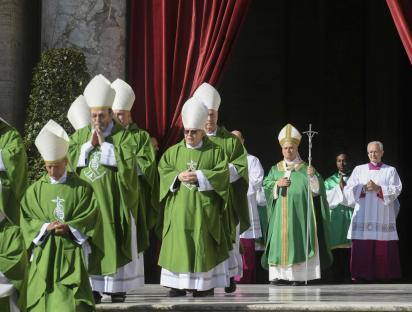
AFTER THE MASS of the Holy Spirit, celebrated just before the conclave was to begin, I saw the Cardinals, or most of them, leaving Saint Peter’s separately and in informal groups. Even weighing the fact that the scarlet cardinalatial garb is striking enough to do something for any man, they are an impressive body. There is something particularly moving in seeing the sprinkling of dark-skinned prelates taking their place in the august body. The black African Cardinal Rugambwa will celebrate his fifty-first birthday in a few weeks, but he looks years younger—a slim man of princely bearing and exceptionally gracious manner. With the headlines full of the racial crisis in the United States, it was hopeful to see white Christians, many from the States, humbly kissing his ring. The elderly Jesuit, Cardinal Bea, reminded me of Father LaFarge—the same benign manner and unperturbability but a hell-raiser for all that.
Later, when the Cardinals were marching in to the Sistine Chapel, a small crowd gathered. Applause for everyone but most of all for Cardinal Cushing. Odd that a foreigner should be the most popular, especially one who is not a product of the Roman seminaries and who can be depended upon to remain forthrightly, uncompromisingly American whatever the circumstances. But the Boston prelate has caught the imagination. His flat statement that he did not understand the Latin at the first session of the Council is the talk of the city. Such candor is warmly appreciated. That it came from an American seems eminently fitting, even endearing.
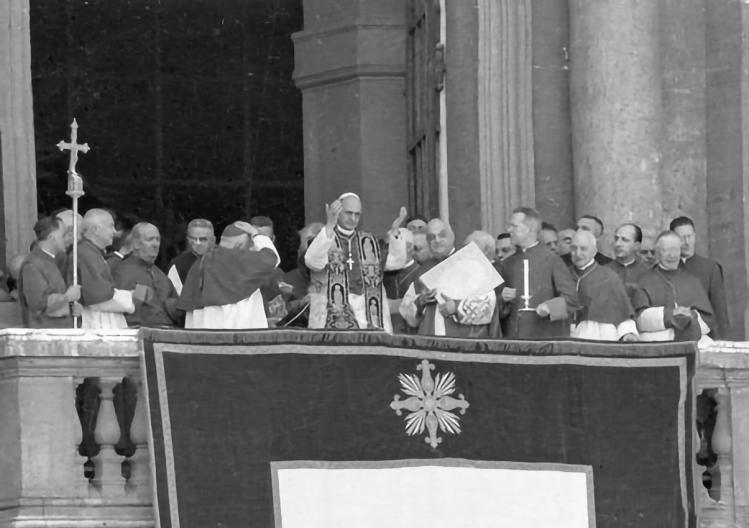
… An old Vatican hand advised me not to bother about going to the square for the first day’s voting. Nothing would happen, he assured me; the smoke would be black. He was right. So the first smoke I saw pouring out of the Toonerville Trolley chimney was white. As the new Pope appeared on the balcony, he stood over the engraving stating that Paul V, a Borghese, built Saint Peter’s. As is usual in Rome, the sense of history was acute.
The people in the square—prelates, priests, monks, friars, nuns, as well as layfolk—were, in the panoramic sweep, an object lesson on the perennial youth of the Church. Religious in ancient habits, like the Benedictine, Dominican, Franciscan, stood side by side with Foucauld’s denim-clad Little Sisters of Jesus, products of the one-world concept of Christendom of our time. The small group of Little Sisters near me included African and Asian as well as European girls. It seems to me that they are the closest we have come to primitive Franciscans. But, thinking of them as latter-day Franciscans, I remembered the letter that came from Maritain in Toulouse last month. The Foucauld group, he stated flatly, are the most alive exponents of the teachings of the Dominican Saint Thomas in the modern Church.
I WAS TO SEE the new Pope three times more before returning home. Following a custom inaugurated by Pope John, he appeared at an open window to lead the Angelus on the first Sunday. The crowd cheered, prayed, then cheered again. These swift changes of mood can exhaust the foreigner. Then there was the audience for journalists. First twitting the press for its gossipy handling of the Council, the Pope went on to state his special affinity for men of the craft. His father was a journalist, as well as a politician, he said, and he pleased everyone by addressing the group as his colleagues in the service of truth.
The arrangements for the audience were most inadequate. The group of seven hundred writers was made to wait for an hour and then was required to walk several flights of stairs instead of riding the elevators. The room chosen for the audience was much too small. Most people had to stand uncomfortably throughout the audience. The only available text of the Pope’s talk was in Italian. Those who did not speak the language had to sit uncomprehending throughout the Holy Fathers’ talk—how much better if they had been able to follow his words in translation. The room was miserably hot and stuffy. Still, the graciousness of Paul VI was enough to obliterate all the dissatisfaction and grumbling that had gone on before his appearance. But while we are thinking of aggiornamento, somebody should do something about improving the press relations of the Vatican. With the press of the world on hand, receiving impressions and shaping attitudes that will be reflected in their writings for years to come, the audience should have been better arranged. Only the Pope saved the day.
The third time I saw the Pope he was being carried up to the altar for the Coronation Mass. Watched from a roof and thereby saw the whole Cecil B. de Mille technicolor expanse of the scene. The most impressive rubric was of course the loud cry (through a microphone) in the midst of the cheers: “Sancte Pater, sic transit gloria mundi,” as the flax blew away as dust. Maybe the little man who called out the message should be sent with a portable microphone to leaders all over the world.
… The new Pope is on the cover of practically every magazine sold at the well-stocked stands along the Via Veneto. I bought a half dozen different ones, to compare the stories. They do not vary much from country to country. Still, for all this publicity there is an out-of-focus element in the profiles written. The essential man has not come through yet. He even looks a little different in every picture, usually much more cold and austere than he appears in person. Naturally, everyone has his own idea of what kind of man now occupies the Chair of Peter. A highly placed Vatican prelate said that if one takes the conventional, but somewhat misleading, liberal-conservative categories that shaped up during the Council, Pope Paul’s position was more on the liberal side than any of his immediate collaborators. (It might, of course, change. Remember Pio Nono.)
LEARNED THAT The Commonweal over the years has been read carefully by at least some ranking prelates in the Vatican. The particular one I spoke to congratulated me (undoubtedly intending the felicitations for all connected with The Commonweal) on the magazine’s having sensed the mood of the universal Church long before it found expression at the Vatican Council. “It must be a great satisfaction to know that stands which were misunderstood at the time are being so frequently vindicated,” he said. I was so surprised that my words did not come freely. I mumbled something, but I was remembering some old letters-to-the-editors and hostile editorials that used to talk indignantly about the Mind of the Church, often identifying it with a set of political prejudices and unquestioning acceptance of the status quo.
… Cancelled my reservation in order to be in the city for President Kennedy’s visit. My monsignor friend was sure that the reception the President would get in Rome would be mild. “The Romans will just not come out to see a head of state, no matter who he is,” he said. With the President arriving the day after the coronation and in extremely hot weather, there was more reason than ever for the prophecy. Even the energetic Romans can get exhausted. The monsignor was right. After the feeble reception, the President cancelled his press conference and cut short his stay in the city. Too bad he does not know my monsignor friend. He might have saved himself a trip. After the tepid welcome, I congratulated the monsignor on the accuracy of his prediction. “They just won’t come for a head of state,” he said again, “but they will come if you give them a show. Tell him to bring Jackie the next time.”