Rome
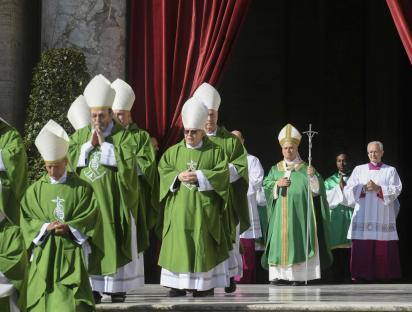
ON September 21, eight days before the Vatican Council reconvened for its second session, Pope Paul VI gave clearer evidence than Pope John XXIII ever did of what lies in store for the Roman Curia, that much-criticized executive arm of the pope. Exactly at ten o’clock that Saturday morning, the new pope walked into the Room of Benedictions, the immense hall over the porch of St. Peter’s, to meet the assembled Cardinals, clerical and lay officials, their staffs and other workers at the Vatican. Without script in his hand, he apologized for what might seem to be a long forthcoming talk; with that in view, he then declared the rest of the day a holiday. The applause had hardly died when he added that he was also granting each one a raise in salary; more applause.
Pope Paul’s prepared discourse, which he then drew out and read, was a jewel of Italian rhetoric, subtle, civilized, telling. When he concluded, the applause swelled ever louder until he finally broke in on it to impart his blessing. His words left his hearers visibly heartened, and members of the Curia were still saying for some days afterwards: “What a talk! It needed saying. At last!” But the talk was a two-edged sword; in which direction it cut most, it is too early to tell.
For most of his talk, the pope encouraged the members of the Curia, reminding them that for thirty years he had been one of them, had many unforgettable friends among them, shared many memories of trying and joyous days with them. He spoke in a soft Italian, under whose affection and intimacy, however, was the grip of a strong intelligence and will. Throughout, Pope Paul insisted that vis-a-vis the Curia he was in command. Describing the essential relation between pope and Curia, he regularly used expressions like “conformity of spirit,” “immediate adherence,” “absolute obedience,” “identity of view.” On the one hand, he thus took any proposed reforms of the Curia under his own protection; the Curia is his administrative arm, not to be reformed by “outsiders.” From its rapport with him, he noted, the Curia derives “its necessity, its usefulness, its dignity, its authority,” and indeed “its justification, or rather its glory.” On the other hand, the pope seemed to be clearing the channels of authority-and therefore of institutional reform-for whatever directions the Council might help decide.
The Pope told the assembled Curia he spoke with a triple intent: “to praise you, to bring you peace, to exhort you.” Each of these purposes seemed a phase in his presentation of the reforms to be expected. He spoke as if everyone knew that reforms were needed, he recalled that the present order of things dated from 1588 under Sixtus V, and has not been revised since 1908 under Pius X and 1917 under the new code of canon law. “It is understandable,” he said, “how such an institution can be burdened under the weight of its own venerable age.” Even his severest phrases here seemed palatable to his audience; did he not make clear that these reforms will be formulated and promulgated by the Curia itself?
THE CORE of the pope’s thought lay in the next few sentences. He mentioned these specific lines of reform: (1) The Curia would need a ‘larger supranational vision.” (2) It would need to be “educated with a more accurate ecumenical preparation.” Pope Paul here quoted from St. Bernard, the 11th century reformer: “Why not choose from all over the world those who one day will have to judge the whole world?” The choice of St. Bernard was subtly done; only a few paragraphs before the pope had congratulated the Curia for a piety and devotion such that, “Today, fortunately, St. Bernard would not write his burning pages on the Roman ecclesiastical world, nor would the reformers of the 16th century.”
(3) The Curia “will not be jealous of the temporal prerogatives of other times, nor of external forms no longer suitable for expressing and teaching truths of profound religous meaning.” (4) The Curia will not be “miserly with its powers, which today, without injuring universal ecclesiastical order, bishops themselves can exercise better locally.” (5) “Questions of economic advantage will never have weight in suggesting a certain reserve and a certain centralization of organs of the Holy See, unless necessary for the good of ecclesiastical order and the salvation of souls.”
Pope Paul then elaborated on the fourth of these points, though cautiously. He observed that even now the various branches of the Curia rely on bishops around the world for advice and help. “We will go further: if the Ecumenical Council should manifest a desire to see associated in a certain manner and for certain questions, in conformity with the doctrine of the Church and canon law, some representatives of the bishops … with the supreme Head of the church, in the care and the responsibility of ecclesiastical government, surely the Roman Curia will not be in opposition.” This hint to the Council will not be overlooked.
Taken together, these five points, and especially the fourth, realize every major line of reform proposed by many among the Council Fathers in last fall’s session. If the Curia is international in outlook, many objections against it fall. If the bishops regain the use of the powers that by right belong to them, to decide the status of certain marriage cases and liturgical usages, for example, and the sense of creativity and responsibility which these powers encourage, the Church should, it is hoped, become much more sensitive to local conditioning and needs. If an international “cabinet” of representative bishops is formed to meet regularly in Rome, a new check and balance will be inserted into the institutional structure of the Church, more in conformity with the ancient collegial character of the episcopacy.
There is, however, one major area of Curial reform about which the Pope did not speak directly. That is the question of free speech and free public discussion of doctrine and practices. It still is not possible for a Catholic to speak with simplicity and frankness on all matters of his personal beliefs, on birth control or the uses of authority for example; and in the United States it is less possible than in Europe, except for Ireland. There is today no medieval Inquisition to fear, but one’s reputation as orthodox and, conceivably, one’s right to the sacraments are still at stake; priests are more vulnerable than laymen. The exigencies of orthodoxy, keeping intact a message committed to the vicissitudes of history, require a certain watchfulness against heresy. But other elements regularly enter the situation: a lack of love for inquiring intelligence and the quest for understanding. The Holy Office, charged with watching over the purity of the message, is the central focal point for criticism in this matter. “Function most delicate,” the pope said, “to be custodian or echo of divine truths and to fashion a language and enter into dialogue with the human spirit.”
The Pope referred often to critics of the Roman Curia, many of whom, he noted, have been egregiously unfair. Cardinal Ottaviani, chief of the Holy Office, for example, has been made the villain of morality plays attempting to dramatize the first session of the Council. No matter how good the Curia might be, the Pope suggested, it could never be good enough to measure up to the standards of the Gospels; it is always fair game for critics. He urged the Curia to accept the criticisms as a stimulus, to receive them with humility, with reflection, even with gratitude. “Rome has no need to defend herself by becoming deaf to suggestions which come from upright voices, and all the less when these are voices of friends and brothers.”
In the course of his talk, Pope Paul described himself as one “who today has made his own the heritage of Pope John XXIII … and makes of it a program for the entire church.” Where Pope John ruled with kindness, Pope Paul, it appears, will rule with workmanlike tact, energy, and skill. He does not have the ways that made Pope John loved, but he is in turn gifted with abilities men of affairs will increasingly recognized and admire. The second session of the Council will be his as much as the first was Pope John’s, not because either of them intervene but because both of them, each in his way, make the quest for the life of the gospels more possible for the ponderous institution they serve.
Pope Paul has already reduced the number of the moderators of the sessions from ten to four, two of them the noted progressive leaders Cardinal Suenens of Belgium and Cardinal Dopfner of Germany, and the third the leading Italian progressive, Cardinal Lercaro of Bologna; the fourth is Cardinal Agagianian, the Armenian member of the Curia. He also decided to invite laymen to participate in the Council. Finally, in perhaps the most revolutionary step so far, he has so diminished the emphasis on the secrecy of the Council sessions that the press, though not present in St. Peter’s for the sessions, will now have access to full information from the participants. Since one of the most powerful forces generated by the first session of the Council was the worldwide “education in theology” made possible by the press, the effects of this new decision on countless individuals around the world and, by reaction, on the Council Fathers themselves, will be difficult to calculate.
(Michael Novak, a regular contributor to these pages, is currently in Rome for the Vatican Council.)