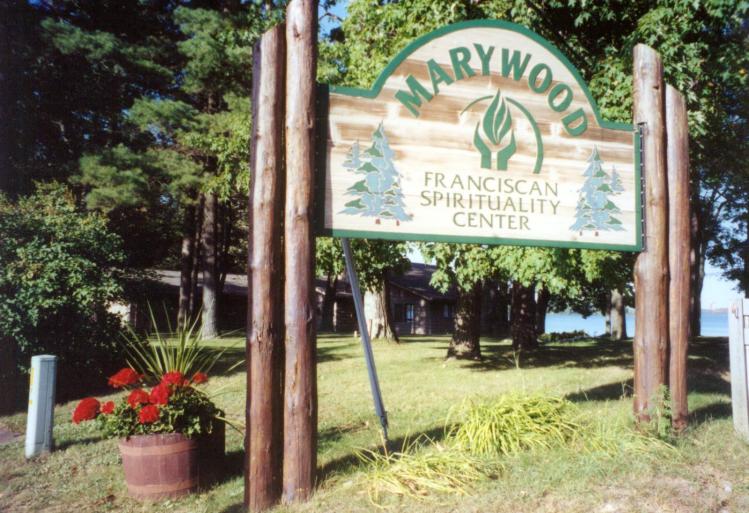
Last October, two acres of lakefront land in northern Wisconsin changed hands. The Franciscan Sisters of Perpetual Adoration (FSPA) transferred the property, which includes Marywood Franciscan Spirituality Center, to the Lac du Flambeau band of the Lake Superior Chippewa. It is the first known transfer of Church-owned land to a tribal nation as an explicit act of reparation for the Church’s actions during the colonization of America and the harms caused through its network of Indian boarding schools. FSPA sold the land to the tribe for $30,000, a little more than one percent of its market value.
Two acres does not sound like much, especially compared to the vast homelands of the Ojibwe, of whom the Lac du Flambeau are a part; their lands once encompassed the northern shores of the Great Lakes and much of Wisconsin, Michigan, and Minnesota. The transferred land sits fifteen minutes away from the Lac du Flambeau reservation, which comprises about 107 square miles. But these two acres tell a story—from the colonization and dispossession of previous centuries to present-day racism and generational trauma. And their transfer could also show a new way forward, revealing what is possible when the Church confronts its sins and restores its relationships.
The Franciscan Sisters loved Marywood for decades. It is a “sacred, beautiful, loving place,” Sr. Eileen McKenzie, former FSPA president, told me. But, as the sisters have grown older and fewer in number, it has become harder to take care of the land and its facilities, or to use it to its fullest potential. “We’re in this time of loss in religious life, a via negativa,” she said. “The way we let go is so important to our spiritual integrity.”
Plenty of congregations do let go—often selling their property to hospitals, schools, or other organizations. But a different idea presented itself to the sisters: rematriation, the term for the return of land to Indigenous care. It came to them gradually, McKenzie said, starting with an inquiry from a local journalist writing an article about St. Mary’s Boarding School. FSPA ran St. Mary’s (one of more than five hundred American Indian boarding schools that existed in the nineteenth and twentieth centuries in the United States) from 1883 to 1969 on the nearby Bad River Ojibwe reservation. “We closed the mission the year I was born,” McKenzie said. By the time McKenzie was a member, the school and its legacy were receding into memory—something the older sisters had been involved with but that was now part of the past. Those sisters, she recalled, had spoken fondly of the children they encountered there and were proud of the work they did. “There was a sense of charitable mission,” which the order considered the school’s legacy.
So McKenzie decided to do some research—“I just did a Google search, honestly”—and the first thing she found was an Atlantic article about the history of Indian boarding schools. The author, Mary Annette Pember, describes the experiences of her mother, who was forced to attend St. Mary’s at the age of five. “It was the first time I had ever heard of surviving a boarding school,” McKenzie recalled. Thus began a five-year process of trying to learn about and make amends for the order’s participation in the federal government’s long campaign of eradicating America’s Native people and culture.
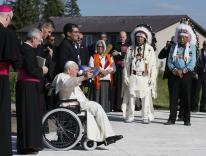
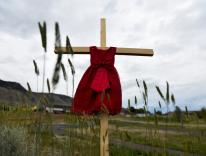
Hidden mostly from non-Native people until recently, the history of Indian boarding schools emerged into mainstream awareness in large part because of a gruesome discovery: in 2021, the Tk’emlúps te Secwépemc announced that a research team had found 215 suspected graves of children on the grounds of the Kamloops Indian Residential School in British Columbia. The discovery prompted questioning and investigation in both the United States and Canada, and eventually, an apology from Pope Francis about the Catholic Church’s role in running the Canadian schools.
But Native people in the United States and Canada didn’t need a reminder. The schools are part of living memory, and the generational trauma that they have caused still reverberates. In the United States, over the course of 150 years, tens of thousands of Indigenous children were subject to a program of forced assimilation at these schools, which numbered five hundred and were run by either the federal government or a religious denomination. Their purpose was described bluntly by Brigadier-General Richard Henry Pratt, founder of one of the largest: “To kill the Indian…to save the man.” One hundred of these schools were operated by the Catholic Church, more than any other denomination. Children were forbidden from speaking their Native languages and required to change their names. Their long hair was cut. They were forced into manual labor—housekeeping, farming, construction, blacksmithing—as part of their “education.” Food was inadequate and overcrowding caused disease to spread. Children were often physically punished, and clerical sexual abuse loomed over their lives. By the 1920s, 76 percent of Indigenous children were attending boarding schools, and one thousand of them had died. According to the National Native American Boarding School Healing Coalition, some students never returned home, and families have never been told what happened to them—if they ran away, or died from disease, abuse, a work accident, or suicide.
In Medicine River: A Story of Survival and the Legacy of Indian Boarding Schools, Pember plumbs her family history to illustrate the effect that the schools had on Indigenous people. One religious sister her mother encountered had a particularly harmful impact:
It was Sister Catherine’s shaming words…that seem to have cut deeper than any strap. According to Sister Catherine’s God, Indians were dirty, lazy, barely human creatures unfit to raise their own children. She believed God had sent her to save those children—soul by soul, brick by civilized brick—and make them into his servants, whether they liked it or not. Sister Catherine’s belittling phrase “dirty Indian” lingered in my mother’s ears, which she eventually poured into mine.
Forcing families to send their children to boarding schools was “part of the federal government’s systematic assimilation and civilization policies intended to dispossess Indigenous peoples of their lands and resources so white people [could] settle and acquire [their] lands,” Pember writes. The alternative—outright extermination—was considered too costly. (Secretary of the Interior Carl Schurz estimated that it would cost $1 million to kill one Native person, but a mere $1,200 to send them to boarding school for eight years.) The government worked with churches of many denominations to help administer some of those schools, and Catholic orders clambered for the opportunity. At a time when Catholics were regarded with some suspicion by many Americans, they hoped that carrying out government policy would help them claim their place in American society—or as historian Francis Paul Prucha, SJ, put it, Catholics’ “successful lobbying for their interests in the Indian school question gave them a more widely accepted role in national affairs.”
McKenzie recalled the sense of disconnect she felt as she learned this history for the first time in 2020. “We had been voicing opposition to the ‘kids in cages,’” the first Trump administration’s policy of separating families to discourage illegal immigration. “But in 1900, we were instruments of a government policy that intentionally separated families.” She brought these stories to her fellow sisters, asking what it would mean to begin to repair the harm they had done. At first, she said, the sisters reacted with some doubt or defensiveness: “‘We’ve never heard about this before,’ or ‘It was a good experience’ for the students…. We encountered resistance within our own congregation.”
Sr. Sue Ernster, current FSPA president, put some sisters’ feelings another way: “We were doing what we were asked. We thought we were doing the best [we could].” Ernster became president in the middle of the conversations that McKenzie had initiated, and she kept them going. “We sisters had to wrestle with the fact that we are complicit in forced assimilation, and because of that, harm was caused. We have to listen to the pain of others, even if our intent wasn’t to do that,” she said.
“The way you let go can be just as powerful as the things you built,” Brittany Koteles, cofounder and director of Land Justice Futures (LJF), told me. LJF provides accompaniment to religious communities discerning how to transition their land holdings with the goal of “racial and ecological healing.” Ernster sought out the guidance of LJF (at the time known as Nuns and Nones) as they reflected on the harms they had caused, knowing that they had to “right-size” because of the changing demographics of the order. “Now that we know differently, we have to respond differently,” Ernster said.
LJF has provided trainings about the meaning of land ownership and different ownership structures to nineteen religious communities and four thousand sisters. The goal is to pursue right relationship with all stakeholders in a land transition—the land itself, as well as poor communities and other marginalized groups. Land-use decisions and transitions are often approached more like a “bureaucratic burden,” Koteles said, rather than the opportunity they could be. “There’s not a lot of support or capacity to think creatively and prophetically about…the highest and best use of the place we love.”
In 2023, LJF assisted FSPA in a land assessment of Marywood—investigating how the sisters came to own the land, who its first caretakers were, and what treaties governed its use. They determined that its right stewards were the Lac du Flambeau Tribe, and in 2024 they approached the tribe about a land transfer.
The feeling in the tribe’s leadership was “genuine shock and surprise,” said Araia Breedlove, public-relations director of the Lac du Flambeau Tribe. “I’m not going to sugarcoat it—we did need to check our emotions and anger and set it aside to have a civil respectful conversation.” But, she said, it’s very good that they did. “Putting pride aside, thinking about the betterment of our people and our future” was the first step in developing a trusting relationship with the sisters.
“I’m learning how much courage it took the tribe to engage with us,” Ernster said. “We began to understand the responsibility that came with our position.”
The two groups forged a mutual, trusting relationship. Breedlove said that they found “extremely similar values” when they talked about caring for the land. “They knew we could take care of this place, how we take care of our land.” McKenzie said that the sisters’ Franciscan spirituality guided them and helped the two groups find common ground as they centered the needs of the land.
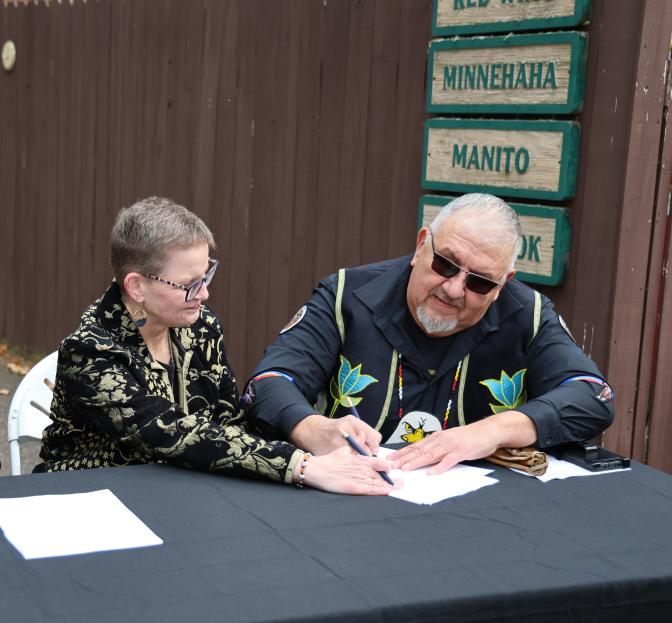
By the time the land was officially transferred in October, the FSPA leaders and the leaders of the tribe had formed new friendships over their love of Marywood. “We have a partnership and a bond,” Breedlove said. “I always joke that Sr. Sue and I are going on tour together—I have gained someone I will love for life.”
The rematriation of Marywood was momentous, but there remains an overwhelming amount of harm to address. Anti-Indigenous racism is still a powerful force in northern Wisconsin. Non-Native residents were strongly opposed to the transfer, expressing concern that the Lac du Flambeau would use the land to build a casino. During the transfer process, the neighbors tried to insist that FSPA put restrictions on what the tribe could do with the land, but the sisters chose not to. Tribe members report common harassment or violence directed at them as they exercise their treaty-affirmed rights to hunt, fish, and harvest: non-Natives misunderstand treaty rights, believing tribe members are getting “special treatment.” The history of racism is visible on a map of the reservation: only four percent of the reservation is owned by members of the tribe, while 24 percent is owned by non-Natives. Non-Natives also own most of the reservation’s lakefront property.
I asked Breedlove how members of the tribe feel about the rematriation of Marywood. She said that people are overwhelmingly pleased. “This is a power move for us.” Koteles told me that the vast majority of tribal members she has spoken with are very happy with the rematriation. But some remain skeptical. “For really understandable reasons,” she said, “the hurt, the trauma is so deep.”
In 2024, the United States Conference of Catholic Bishops (USCCB) apologized for the trauma it caused in operating boarding schools, but also proposed that some good things had come out of them. The statement struck some Indigenous people as less than adequate. “If you’re going to give an apology, just say sorry,” Nick Tilsen, chief executive of Indigenous-rights organization NDN Collective, told The New York Times. Pember writes that the USCCB apology, as well as Francis’s apology to Indigenous people in Canada, seem to place most of the blame for the genocide of Indigenous people on the government instead of the Church.
Pember points out that in the nineteenth century, as the government expanded westward and enlisted churches in its project, it simply handed over some of the Native land it seized to churches to use as they wanted, rather than put it in a trust, as it did with reservations. The government granted more than ten thousand acres of land to the Bureau of Catholic Indian Missions to be used for schools. As the schools closed in the 1960s and ’70s, BCIM gave those lands to individual dioceses and parishes. In the course of her research, Pember determined that much of it still belongs to the Church—land stolen from Native people and given to the Church for free.
I asked Koteles what the Church should be doing now in light of its history with the destruction of Indigenous peoples. “The conversation about reparations can make it sound like the Church has to say sorry and be quiet,” she said. “But it’s more powerful to say sorry and be loud.”
If the Church publicizes the evils it has committed, couldn’t that drive people away? That fear is “entirely misguided,” she said. “I’m more Christian than I’ve ever been because I’ve been discovering the radical roots of the tradition through the choices the sisters are making.” The Church is the largest private landowner in the world, and now there’s an opportunity to use that land differently. “Jesus’ instructions were ‘Give everything away to the poor and join me.’ That message hasn’t changed. Could it be that that relinquishment might actually make us feel alive?”
What does that relinquishment look like? At Marywood, it will mean a return to a different kind of relationship with the land. As of this writing, the Lac du Flambeau Tribe hasn’t decided what it will do there. One proposal is to convert the retreat center into housing for health-care workers to serve the reservation, where access to medical care is sometimes difficult. Another is to use the land as a cultural center for Ojibwe crafts and traditions, like basketmaking, language classes, maple-syrup tapping, seed-planting, and spearfishing (which is made easier by having lake access).
Breedlove tells me that above all, the tribe will take care of the water and the land—and when the land flourishes, so do the people. In bringing their traditions and practices, “we put our prayers down. We’re carving back pieces of our homeland.”
Correction: In 2021, 215 suspected graves, not remains, were found on the grounds of Kamloops Indian Residential School.
We welcome your comments about this article. Please send your response to [email protected].