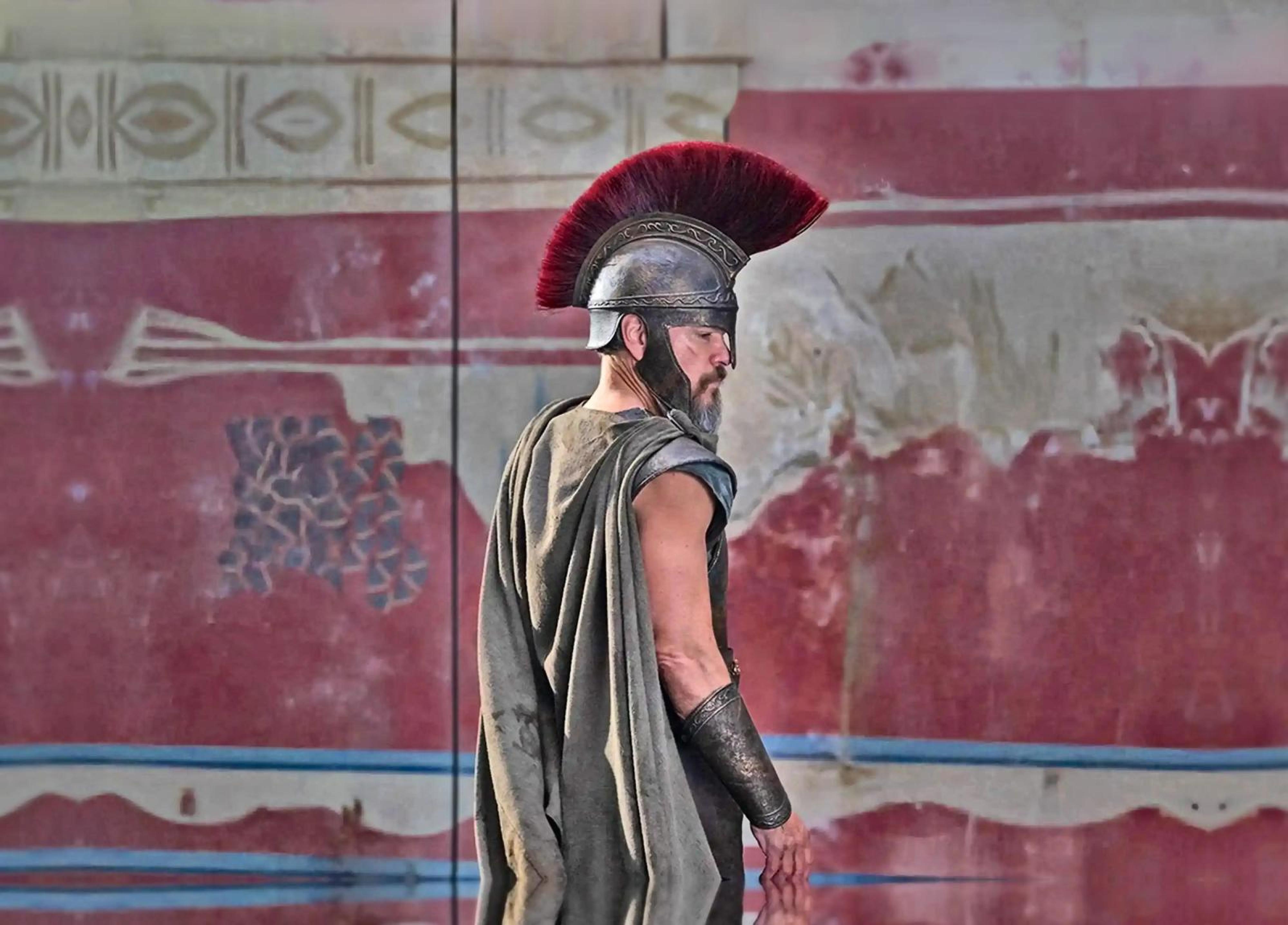
What’s the point of Great Books? There’s never been a straight answer. Leo Strauss argues that they offer an opportunity for “listening to the conversation among the greatest minds” of history, transmitting timeless wisdom to future generations. Others—including Socrates in Plato’s Republic as well as today’s critics of Eurocentric canons—might strip texts like Homer’s Iliad of the very title of “great book.” In their view, such works glorify violent misdeeds and propagate pernicious values. Some of today’s leading champions of liberal education, such as Purdue’s Melinda Zook, prefer the term “transformative texts” for the books that have changed the world and can still change their readers.
Patrick Deneen’s American Odyssey takes a somewhat different approach to one of the indisputable monuments of the Greco-Roman tradition, Homer’s Odyssey. Here, Odysseus’s epic journey isn’t an opportunity for readers’ self-transformation or even a vehicle for universal insights. Instead, Deneen takes the Odyssey as a sort of mirror for twenty-first-century readers in the United States. They—like Odysseus—are driven by two competing drives: a need for novel adventure and a persistent longing for home. “No ancient story,” Deneen writes, “is as well-matched to our American souls as the Odyssey.”
In the wake of Christopher Nolan’s blockbuster movie adaptation of the Odyssey, this is a good time to reconsider what we’re supposed to get out of great books like Homer’s epic. Do we see our modern American selves reflected in the duplicitous king of Ithaca? Should we even want to? Deneen thinks we should, and he urges us to “gain deeper self-understanding” by studying the “honorary Americans” who populate Homer’s story. Invitations to return to the richness of Homeric poetry are always welcome, but the thesis of Deneen’s book—that there is something particularly American about a three-thousand-year-old poem—risks reducing Homer’s boundless, wine-dark sea to a can of Coke.
Deneen’s argument begins not with Homer but with Alexis de Tocqueville’s Democracy in America. For today’s readers, this nineteenth-century sociological study is best known for its praise of American “associations” and its anxiety about the “tyranny of the majority,” the psychological pressure to conform to prevailing opinion. From among the many topics Tocqueville’s great survey covers, American Odyssey focuses on his assessment of our “national inability to rest satisfied in one’s achievements.” Even though Democracy in America was published nearly two hundred years ago, Deneen argues that its diagnosis of our agitated “restlessness” remains a “central feature of the American character.”
But this “gnawing fear that there remain challenges yet to be conquered” constitutes only half of Tocqueville’s national portrait. Inasmuch as he saw Americans as agitated strivers, he also marveled at their “strong sense of loyalty…toward their local towns and fellow citizens.” In the “small-town self-government” of New England meeting halls, Deneen writes, Americans reveal their “love of places.” Paradoxically, then, American democracy “is simultaneously realized in the rooted experience of the township and animated by the restless spirit of the seeker.” In this way, we Americans all have—per the subtitle of Deneen’s book—“divided souls.”
The idea of a “divided soul” might prompt us to revisit a wide range of theorists, from Plato to Freud, but Deneen grounds his exploration of Americans’ fractured psychology in Homeric epic. Gazing into the mirror of the Odyssey, he sees a reflection of the “highly familiar American themes” surrounding restless rootedness. Each chapter of his book treats one of the “most paradigmatic stories by and about Americans [that] are Odyssean in their essence.” In The Wizard of Oz’s Dorothy Gale, for example, he finds a quintessential “American ‘everywoman,’ longing at once to get away and to go home.” In Field of Dreams, there’s the “everyday hero” of Doc Graham, who—like Odysseus passing on Calypso’s offer of eternal pleasure—“abandons the immortality of the field of dreams to save a mortal girl and return to his wife.” Among Deneen’s other examples of Odyssean venturing, we find Huckleberry Finn, Tom Hanks’s Jim Lovell from Apollo 13, and Jimmy Stewart’s George Bailey from It’s a Wonderful Life. In “a particularly powerful way,” all these figures partake in a Homeric “dualism [that] is a constitutive aspect of the American character.”
It’s true, of course, that we can recognize both a “restless spirit” and a longing for an Odyssean nostos, or “homecoming,” in countless exemplars of American literary culture. But instead of seeing a uniquely American quality reflected in the Odyssey, we might instead glimpse a human impulse that transcends one nation (even without veering into Straussian universalism). Indeed, the competing interests that Deneen pins on American psychology—between the familiar and the unknown, between what is established and what is possible—are not exclusively ours. In the opening pages of American Odyssey, he gestures toward this broadening by citing historical figures like Christopher Columbus and Amerigo Vespucci, only to recast these European seafarers as proto-Americans. But I wonder how Deneen might account for Odyssean figures who stand well outside the penumbra of American influence. The title character of Goethe’s Faust, for instance, risks eternal damnation in pursuit of novel experience. American Odyssey nods only briefly to James Joyce’s modernist refashioning of that “Odyssean essence” on the streets of Dublin. Even more broadly, Joseph Campbell’s typology of the “Hero’s Journey”—which begins with a “call to adventure” away from one’s home—can be found across many world mythologies, beyond the influence of America or ancient Greece.
In my view, part of what makes a book like the Odyssey or Faust a great one is its ability to resonate deeply with all sorts of people—not only those of one nationality. Tocqueville’s Democracy in America is itself a great book because it is not just about either democracy or America. This is not my own radical interpretation. Tocqueville insists that, despite its title, his magnum opus is interested in matters well beyond the Atlantic seaboard: “In America I saw more than America.” Elsewhere, he considers the possibility that, as the passions for liberty and equality spread, in “all corners of the world we find the same ways of acting, thinking, and feeling.” Anecdotally, dozens of my own international students have attested to Tocqueville’s relevance to their own non-American upbringing—evidence not just of American soft power but also of Tocqueville’s keen insights into modernity. If we can gaze into a great book, whether Tocqueville’s or Homer’s, and see our own national reflection, we should consider that citizens of other nations can do the same.
By taking the Odyssey as a story that reflects his own people, Deneen follows several illustrious predecessors. The most renowned among them is probably Vergil. His Aeneid narrates the travels of the Trojan refugee Aeneas through a series of Homeric tropes: a Cyclopean brush with death, an abandoned lover on a faraway coast, a day trip to the underworld. By setting Rome’s cultural ancestor in an Odyssean mold, Vergil tells his readers—the Emperor Augustus among them—that they, too, should see Homer’s homesick hero as someone who is “well-matched to their souls.”
But while Deneen takes Odysseus’s defining quality as his conflicted homesickness, earlier traditions have developed a rather more complex—and ethically compromised—understanding of the king of Ithaca. Vergil presents Aeneas as a kind of Roman Odysseus, yet the latter appears in Vergil’s poem itself as the “cruel” and “grim” trickster of the pitiless Greeks. Elsewhere, Vergil recollects how Odysseus profanely looted Troy’s wealth from its “flaming shrines.” If we see our reflection in Homer’s characters, the image isn’t always going to be a pretty one. In this vein, a freckled Dorothy Gale, no matter how much she longs for a nostos of her own, looks out of place alongside the adulterous and deceitful Odysseus.
There is, it should be noted, one character study in American Odyssey that picks up on these jarring ethical dimensions of ancient heroism: Jimmy Stewart’s George Bailey, whom Deneen calls a “consummately Odyssean character.” In Deneen’s unconventional and provocative interpretation of It’s a Wonderful Life, Bailey “longs, with profound, existential urgency, to get away,” but never leaves Bedford Falls. Instead, he “dutifully but begrudgingly takes over the family business.” But beyond the “deep ambivalence toward home”—the scope of most of the analysis in American Odyssey—Frank Capra’s film reveals how Bailey plans to develop a subdivision called “Bailey Park” atop a cemetery. In Deneen’s view, Bailey “commits an act of unspeakable sacrilege,” not unlike the looting of Troy’s temples. And “like the explorers and pioneers” of America’s frontier, Bailey “desecrate[s] holy land” and “eviscerates memorials of the past.” Deneen’s portrait of Bailey is “consummately Odyssean” precisely because it reminds us that—well beyond homesick adventuring—every Homeric hero is occasionally the bad guy.
This figure of the “complicated man”—to borrow the classicist Emily Wilson’s epithet—at the heart of Homer’s Odyssey, Vergil’s Aeneid, and even Capra’s It’s a Wonderful Life brings us to the latest silver-screen interpretation of ancient epic, Nolan’s The Odyssey. Just as Deneen’s American Odyssey often simplifies Odysseus into the single tension between adventure and home, Nolan’s film narrows Odysseus into the role of a shellshocked, remorseful veteran. Others have fruitfully interpreted Homer through the lens of wartime trauma (including Jonathan Shay in Achilles in Vietnam), but Nolan’s film clings to this trait at the expense of Odysseus’s complexity. His years of adulterous intimacy with Calypso, who is, in Nolan’s telling, more a therapist than a lover, are only hinted at with the brush of her hand. Odysseus’s vengeful and gory mangling of suitors and maidservants—shocking even to students today—has been replaced with an unremarkable combat scene. Nolan’s drumbeat of “Zeus’s Law”—the moral obligation to welcome the stranger—flattens Homer’s multidimensional universe into a fable worthy of Aesop.
It’s not quite fair to demand that Nolan account for more than twelve thousand lines of hexameter poetry in three hours, and the medium of the summer blockbuster can only accommodate so much complication of any kind. The film is best appreciated as a loose reworking rather than as a faithful dramatization. Nolan’s megabudget Odyssey, which was produced for a global audience, does manage to avoid the pitfall of presenting its characters as “honorary Americans.” And despite its engagement with issues of immigration and asylum, it never devolves into ham-handed politicking. The same cannot be said of American Odyssey, which occasionally drifts into punditry. Closing out a discussion of the problems of human isolation, for example, Deneen takes a swipe at the “confidence of those self-described ‘progressives’” and their “mantra, ‘Follow the science.’” Near its end, American Odyssey abruptly pivots to falling American birth rates, which Deneen unconvincingly attributes to our “condition of homelessness.”
Despite slipping into partisanship and forcing Homer’s capacious epic into a simpler American idiom, Deneen’s work reminds us of the value of great books: their limitless capacity to inspire thoughtful judgment about everything from Dorothy Gale to suburban land use. There is, I would add, a certain irony to Deneen’s ideological intrusions. His bestselling 2018 book Why Liberalism Failed blamed educational rot on faculty who “demonstrate their progressiveness by showing the backwardness” of great books. Deneen’s distillation of ancient heroism into a model for, and vindication of, his own brand of social conservatism starts to look like the mirror image of the academic progressivism he detests. In Why Liberalism Failed, he claimed that the value of classical texts lies in their capacity to cultivate a freedom from the “tyranny of internal appetite and desire.” American Odyssey echoes this claim by turning Odysseus into an object lesson about the importance of controlling one’s desires. In him, Deneen sees a reflection of our American struggle for “refined” liberty—as opposed to its false counterpart promoted by modern liberalism. In short, American Odyssey isn’t just a somewhat flat reading of Homer; it’s an instrumental one, transforming a rich epic into a suspiciously neat parable. But when we gaze into the Odyssey, a text of fathomless depth, we ought to see more than a reflection of our own preoccupations.
American Odyssey
What an Ancient Story Reveals about Our Divided Souls
Patrick J. Deneen
Creed & Culture
$26 | 198 pp.
We welcome your comments about this article. Please send your response to [email protected].