My daughter recently asked me if I can speak Irish. Her Hispanic mother can speak Spanish, so why wouldn’t her proud Irish American father speak Irish?
She was surprised and disappointed that the answer was no. Where many immigrants to the United States lost their native tongue after a generation in America, Irish immigrants had often lost theirs prior to emigrating. My grandparents arrived here not knowing Gaelic because they had never learned it. The Irish are a people with a nearly lost language. But that nearly speaks to the way the Irish have fought to keep their language. The battle for Irish independence was prefigured not by first massing armaments but by recovering the Gaelic language and culture. Today, the language is at risk of disappearing in the dwindling areas of the Gaeltacht (parts of Ireland that are majority Irish-speaking), but it is also showing surprising signs of revival.
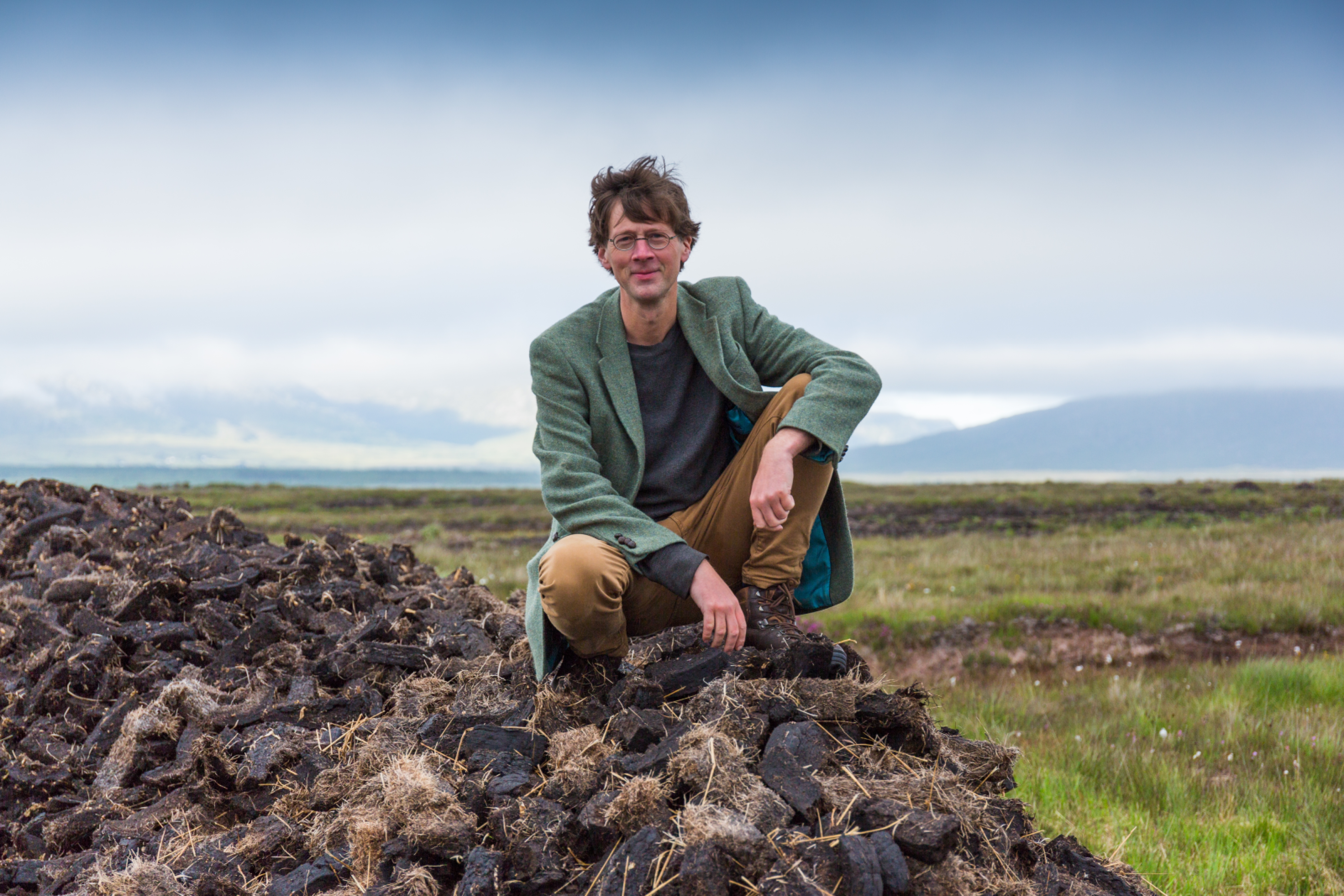
That revival has been partially led by the irrepressible devotee of Gaelic Manchán Magan, whose radio shows and writing have helped inspire the ongoing recovery of Irish not only in Gaeltacht but throughout Ireland and beyond. Magan’s Thirty-Two Words for Field: Lost Words of the Irish Landscape was originally published in Ireland in 2020 but was just published in the United States this year. The book is not meant to teach us Irish but to introduce us to the cultural world of the Gaelic language. As he writes, it is “not a linguistic treatise…it’s a revelry.” Magan knew that the loss of language is real; in response, he committed himself to a “surge of remembering.”
This often-delightful book is indeed a revelry. It does not tell a linear story but instead features accounts and aspects of the language and the landscape. Magan weaves in his family’s history and his own stories from the Gaeltacht to his travels in India, along with mythologies of the faery folk and ancient gods and the Irish battle for independence from their colonial oppressor. It feels less like a book than like a spell. Reading it among the rowhouses of West Philly—an old Irish American neighborhood—I found the book transporting. This spell is deepened by Magan’s own early death in 2025. This great Irish storyteller’s voice comes to us from a man who has already passed over to the other side.
For Magan, language is a prism for seeing the world, and so different languages reveal different things. Irish, he says, is a language of the land and of the spirits. For Magan, that earthy spirituality is an expression of just how old Gaelic is. As the language of the Celtic tribes that once wandered Eurasia, it is far older than English or even Latin. It is also an expression of the deep attachment the Gaels developed to the lands they were ultimately forced into at the fringes of Europe in Brittany, Wales, Cornwall, Scotland, and Ireland. Having lost a continent, the Celts cling passionately to those fringes. For the Irish in diaspora, that clinging endures in our deep nostalgia for the Old Country.
Thus, the revelry his book is meant to inspire should “alter your perception just a little. To spark little jolts inside you regarding the potency of language.” To see the world through the Irish language is to see it differently, to recognize the plurality of nature. To understand it rightly, we need thirty-two words for field: from geamhar, a field of corn grass, to biorrach, a marshy field, or my favorite, cuibhreann, a field neighbors work on together. To be close to the land is to know its abounding plurality and so to know the need for many words for what appears to be the same thing. But for Magan, Gaelic “not only describes things but summons them into being.” The language has spiritual power that opens its speaker to differing spiritual and mystical levels of being.
In detailing the spirituality of the land, Magan’s book addresses what it means to be Irish. That problem has long been raised for the Irish of the diaspora, who sometimes try to be more Irish than the Irish in embarrassing ways (dyeing our beer green). But as Ireland has transitioned to being a wealthy outpost of capitalism, as it struggles with its histories of nationalism, and as it sees a major decline in Catholic faith, the question becomes more acute—even more so as the country diversifies. What does it mean to be or become Irish if you are a Polish or Nigerian immigrant?
Magan’s answer is to reach back into the misty pasts of Gaelic and druidic spiritualism. Such an approach risks collapsing into a hyperparochial Irishness, but Magan avoids that by arguing for the ways the Irish language and culture is both linked to the broader Indo-European language and to other colonized people who seek to maintain their languages and cultures. Irish turns out to be not an isolated tongue but a part of “a unified cultural archipelago of coastal people who have more in common with each other than with the centralized powers that control them.”
It is a powerful message and an option for a sense of Irishness that the Irish in Ireland or abroad might well take up. And yet the book is haunted by another option that Magan clearly dismisses: Catholicism. From the very first page, Magan waves away Christianity, brushing aside the Catholic traditional belief that the rising sun dances on Easter morn as merely cultural appropriation of older pagan stories. Throughout Magan’s story, Christianity is always and only a foreign imposition. St. Patrick and company, we are told, came with their written language to control the Irish. The abbots and abbesses of medieval Ireland were not expressing an authentic Gaelic Catholicism but were replacing real Irishness with something imported. During the era of penal laws—when Irish Catholicism was brutally suppressed by the English—the Irish hid away their priests and celebrated Masses in the hedgerows. Magan focuses instead on Druidic altars as his preferred expression of Gaelic culture. Not once is there a positive example of Gaelic language in relation to the Catholic faith; most of the language’s development after 400 AD is largely dismissed.
When I think of my daughter asking me about my knowledge of Irish, I now think of a word Magan taught me: díláthair, the sense of absence when something is lost or destroyed. I feel that not only about the generations of Sweeneys without their native tongue, but also of Magan’s book without its native faith. I think of the Irish people who held so closely to the Church that they secretly celebrated Masses in the woods with their hidden-away priests. I think of making priest’s bread in my own home, the same bread that people would make when a priest secretly said Mass for them.
Magan’s dismissal of that faith pains me. But it also calls into question the book itself. Can we accurately explain a language and culture if we dismiss most of its history? What would, say, a Gaelic Mass community in Donegal make of this account? Magan claims that the Irish were part of a global archipelago of the colonized, but they were also part of a global archipelago called the Catholic Church. Magan’s book is an attempt to write away the Catholicity of Gaelic Ireland, a writing away that is not deeply rooted but is a form of secularization. The actual religion of a place is replaced by an ersatz paganism. Telling us that the Easter Sun dancing is actually pagan does not usually mean people become pagan; it just means that they sleep in on Easter and neither watch the sunrise nor go to Mass.
My worries about his denial of Christianity led me to do some research about the book. Many of Magan’s definitions and etymologies of Irish words are disputed. He describes his own claims as “vague conjectures” and insists that we should “gauge what we feel is true.” But that leaves me uncertain if any of his book is true. Of course, the Irish are known for tall tales. Even our legendary giant Fionn mac Cumhaill is famed for trickery. Magan’s book is indeed spellbinding, but spells may not be realities. How much of Magan’s book is an example of the gift of the gab and how much is true is hard to know, especially as it turns out there might not actually be thirty-two words for field.
No doubt Aristotle was right that humans as the speaking animal are unique, but there is something particularly linguistic about the Irish. We are a people largely without great paintings, symphonies, sculptures, or buildings. The great art of Ireland is language—whether sung or spoken in a pub, prayed or muttered in a church, written in poetry or prose, penned by James Joyce or Sally Rooney. The Irish are real masters of English. Magan’s book shows that the Irish proficiency with English is grounded in the spirituality of word and land found in Gaelic. Flaws aside, he summons Irish Americans, the Irish in the old country, and anyone concerned with maintaining the Indigenous in the postcolonial world to recover our mother tongues and our deep intimacy with the land. And for that, a word of gratitude and parting to the recently deceased writer: Manchan, go raibh maith agaibh.
Thirty-Two Words for Field
Lost Words of the Irish Landscape
Manchán Magan
Chelsea Green Publishing
$19.95 | 256 pp.
We welcome your comments about this article. Please send your response to [email protected].