In 2004, I was far from home—in every sense of the word. I was a soldier living in Germany and serving as a linguist in the intelligence branch of the U.S. Army. I don’t know how you envision enlisted life in the army, but just let me say that in 2004, in the early years of a confused war, we lived like animals.
Shove a hundred of your country’s most desperate, idealistic, rangy, adventuresome nineteen-year-olds into dirty barracks in the middle of a strange country. Give them unlimited booze. Grant the normal amount of hormones coursing through the young. Tell them they might die or shoot someone for the first time any day now. Make sure that for every ten male soldiers there is one female. And viola! You’ve created a cesspool. Hair, dust, and sticky alcohol lined the hallway baseboards of our barracks. Trauma, guilt, and shame spread like disease. You could see us lined up in neat, square configurations at the edge of the dead-grass parade field each weekday. Our boots shiny black, our uniforms pressed, our hair shaved or slicked back to a tight bun, but all around us and within us an empty and beautyless obscenity.
I had joined the army out of a desire for truth—the kind learned the hard way, through raw experience, exposure to the world’s grit. Well, I got it, or a version of it. What I saw was the wreckage of human fallenness. How mean it all gets. How constricted and ill, how like a living death.
Looking back, I can see that even though I was far from home, living in a pigsty, beauty never stopped rushing out to meet me, its prodigal child. In the evening, I saw the purple hem of its robe swaying in the sunset. And that was not all. Little grey birds called out to me in the morning. A flowering tree ballooned with the smell of exotic perfume as I ran past. Light pushed in through the grime on my window. Beauty was a ghost that haunted me in those days, recalling me with exquisite pain to the knowledge that, like a limb cut off from blood supply, I had fallen asleep and could not survive long that way.
It was under those conditions that I began to write and read poetry. To this day, I believe that art and beauty are never more fully themselves than when they encounter human suffering. Similarly, the message of salvation is no doubt good news to the happy and contented, but for people in extremity without hope, it is life itself—living water for those dying of thirst.
At first my poems were little more than lyric fragments and observations: a description of the way light played off the glass-and-steel dome of the Darmstadt train station, a note about the seemingly impossible task of willing myself to will the will of God, a sketch of the boy who returned from Afghanistan with a phone full of images of charred limbs and mortar holes. But soon these fragments began to coalesce into little bodies of music and image. The need to write arose out of a need to render what I saw, not exactly into order and not into meaning, but into morsels of piercing beauty. I don’t know why beauty answered the violent call inside me then. I don’t think it was just a salve, because beauty wounds as much as it heals. All I can say is that, for me, the creation of beauty was a survival technique.
And I wasn’t alone. One night at the local Irish pub, I met a soldier named Jeremy, who had just returned from Afghanistan. He was a small man—just a kid, really—with clear eyes, and when I told him that I had recently started writing poetry, he piped up that he had begun a poetry group for the guys in his infantry unit. He told me that I could come, but that I would be the only girl and I should be prepared to hear some pretty rough stuff.
We met in his small, stinky barracks room stuffed with infantry soldiers eager to share their most recent poems. These were not the frail, intellectual boys you might imagine when you think of male poets. They were meatheads—more accustomed to pumping iron than quoting sonnets—but like me, they were hungry and, in their desperation, driven to distill their pain into, or by means of, beauty. I heard men read Auden and weep. “Sob, heavy world / Sob as you spin / Mantled in mist, remote from the happy.” I watched them reach and fail and reach again for a word that would roll off their tongue and into the air and hang there like a globe of brazen truth for all of us to see, touch, and taste.
What exactly were we trying to accomplish in that cramped room? It would be too vague to say that we were looking for God in the ashes, in the rubble heap of our experience. We were making art—badly, without any instruction or ambition—to remind ourselves of something.
By some miracle, a few of us were reaching toward the same strange, tenuous thread. In retrospect, I believe we were after a restoration of our humanity. Poetry became the way we tapped back into the call to life, light, and fresh air native to all human beings. It was a kind of protest against the flat, reductive, soul-denying icon of humanity presented to us by a faceless bureaucracy.
Put another way: one afternoon, a girl planted ten marigolds in the hard dirt outside the barracks. They were the only living flowers on base. A few soldiers were so moved, so elated by this small coup of beauty, that they set up a protective camp around the new garden. All night they sat and smoked cigarettes and guarded the fragile little flowers from the trampling, careless feet of drunk soldiers returning from clubs and bars. It was a small rebellion, a little agitation under the skin and in the soul—remember who you are, what you were made for. Of course, within a few weeks the flowers had withered, and some complained that it would have been better if the flowers had never been planted at all. The reminder was too painful. Beauty often is.
The great Polish poet Czesław Miłosz lived through the German occupation of Warsaw and was later threatened by Soviet authorities. After defecting to the United States, he wrote a book called The Captive Mind, in which he proposed a somewhat controversial idea about the judgment of art:
A man is lying under machine-gun fire on a street in an embattled city. He looks at the pavement and sees a very amusing sight: the cobblestones are standing upright like the quills of a porcupine. The bullets hitting against their edges displace and tilt them. Such moments in the consciousness of a man judge all poets and philosophers. Let us suppose, too, that a certain poet was the hero of the literary cafés, and wherever he went was regarded with curiosity and awe. Yet his poems, recalled in such a moment, suddenly seem diseased and highbrow. The vision of the cobblestones is unquestionably real, and poetry based on an equally naked experience could survive triumphantly that judgment day of man’s illusions.
The implicit argument here is that poetry is under a kind of moral obligation. It must answer the call of human suffering. For it to “survive triumphantly that judgment day of man’s illusions,” it must survive in the mind of a man who is in extremity.
Many poets would reject that idea. First, they might say, Miłosz is wrong to speak of morality and art in the same breath. What obligation does art have but to itself? It has no responsibility to the reader or to reality. It is ontologically and ethically autonomous—a distinct entity whose movements are opaque to poet and audience alike. Next, they might say that consciousness in extremity is not the proper judge of art any more than sex would be the proper judge of love. Or they might say that it is wrong to speak of the judgment of art at all, as though such an absolute vantage point might be achieved.
But for Christians—and Miłosz was a Christian—art can’t escape morality. For one thing, no Christian poet can take seriously the notion that poetry is disconnected from reality, for we believe that the Word became flesh and dwelt among us. Language is, therefore, deeply knit into the fabric of reality and laden with moral and spiritual significance. This is especially true of poetry, language refined to its most luminous and demanding form. Poetry is accountable to the real. It must reflect and announce and body forth the truth in all its many and varied forms.
For Miłosz, poetry cannot be true unless it is conscious of extremity. Taken literally, he seems to suggest that death stands as the judge and arbiter of art. The man Miłosz imagines or remembers is, after all, lying under machine-gun fire. Death is proximate; he can taste it, and all his senses trill in anticipation of their end. But I do not think that Miłosz is aligning himself with Wallace Stevens’s oft-quoted line from the poem “Sunday Morning”: “Death is the mother of beauty.” It’s not that the shadow of death has made the cobblestones beautiful or amusing, but rather that art must be morally accountable to death. It must speak in moments of real peril and suffering.
A lecturer paraphrasing theologian Jürgen Moltmann once said that if our theologies are to count for anything, we must be able to pronounce them to an innocent child as she is led to her execution. If our accounts of God are too abstruse or weak-kneed to be useful in such moments, they are of no use whatsoever. Think, too, of the ministry of Christ. The people capable of seeing who he was, who could receive the miracle of his presence, were very often those who lived under machine-gun fire.
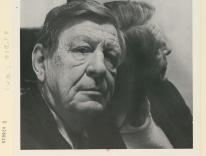
Of course, not all art need address suffering directly. Human anguish is not the only subject suitable for artistic interpretation. W. H. Auden, for one, puts awe, not suffering, at the center of the poetic impulse:
Whatever its actual content and overt interest, every poem is rooted in imaginative awe. Poetry can do a hundred and one things, delight, sadden, amuse, instruct—it may express every possible shade of emotion, and describe every conceivable kind of event, but there is only one thing that all poetry must do; it must praise all it can for being as for happening.
How to square Miłosz with Auden? How can we speak of an art that is at once as true to the woman in anguish as it is pliable, wild, and joyous enough to “praise all it can”? I don’t think we can say art birthed from suffering is intrinsically superior to the poem written on a lazy Sunday afternoon. But I do think—and Miłosz and Auden are aligned on this point—that the greatest works of art are so faithful to the real, so completely absorbed in rendering out of air, breath, and imagination what is true, both in human experience and beyond it, that joy and sorrow become entangled with one another. Praise and suffering become inseparable. Such beauty can and does address suffering, even if suffering is not its explicit subject. Consider the marigolds. Somehow their earnest bobbing heads and innocent color spoke directly to the hearts of soldiers on the fringe of a senseless war.
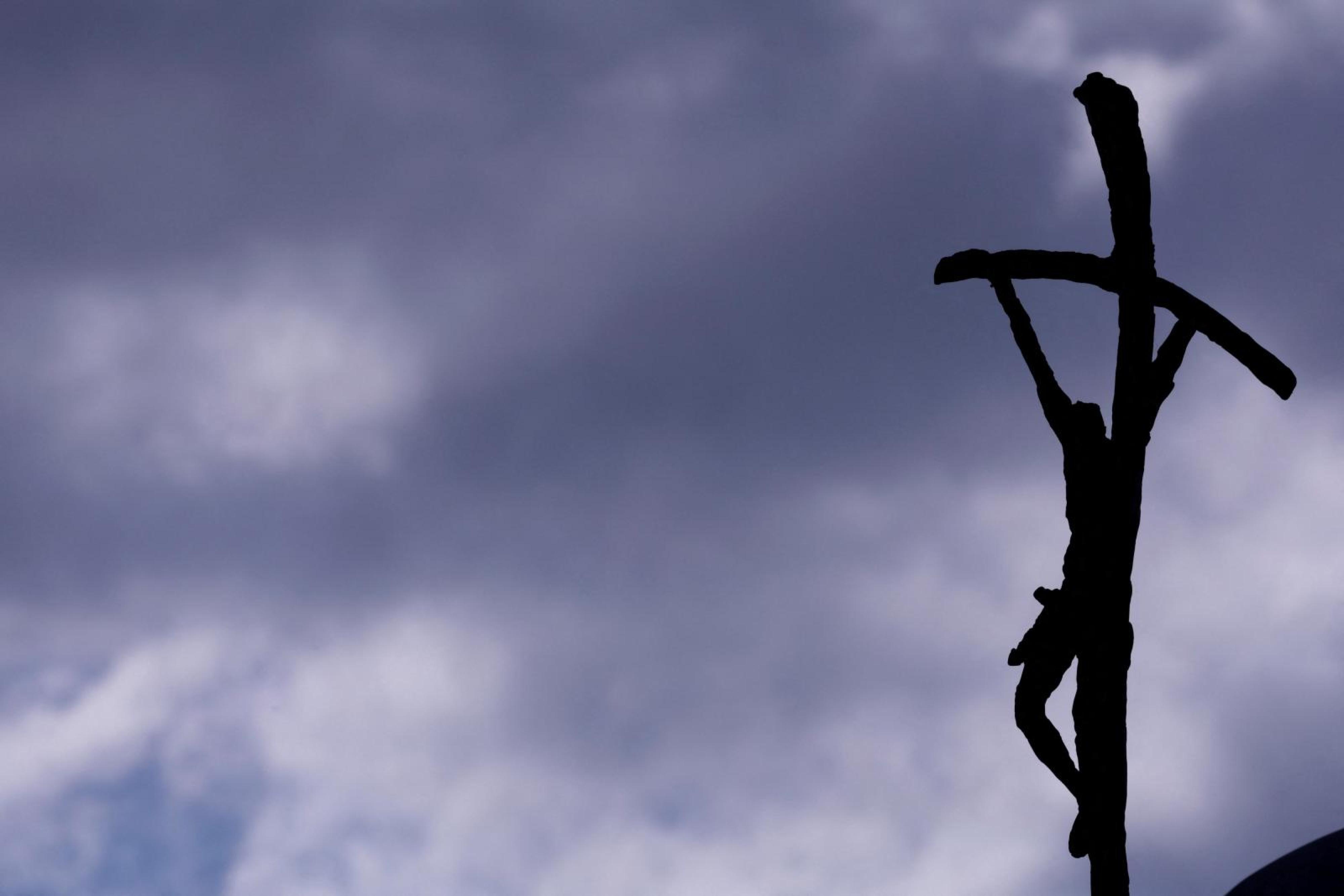
For Christians, there is no beauty as complete, as strange, or as troublesome as that of the cross. There, life and death, hope and devastation, shame and joy are inextricably mixed. When Miłosz speaks of the man in extremity, we would do well to imagine Christ nailed to the cross, the words of Psalm 22 hanging from dry lips: “My God, my God, why have you forsaken me?” And what is our response? With Auden, we kneel down and “praise all [we] can for being as for happening.” Such paradoxes present difficulties for the theologian and philosopher, who remove themselves from life in order to grasp it from the outside, but for the artist who is “rooted in imaginative awe,” those mysteries can live, breathe, and spread their wings.
In the end, Auden and Miłosz aren’t saying such different things. If poetry is to express, and even become, awe, art must at some point come to the cross—not literally, and not necessarily even in an explicitly Christian sense, but in the sense that beauty and awe cannot become what they are if they are held apart from the executioner’s shadow.
There is a final image I’d like to impart. Sixty years ago, a woman named Charlotte Delbo wrote a harrowing memoir about the time she spent in Auschwitz. At one point, she describes walking in a line of dying women, either headed to work or on their way back to camp. Their clothes were thin; their shoes were not shoes; their bodies held no fat. They were trudging through snow and ice when, through a clearing, Delbo saw a house she had seen many times. But on this day, through a window framed by white and more white, she saw a single, pink tulip. It was radiant. It was life itself. It was beauty. It sharpened their pain. News of the tulip spread, and the women became obsessed with it, looking for it eagerly each morning and evening, as though it had something urgent and magnificent to say to them.
We welcome your comments about this article. Please send your response to [email protected].