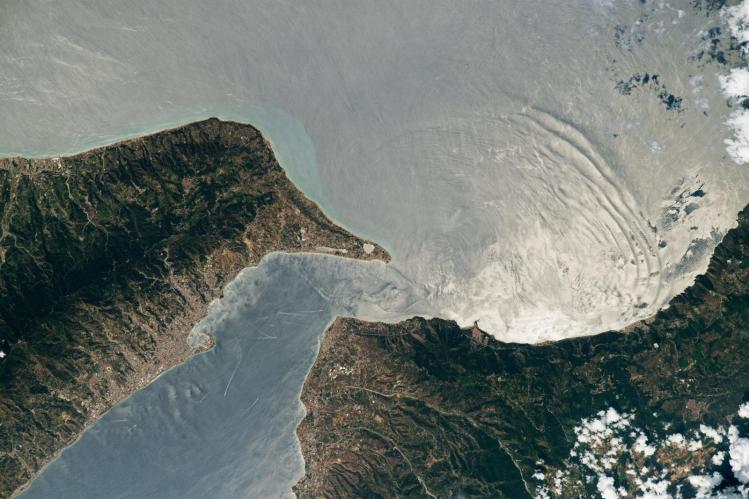
In recent days, The Washington Post and the Financial Times have turned international attention to a project that, in Italy, has long hovered between phantom and obsession: a bridge over the Strait of Messina. Last month, the Italian government approved plans for what promises to be the longest single-span suspension bridge in the world. Construction is scheduled to begin next May and end in 2032. The idea is an old one: for more than a century, the dream of joining Sicily and Calabria with an arc of concrete and steel has come and gone and come again like the tide. But today, the proposal has acquired a new significance. For some, the bridge is no longer just an engineering project but an expansion of NATO’s strategic network across the Mediterranean. Meanwhile, in the more provincial, triumphalistic imagination, the bridge is imagined as a kind of magic key—an all-purpose remedy for the troubles of Messina, Sicily, and even the entire South of Italy.
When Americans think of bridges, the associations come almost automatically: the Golden Gate Bridge, the Brooklyn Bridge, those suspended colossi that have shaped skylines and national identity. But these comparisons—so often repeated in Italian journalism—miss something essential. Every place has its own genius loci, and the Strait of Messina is not an absence but a fullness, dense with myth, literature, history, and memory. To reduce it to an infrastructural gap would be like claiming that The Odyssey is merely the diary of a boat trip. To treat the Strait like a problem to be solved by civil engineering is to imagine that a myth can be resolved by a calculation. The Strait demands to be properly seen and considered in its own right, long before it is crossed.
Let’s set aside the fact that the project—still far from execution—remains an engineering question mark. The real issue is what it means culturally. What is missing from the whole Italian debate about the bridge is culture. The country risks drowning in technical and political quarrels without pausing to ask what cultural value lies in this immeasurable asset. And this even though, in 2022, National Geographic listed the beach of Capo Peloro, at Sicily’s northeastern tip, as one of the most beautiful in the world, describing it thus:
Cleaving Sicily from mainland Italy, the beautiful Strait of Messina is a place of legend…. At the north-eastern tip of Sicily, Capo Peloro sits where the Ionian and Tyrrhenian seas swirl into each other. Spilling out in front of the village, the beach—a nature reserve—is a wide, flat expanse of sand…. Dolphins frolic in the crystalline waters and swordfish pass through the strait in summer, while the Calabrian coast looms on the horizon.
For years now, there has even been a campaign to recognize the Strait as a UNESCO World Heritage Site.
Within just a few nautical miles, Scylla and Charybdis confront each other. To be caught “between Scylla and Charybdis” is a common expression for being trapped between two evils. We owe this enduring image to Homer. In Book XII of The Odyssey, Odysseus, pressed between two monsters, chooses to pass closer to Scylla, sacrificing six men rather than risking the whirlpool of Charybdis. In Alexander Pope’s translation:
Dire Scylla there a scene of horror forms
And here Charybdis fills the deep with storms.
When the tide rushes from her rumbling caves,
The rough rock roars, tumultuous boil the waves;
They toss, they foam, a wild confusion raise,
Like waters bubbling o’er the fiery blaze.
The myth of Scylla and Charybdis did not remain confined to the Mediterranean but gradually entered the symbolic vocabulary of English literature. In the Renaissance, it took shape as a threatening image tied to the dangers of both the sea and the human soul. Soon after, Francis Bacon reinterpreted it philosophically, as a representation of opposing errors in thought: on one side, the excess of irrelevant detail; on the other, abstract generalization that forgets concrete facts. With Milton, it became a shorthand for the experience of navigating between opposing forces, spiritual and temporal. Romantics and moderns continued to steer through this imaginary strait. James Joyce devoted an entire episode of Ulysses to the theme of Scylla and Charybdis. Here, in an argument about Shakespeare and Hamlet set in the National Library of Dublin, the myth becomes a metaphor for interpretive tension and intellectual dilemma: the narrow passage between opposing risks—dogmatism and nihilism—is mirrored by the Strait of Messina, which thus turns into an allegory of literary criticism itself.
And the myth still lives. It appears in Megan Fernandes’s poem “Scylla and Charybdis,” published in The New Yorker in 2019, where she reframes it as emotional allegory, evoking the turbulence of heartbreak. It appears in the work of the German artist Anselm Kiefer, whose Scylla and Charybdis invokes sea monsters as metaphors for epochal dilemmas, impossible choices, a humanity suspended between two abysses. For Kiefer, the myth becomes a language for the contemporary condition, in which we are forced to steer between memory and oblivion, technology and nature, war and peace. The Strait enters his imagination not as a geographical site but as an archetypal space, a threshold between destruction and hope, knowledge and annihilation.
In short, the Strait of Messina has never been just a stretch of water. It’s a place that demands to be described and interpreted. Geography here is inseparable from myth: not a neutral container, but a landscape shaped by centuries of stories, images, and legends. Which is why any time the idea of a bridge comes up, the conversation inevitably turns to questions of identity, memory, and collective imagination.
To speak of the bridge today is to confront a place that is already the bedrock of cultural identity, itself a symbol and universal metaphor. No wonder the Strait generated other founding legends, like Colapesce: the youth who chose to remain beneath the sea, propping up a cracked pillar of Sicily. He embodies a people bearing their land on their shoulders. Colapesce is not a children’s tale but the embodiment of a sacrifice that holds an island in balance.
The imperatives of modernity—of “progress,” itself a myth—reveal a tension between technical uniformity and the local spirit. The Messina Bridge risks extinguishing a story three millennia old. America has celebrated its bridges as emblems of modernity: Whitman sang the ferry as collective ritual; Crane turned the Brooklyn Bridge into new epic. But in Sicily, myth and symbolic heritage may be buried under pylons. Development cannot be conceived at the expense of memory, beauty, or the concrete life of communities.
And so the bridge project remains suspended, for now. Its fate rests not only on technical feasibility but on meaning, a terrain harder to master. Each time the subject resurfaces, Italy seems to be asking itself a question not about engineering and economics, but about the meaning it attributes to its own future. What would be the cultural loss of “normalizing” a place that is, by its very nature, an exception, a fracture? Culture means guarding the myths that have shaped a landscape, allowing them to keep generating new meaning. The Strait is not, and never will be, just a geographical problem in need of a technical solution.