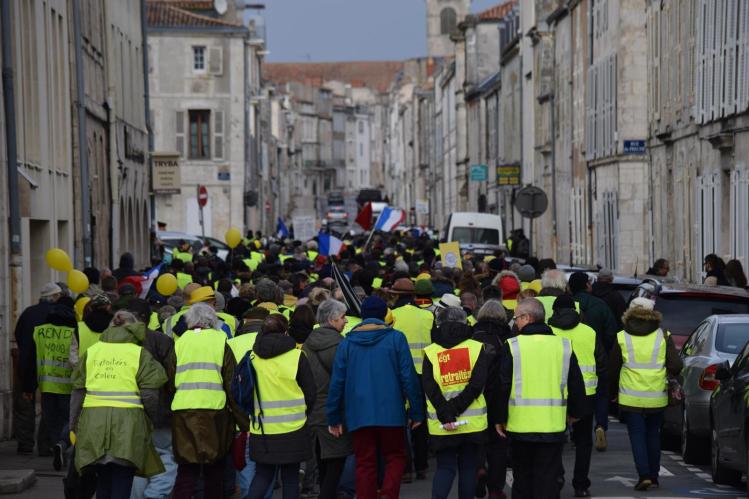
Every French motorist is required to keep a reflective yellow vest (gilet jaune) in their car for safety in case of a roadside breakdown. But when gas prices went up sharply in 2018, these yellow vests took on a new meaning: French citizens started donning them as an act of protest, taking over traffic circles throughout the country. Already struggling to make ends meet, the protesters were worried about how they would afford to drive to work, and they needed to make their message clear: This is an emergency. Something is wrong here.
The sense that “something is wrong” was certainly also part of what animated the Tea Party movement (a forerunner of the MAGA movement) and other forms of populism on both sides of the Atlantic. Of course, something is wrong: low wages, inflation, increasing economic inequality, overdose deaths, and a hollowing-out of rural and small-town communities. These are serious, deeply felt problems, and the resentment they generate is understandable, even if the idea that a celebrity billionaire might adequately address them is not. The tragedy of contemporary populism is that its leaders attend to genuine distress but manipulate it for their own purposes: “Lack of concern for the vulnerable can hide behind a populism that exploits them demagogically for its own purposes,” as Pope Francis wrote in Fratelli tutti.
The sense that something is wrong is also channeled into conspiracy theories that distort and distract from legitimate grievances. This is part of why QAnon and vaccine conspiracy theories are so profoundly damaging: they take real problems (human trafficking, health-care profiteering) but direct frustration about those problems in misguided and counterproductive directions. Deluded worries about Q or microchips overshadow the very real threats of online child exploitation, corruption in the health-insurance industry, or conflicts of interest at play in the MAHA (Make America Healthy Again) movement. Even worse are the conspiracy theories, stoked by populist leaders, that scapegoat the vulnerable. Targeting immigrants or sexual minorities, who have little or no control over the real drivers of discontent, takes the focus off the billionaires who profit from cronyism and exploitative wages.
But what if there was a way to listen to the real distress of ordinary citizens, unfiltered by populist agendas, conspiracy-theorist influencers, or party politics? During the Gilets Jaunes movement, many of the protestors decided to write down their grievances, or doléances. President Emmanuel Macron embraced the impulse and asked that the doléances be compiled by local governments. All over France, town halls collected complaints, proposals, wishes. In some places, a notebook was set out in the town hall for people to write in. But often, citizens brought in their own submissions, some of them quite formally composed, in plastic report covers with handwritten titles. People could also submit their doléances online, but France maintains a culture of handwriting, and the majority arrived on paper. This gave the submissions a deeply personal quality.
As one researcher said about the experience of reading them:
You’re confronted face to face with the text, and with the way it’s written, with the person who wrote it…and then you also discover, sometimes, when you see certain types of writing, how the person really had to apply himself to be able to write and be read. You realize that it wasn’t taken lightly…. I find it all the more violent, then, that this commitment wasn’t respected.
Doléances have a long history in France. They were last collected on such a scale in 1789, when the majority of the population was illiterate and couldn’t write their complaints on their own. On the eve of the French Revolution, King Louis XVI ordered that cahiers (registers) of doléances be collected from around the country. These compilations were then brought to Paris by the representatives to the Estates General, which Louis had called to try to assuage revolutionary rumblings.
The cahiers are a remarkable historical record reflecting the concerns of all levels of society—clergy, nobles, and the ordinary people of the “Third Estate.” The Third Estate’s demands are all-too-current: basic civil rights, a fair distribution of the tax burden, an equal political voice in society. It is easy to sympathize with the people of Blois, for example, who addressed the king thus:
We beseech His Majesty:
1. To take the most effectual means of preventing bankruptcies;
2. To fix a term, after which prisoners for debt may recover their liberty;
3. To interest himself in ameliorating the condition of negroes in the colonies.
Impressed as we are with the great influence of public education upon the religion, morals and prosperity of the state, we beseech His Majesty to favor it with all his power. We desire:
1. That public instruction shall be absolutely gratuitous, as well in the universities as in the provincial schools…
It is clear that their hopes were high, but the people of the Third Estate were not naïve. The author of a cahier from Orléans cautioned:
To be represented in the Estates-General, we cannot choose a lord, nor a noble without facing the greatest danger. There are some human, generous, and kind lords. But they can be jealous of their rights and their privileges and can keep us under their dependence. We should not trust any gentleman who approaches us or have his servants approach us in order to be elected…. [T]heir plans are [intended to] trap us and they only want to cheat us. As farmers…if we seek our representatives somewhere else, our interests will be sacrificed and we will keep on being poor.
Despite the skepticism, expectations must have been raised after the grievances were solicited and collected. It is no wonder that, later that year, when it became clear nothing would come of them, things boiled over, to the severe detriment of King Louis and the ancien régime.
All the more surprising that after initially welcoming the doléances in 2018 and 2019, President Macron followed Louis’s example and swept them under the rug. There was a hasty attempt to report back to the public, with a press conference planned for the afternoon of April 15, 2019. But on that very day, all eyes were on Paris for a very different reason: Notre Dame was on fire. The moment for the doléances was allowed to pass, and since then, not a word from Macron.
That was not acceptable to Fabrice Dalongeville, mayor of a small town in the north of France. He set out on a journey through the French countryside “in search of the doléances,” accompanied by a documentary filmmaker. Dalongeville met with local government officials, researchers who had managed to access some of the doléances in town archives, and—most movingly—the authors of several significant doléances. He even lent his support to two “Town Criers” who, since Macron was not promulgating any results, decided to do it themselves: they shouted the texts of their fellow citizens’ doléances aloud in their town square, lending physical voice to the grievances.
What do these doléances contain? Some are quite polite, even amusing. In Bordeaux, where they called it a “cahier of hopes,” we read, “I’d like school to start later, around 9:30, if possible.” Also: “Good morning, Mr. Macron. Do you have any plans for single mothers?” Others are strident, even despairing: “The time of kings has been abolished. Come and live our lives and maybe afterwards you’ll understand. But I have my doubts. You’re too far above it all.” “Life is too expensive. Too hard.” Many are quite powerful:
The values of France are Liberté, Égalité, Fraternité…. Equality? How can you talk about equality when it takes six lifetimes of working at minimum wage to earn what others make in an hour? Where is fraternity when governments have forgotten their duties, while imposing their own vision? They don’t listen to the people. Monsieurs Leaders, I am just a fellow citizen like many others. But let me remind you that “fellow citizen” [concitoyen] is a single word.
The sense of distance, of not being listened to or recognized, is palpable. The authors feel forgotten by the politicians they elected. In this way, Dalongeville’s careful attention to the doléances and the people behind them strikes a real contrast. He is not a Gilet Jaune, nor a partisan booster, but simply a local leader who respects the dignity of his fellow citizens and wants his government to be receptive to their concerns. As he has written, “Democracy is not limited to voting. It is lived, learned, practiced. And this requires institutions that are more porous, more open.”
Dalongeville is an improbable hero. Unpretentious and unpolished, one senses he feels as betrayed as his constituents, having promised them Macron would respond to their grievances. But the more lasting impression is this: he cares deeply about the people of his village and of his country. Whether or not he agrees, he wants their voices to be heard. To him, the cahiers des doléances are not nuisances—nor a mere matter of public perception to be managed—but real “treasures.” They reflect the dignity of the many people who took the time to write them.
But even he, a public official, had trouble gaining a hearing in Paris. Eventually he succeeded in gaining the attention of some members of Parliament, though with limited results. One wonders whether a small-town mayor, no matter how determined, can ever get Monsieur le President to really listen to his people.
The problem of many democracies at the moment is one of distance: the gap between the will of the population and the actions of their leaders, between workers and CEOs, and among politicians themselves, who are too trapped in polarized systems to find any collaborative way forward. Dalongeville’s effort to truly listen to ordinary citizens is a taste of what could be possible in a democracy when the voice of each person is given the value it deserves.
Democracy requires a degree of faith that “the people” know what is in their own best interests and have the wisdom to choose what is best for their polity. But public opinion can be manipulated by advertising and propaganda, social-media algorithms, AI, and certainly by politicians who “seek popularity by appealing to the basest and most selfish inclinations of certain sectors of the population,” as Fratelli tutti puts it. Of course, money distorts as well when it’s funneled toward ideas championed by a few oligarchs and away from those backed by popular mandate. All of this contributes to polarization that obscures just how much common ground there is among voters.
By providing direct, unmediated access to the opinions of ordinary people, the doléances suggest the possibilities on offer if we are able to clear away some of these distortions. A consultant named Gilles Proriol was temporarily given access to a large body of the doléances and identified recurring themes. His immediate conclusion was that many of the issues prevalent in media and political discourse are not, in fact, major concerns for most citizens. “People talk very little about immigration,” he said, “when you don’t ask them directly. The issues of immigration, security, violence and terrorism? Spontaneously, when you ask people open-ended questions, that’s not what concerns them most today.”
Instead, he explains, many themes in the doléances—especially around health care, taxation, public services, and democracy—exhibit such broad overlap that it would be “undoubtedly possible to draw up a political program of over a hundred proposals with which the vast majority of French people would agree.” Successful experiments with more direct democracy—for example, citizens’ assemblies empowered to make policy recommendations in small communities in Belgium, or participatory budgeting in cities from Porto Alegre to New York—suggest that he’s right.
In 1865, Abraham Lincoln wrote, “The people, when rightly and fully trusted, will return the trust.” If only more leaders trusted their fellow citizens and, like Mayor Dalongeville, regarded their voices as a treasure.